
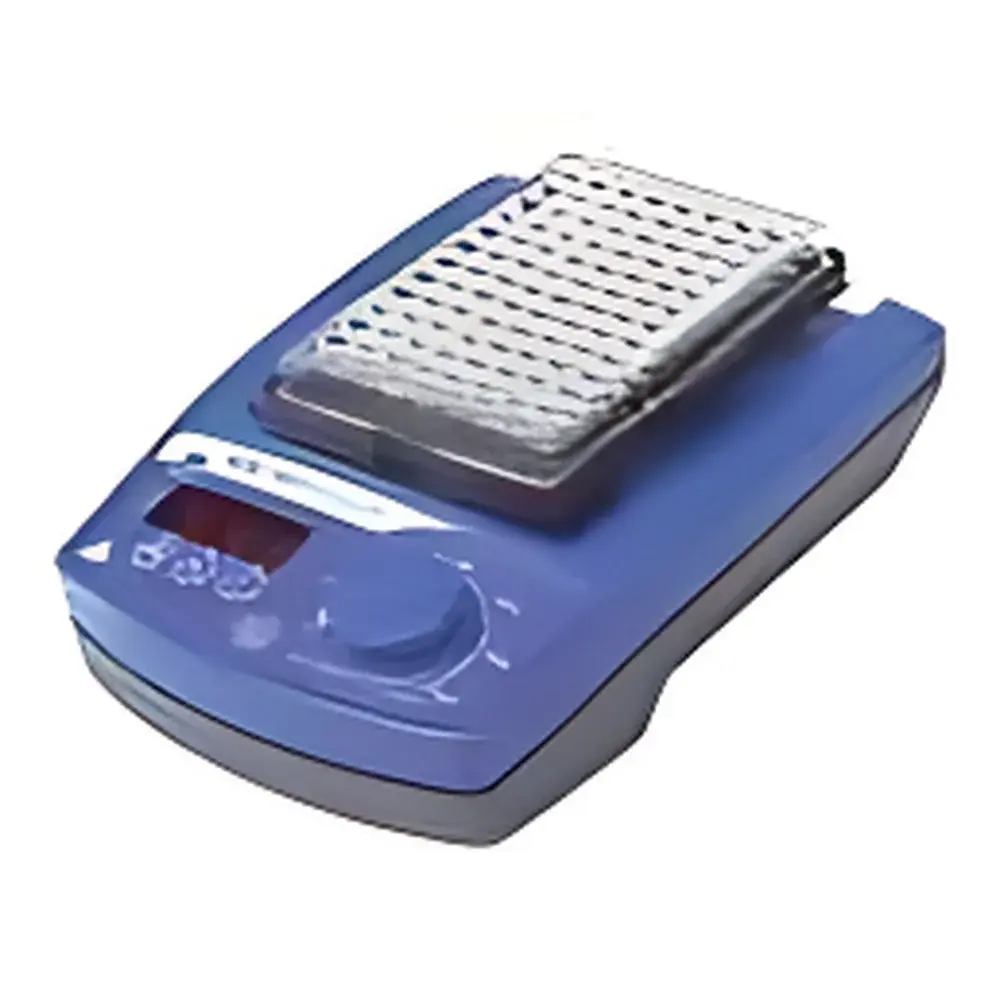
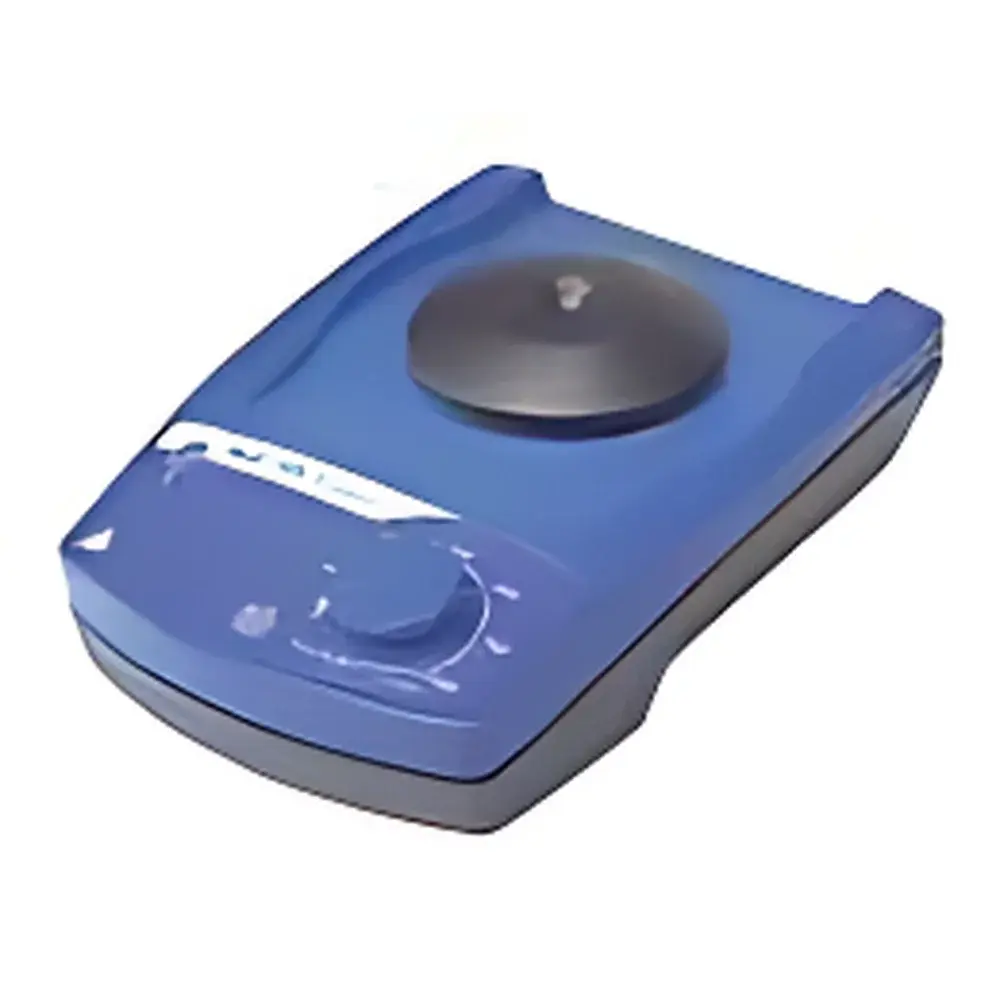
IKA MS3 Basic and MS3 Digital Orbital Shaker
| Brand | IKA |
|---|---|
| Origin | Germany |
| Model | MS3 Basic / MS3 Digital |
| Operating Mode | Timer & Continuous Operation |
| Vibration Type | Orbital |
| Housing Material | Zinc-Plated Cast Iron |
| Amplitude | 4.5 mm |
| Speed Range | 0–3000 rpm |
| Minimum Adjustable Speed | 200 rpm |
| Max Load Capacity (incl. fixture) | 0.5 kg |
| Timer Range (Digital) | 1 s – 999 min |
| Display | Analog scale (Basic) / LED 7-segment timer display (Digital) |
| Power Input | 100–240 V, 50/60 Hz |
| IP Rating | IP21 |
| Dimensions (W×H×D) | 148 × 205 × 63 mm |
| Weight | 2.9 kg |
| Compliance | DIN EN 60529 |
Overview
The IKA MS3 Basic and MS3 Digital Orbital Shaker is a compact, high-reliability benchtop instrument engineered for consistent, low-shear orbital mixing of small-volume samples in tubes, microcentrifuge vials, and standard 96-well microplates. Based on proven orbital motion kinematics—characterized by a fixed 4.5 mm orbit diameter—the device generates uniform, non-turbulent agitation ideal for cell suspension, reagent homogenization, ELISA plate washing, and sample preparation prior to downstream analytical workflows. Its robust zinc-plated cast iron housing ensures mechanical stability and long-term operational integrity under routine laboratory conditions. Designed for integration into QC/QA labs, academic core facilities, and pharmaceutical R&D environments, the MS3 series complies with DIN EN 60529 (IP21 ingress protection), supporting safe operation in ambient lab settings (5–40 °C, ≤80% RH). The dual-model architecture—MS3 Basic (analog speed control) and MS3 Digital (digital timer + LED display)—provides scalable functionality without compromising fundamental performance or ergonomic design.
Key Features
- Orbital motion with precisely controlled 4.5 mm orbit diameter ensures reproducible mixing across sample formats
- Speed range of 0–3000 rpm, adjustable down to 200 rpm minimum—optimized for gentle suspension or vigorous resuspension
- Two operational modes: Mode A (safety-limited mode with automatic fixture detection) and Mode B (full-speed mode, up to 3000 rpm regardless of fixture type)
- Digital variant includes an LED 7-segment timer supporting programmable intervals from 1 second to 999 minutes; Basic model supports continuous or momentary (touch) operation only
- Integrated touch-activated momentary mode enables rapid pulse mixing without timer engagement—ideal for intermittent sample checks
- Zinc-plated cast iron chassis delivers structural rigidity, vibration damping, and corrosion resistance in humid or chemically exposed lab environments
- Universal fixture compatibility: accepts MS3.1 standard pad, MS3.3 universal pad, MS1.32 tube pad, MS3.4 microplate adapter, and MS1.21 foam pad—each optimized for specific vessel geometry and load distribution
- Rated for 100% duty cycle: supports uninterrupted operation over extended periods without thermal derating or performance loss
Sample Compatibility & Compliance
The MS3 accommodates a wide range of common labware, including 0.2–50 mL conical tubes, PCR strips, microcentrifuge tubes, and single or stacked 96-well microplates (up to 1 plate per run). Fixture selection directly influences maximum achievable speed under Mode A: use of the MS3.1 standard pad permits full 3000 rpm operation, whereas alternative pads limit speed to 1300 rpm for safety and mechanical consistency. All configurations support a maximum gross load of 0.5 kg—including fixture mass—and maintain stable orbital trajectory within ±2% speed deviation across the operating range. From a regulatory perspective, the device meets essential safety and electromagnetic compatibility requirements per DIN EN 60529 (IP21) and IEC 61000-6-3. While not inherently 21 CFR Part 11 compliant (lacking audit-trail-capable software), its analog/digital controls are suitable for GLP-aligned workflows where manual log entry and procedural documentation are employed.
Software & Data Management
The MS3 Basic and MS3 Digital operate as standalone hardware units with no embedded firmware, network interface, or data export capability. The Digital variant features a local LED timer display but does not store historical run logs, support remote configuration, or provide analog/digital output signals. Consequently, data integrity relies on user-initiated documentation—e.g., handwritten logs, LIMS-integrated manual entry, or external time-stamped video capture for critical mixing steps. This architecture aligns with ISO/IEC 17025 Clause 7.7 (equipment records) and ASTM E2500-13 (verification of equipment function), where traceability is maintained through procedural controls rather than automated system logging. For laboratories requiring electronic record retention, integration with third-party environmental monitoring systems or PLC-based lab automation platforms is feasible via external relay triggers (not supplied).
Applications
- Homogenization of cell suspensions prior to flow cytometry or viability assays
- Reconstitution of lyophilized reagents and standards in clinical diagnostics
- Washing steps in ELISA, lateral flow assay development, and immunoassay validation
- Equilibration of enzyme-substrate mixtures in kinetic studies
- Pre-analytical sample agitation for HPLC, GC, and mass spectrometry workflows
- Routine mixing of buffer solutions, dilutions, and calibration standards in ISO 17025-accredited testing labs
- Supporting USP sterility test preparations requiring uniform microbial suspension
FAQ
What is the difference between Mode A and Mode B?
Mode A enforces fixture-dependent speed limits (3000 rpm only with MS3.1 pad; 1300 rpm with others) for mechanical safety and consistency. Mode B bypasses fixture detection and allows full 3000 rpm with any compatible pad.
Can the MS3 Digital be used for microplate shaking in high-throughput screening?
Yes—it supports single 96-well plates using the MS3.4 adapter and maintains uniform orbital motion across all wells at speeds up to 3000 rpm in Mode B.
Is the MS3 suitable for use inside a cold room?
It is rated for operation between 5 °C and 40 °C; prolonged use below 5 °C may affect motor brush life and timer electronics reliability.
Does the MS3 Basic include a timer function?
No—the Basic model supports only continuous or momentary (touch) operation. Timing must be managed externally.
What maintenance is required for long-term reliability?
No scheduled maintenance is specified; periodic inspection of fixture mounting screws and visual verification of housing integrity are recommended per IKA’s service guidelines.



