
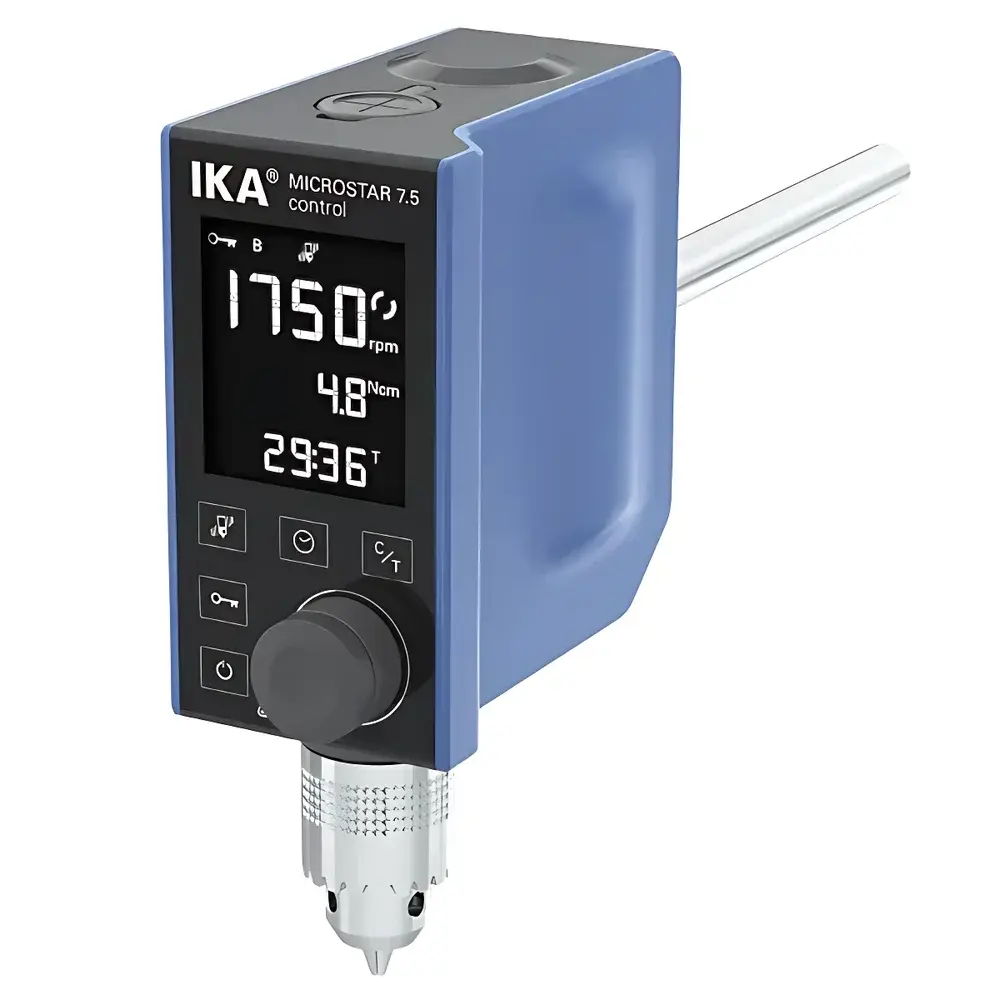
IKA NANOSTAR 7.5 Digital Overhead Stirrer
| Brand | IKA |
|---|---|
| Origin | Germany |
| Model | NANOSTAR 7.5 digital |
| Max. Stirring Volume (H₂O) | 5 L |
| Motor Input Power | 32 W |
| Motor Output Power | 22 W |
| Drive Principle | Brushless DC Motor |
| Speed Display | LED |
| Speed Range | 0/50–2000 rpm |
| Max. Viscosity | 4000 mPa·s |
| Max. Output Power at Shaft | 15.7 W |
| Continuous Duty Cycle | 100 % |
| Max. Torque at Shaft | 7.5 N·cm |
| Speed Control | Analog Knob |
| Speed Setting Accuracy | ±1 rpm |
| Speed Measurement Deviation | ±1 % (n > 300 rpm), ±3 rpm (n < 300 rpm) |
| Clamp Type | Fixed Chuck |
| Chuck Diameter Range | 0.5–8.2 mm |
| Hollow Shaft ID | 8.5 mm |
| Hollow Shaft Insertion (at standstill) | Yes |
| Extension Arm Diameter | 13 mm |
| Extension Arm Length | 160 mm |
| Rated Torque | 0.075 N·m |
| Timer Display | None |
| Housing Material | Cast Aluminum Coated / Thermoplastic Polymer |
| Dimensions (W×H×D) | 53 × 147 × 130 mm |
| Weight | 0.8 kg |
| Ambient Temperature Range | 5–40 °C |
| Relative Humidity Limit | 80 % |
| Ingress Protection | IP54 (per DIN EN 60529) |
| USB Interface | Yes |
| Supply Voltage | 100–240 V AC |
| Frequency | 50/60 Hz |
| Standby Power Consumption | 0.3 W |
| DC Output | 24 V = |
| Current Draw | 1300 mA |
Overview
The IKA NANOSTAR 7.5 Digital is a compact, high-precision overhead stirrer engineered for routine and demanding laboratory mixing tasks where space efficiency, operational reliability, and consistent torque delivery are critical. Based on brushless DC motor technology, it eliminates carbon brush wear—ensuring long-term speed stability, reduced maintenance, and silent operation across its full 50–2000 rpm range. Unlike traditional geared stirrers, the NANOSTAR 7.5 employs direct-drive architecture with integrated electronic commutation, delivering high reproducibility in rotational speed and torque output under varying load conditions—including viscous media up to 4000 mPa·s. Its hollow shaft design (8.5 mm internal diameter) permits real-time insertion of temperature probes, pH electrodes, or sampling needles without interrupting agitation—a feature essential for kinetic studies, reaction monitoring, and process validation workflows. With a footprint reduced by 30% compared to the MICROSTAR 7.5 while retaining identical performance specifications, the NANOSTAR 7.5 addresses modern lab constraints: benchtop congestion, multi-user shared environments, and modular workstation integration.
Key Features
- Brushless DC motor with electronic speed regulation ensures zero drift and minimal thermal drift over extended operation
- LED digital display provides real-time, high-contrast rpm readout with ±1 rpm setting resolution
- Hollow stainless-steel shaft (8.5 mm ID) enables in-situ sensor insertion during active stirring—critical for GLP-compliant reaction profiling
- IP54-rated housing (per DIN EN 60529) offers protection against dust ingress and water splashes, supporting use in wet-lab and fume hood environments
- USB interface supports firmware updates and future protocol expansion—compatible with IKA Labworldsoft configuration tools
- Cast aluminum base with thermoplastic polymer coating delivers mechanical rigidity, chemical resistance, and ESD-safe handling
- 160 mm extension arm (13 mm diameter) ensures stable vertical alignment and minimizes wobble at high speeds and elevated viscosities
- Full 100% duty cycle rating enables unattended overnight operation in batch synthesis and dissolution testing applications
Sample Compatibility & Compliance
The NANOSTAR 7.5 accommodates standard laboratory vessels from 10 mL vials to 5 L jacketed reactors using IKA-compatible chuck systems (0.5–8.2 mm shaft diameters). Its torque profile (7.5 N·cm peak, 0.075 N·m rated) is validated for Newtonian and mildly shear-thinning fluids—common in buffer preparation, cell culture media conditioning, polymer solution homogenization, and catalyst slurry dispersion. The device complies with IEC 61000-6-3 (EMC emission standards) and IEC 61000-6-2 (immunity), and meets essential safety requirements under IEC 61010-1 for laboratory electrical equipment. While not certified for hazardous area use, its IP54 rating and absence of sparking components make it suitable for non-explosive solvent-based environments when operated within specified ambient limits (5–40 °C, ≤80% RH).
Software & Data Management
Firmware updates are delivered via USB connection using IKA’s standardized Labworldsoft update utility—enabling version-controlled calibration parameter retention and traceable software revision history. Though the unit lacks onboard data logging or real-time export capability, its analog speed control loop and digital display output are fully compatible with third-party acquisition systems via external tachometer signal tapping (optional accessory). For regulated environments, the absence of embedded storage or network connectivity simplifies 21 CFR Part 11 compliance pathways—audit trails for speed settings and runtime can be maintained externally through lab notebook entries or LIMS-integrated protocols.
Applications
- Preparation of homogeneous aqueous and organic solutions in analytical and QC labs
- Agitation of viscous suspensions in pharmaceutical formulation development (e.g., ointment bases, nanoparticle dispersions)
- Controlled mixing in glass-jacketed reactors during exothermic synthesis
- Standardized dissolution testing per USP and Ph. Eur. 2.9.3, where constant rpm and low vibration are mandatory
- Cell culture media equilibration and serum supplementation under sterile laminar flow hoods
- Calibration verification of viscometers and rheometers using reference fluids with known shear-rate dependence
FAQ
Does the NANOSTAR 7.5 support external speed control via analog voltage or RS232?
No—it features dedicated analog knob control only; no analog input or serial command interface is provided.
Can the hollow shaft accommodate a Pt100 probe with standard 6 mm sheath diameter?
Yes—the 8.5 mm internal diameter allows clearance for most commercially available 6 mm rigid temperature probes.
Is the USB port used for data logging or only firmware updates?
Exclusively for firmware updates; no real-time data streaming or storage functionality is implemented.
What is the maximum recommended vessel height for stable operation with the 160 mm extension arm?
For optimal mechanical stability and minimized resonance, vessel height should not exceed 300 mm when using the standard clamp configuration.
Does the device retain speed settings after power cycling?
No—speed must be manually reselected upon each power-on; no non-volatile memory is included.



