
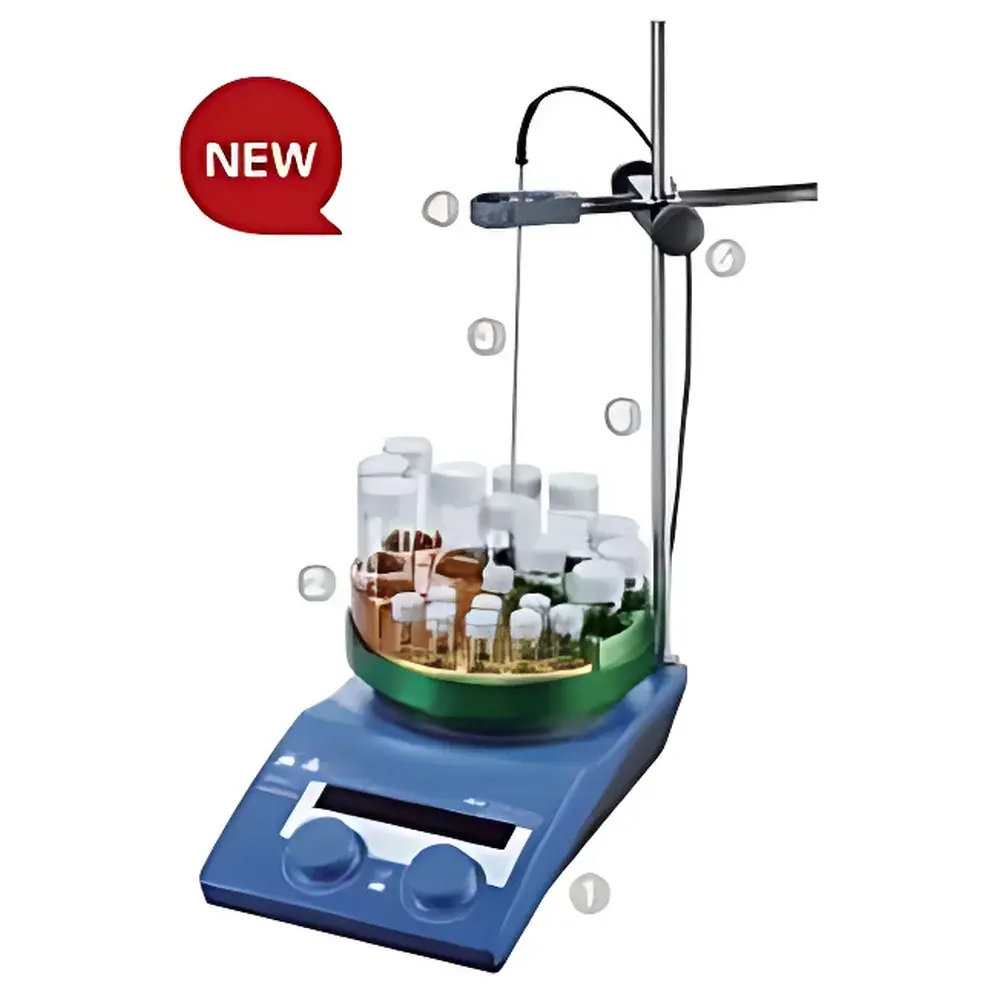
IKA RCT Basic Heating Magnetic Stirrer with H135.3 Multi-Block Heating Platform
| Brand | IKA |
|---|---|
| Origin | Germany |
| Model | RCT Basic |
| Instrument Type | Heating Magnetic Stirrer |
| Max. Stirring Volume | 20 L |
| Speed Range | 50–1500 rpm |
| Temperature Control Range | 50–310 °C |
| Heating Power | 600 W |
| Plate Material | Anodized Aluminum |
| Plate Diameter | Ø135 mm |
| Dimensions (W×H×D) | 160 × 85 × 270 mm |
| Weight | 2.5 kg |
| IP Rating | IP42 |
| Input Voltage | 220–230 V / 115 V / 100 V |
| Frequency | 50/60 Hz |
| External Sensor Interface | DIN 12878 |
| Temp. Accuracy (with PT1000) | ±1 K |
| Speed Accuracy | ±5% |
| Safety Over-Temp Limit | Adjustable 50–360 °C |
Overview
The IKA RCT Basic Heating Magnetic Stirrer with H135.3 Multi-Block Heating Platform is an engineered solution for parallel thermal and mechanical control in synthetic chemistry, pharmaceutical process development, and materials science laboratories. It integrates precise magnetic stirring with independent, uniform conductive heating across multiple reaction vessels—leveraging the fundamental principle of eddy-current-driven rotation of magnetic stir bars within a controlled thermal field. Unlike conventional hotplate stirrers limited to single-vessel operation, this system employs a modular aluminum heating platform designed to accommodate up to four interchangeable “pie-style” heating blocks (H135.310–H135.313), enabling simultaneous temperature regulation and agitation in up to 36 discrete vessels—depending on block configuration and vessel geometry. The system operates under closed-loop temperature control via integrated or external PT1000 sensors, ensuring traceable thermal stability compliant with GLP-aligned workflows.
Key Features
- Single-point magnetic stirring with digitally displayed speed (50–1500 rpm) and analog-adjustable, stepless speed control
- Dual-mode thermal management: direct plate heating (600 W) plus optional external sensor feedback (DIN 12878 interface) for ±1 K accuracy
- H135.3 heating platform supports four independently mountable anodized aluminum heating blocks—each optimized for specific vessel diameters and thermal mass profiles
- Anodized surface with color-coded coating ensures rapid visual identification of block types and prevents magnetic interference during stirring
- Integrated safety circuitry includes adjustable over-temperature cutoff (50–360 °C), automatic shutdown upon sensor disconnection, and IP42-rated enclosure for dust and splash resistance
- Compact footprint (160 × 85 × 270 mm) and lightweight design (2.5 kg) facilitate integration into fume hoods, gloveboxes, or automated lab benches
Sample Compatibility & Compliance
The RCT Basic + H135.3 platform accommodates standard laboratory glassware—including round-bottom flasks (25–1000 mL), screw-cap vials, and multi-well reaction plates—when paired with appropriately sized heating blocks. All aluminum blocks are non-magnetic and thermally conductive, eliminating eddy-current losses and ensuring uniform heat distribution across each vessel bottom. The system complies with IEC 61010-1 for electrical safety in laboratory equipment and meets DIN EN 60529 (IP42) for environmental protection. When operated with PT1000 sensing and documented calibration records, it supports audit-ready workflows aligned with ISO/IEC 17025, USP , and FDA 21 CFR Part 11 requirements for electronic records and signatures—particularly when used in method validation or stability testing protocols.
Software & Data Management
While the RCT Basic operates as a stand-alone analog-digital hybrid instrument without native PC connectivity, its DIN 12878 sensor port enables integration with third-party data loggers or centralized lab monitoring systems (e.g., LabVIEW, DeltaV, or custom SCADA). Users may record time-stamped temperature and speed values using external USB or Ethernet-enabled loggers compliant with ASTM E2500-18 guidelines for data integrity. For GxP environments, manual calibration logs, sensor verification reports, and maintenance records should be retained per internal SOPs—supporting full traceability from setup through experiment execution.
Applications
- Parallel synthesis screening in medicinal chemistry, including Suzuki, Heck, and amidation reactions requiring precise thermal ramping and inert-atmosphere compatibility
- Controlled crystallization studies where uniform nucleation kinetics across replicate vessels depend on identical thermal gradients and mixing intensity
- Enzyme kinetic assays requiring stable sub-ambient to elevated temperatures (50–310 °C) with continuous homogenization to prevent localized denaturation
- Material precursor aging tests under accelerated thermal stress, validated per ASTM D3045 or ISO 2578
- QC/QA batch release testing of viscous formulations (e.g., adhesives, coatings) where viscosity consistency correlates directly with thermal history and shear exposure
FAQ
Can the RCT Basic operate without an external temperature sensor?
Yes—the unit provides basic plate temperature control using its internal sensor; however, ±1 K accuracy and regulatory compliance require connection of a calibrated PT1000 probe via the DIN 12878 port.
Are all four heating blocks required to be installed simultaneously?
No—blocks are individually mounted and can be mixed or omitted based on experimental needs. Each block functions autonomously once secured to the H135.3 platform.
Is the RCT Basic compatible with corrosive reagents or solvents?
The anodized aluminum surface resists mild acids and organic solvents; however, prolonged exposure to strong oxidizers (e.g., concentrated HNO₃) or halogenated solvents requires protective silicone mats or alternative ceramic-coated blocks.
What is the maximum recommended vessel height for stable stirring at 1500 rpm?
For optimal vortex formation and stir bar retention, vessel height should not exceed 2.5× the internal diameter; for 1000 mL round-bottom flasks, use stir bars ≤80 mm in length and maintain liquid fill levels between 30–70% capacity.
Does IKA provide calibration certificates for the PT1000 sensor included in the kit?
The supplied PT1000 is factory-tested but not individually certified; users must perform in-house calibration against NIST-traceable references prior to GxP-critical applications.



