
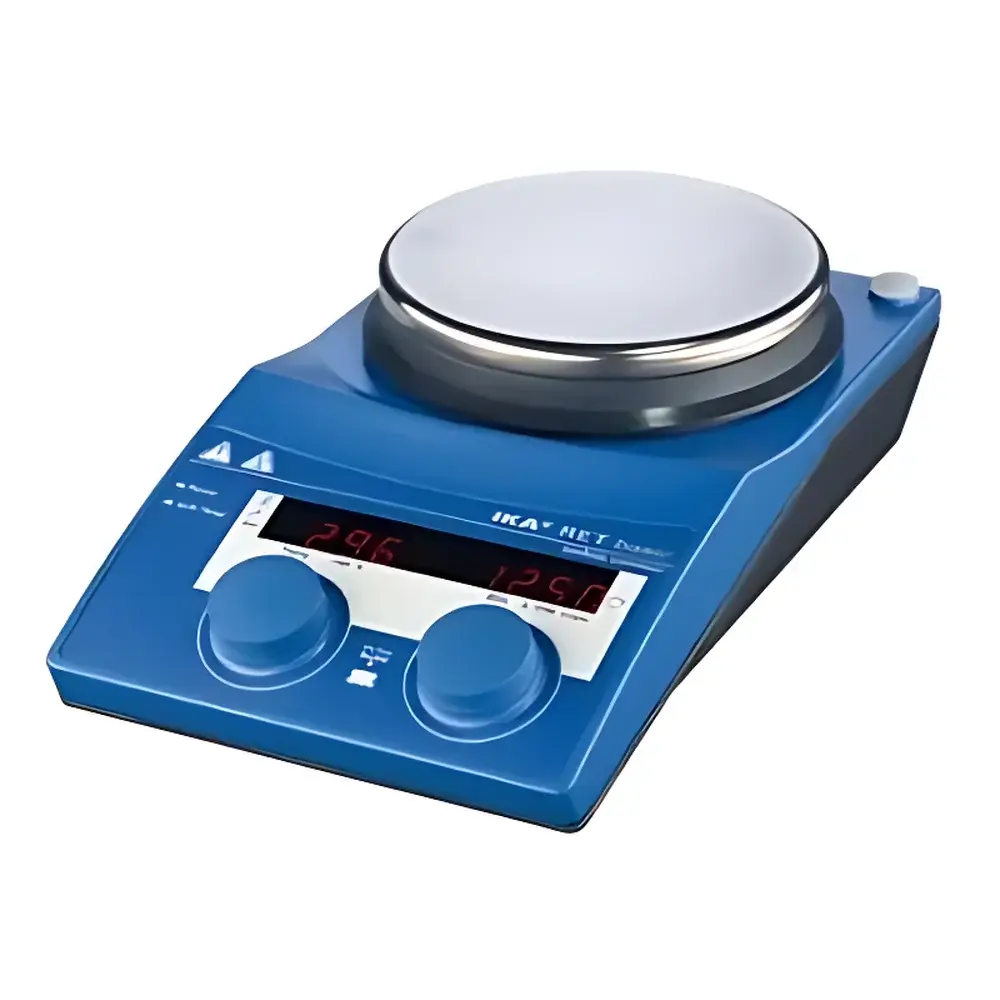
IKA RCT Basic (Safety) Magnetic Stirrer
| Brand | IKA |
|---|---|
| Origin | Germany |
| Model | RCT Basic (Safety) |
| Instrument Type | Magnetic Stirrer |
| Max. Stirring Volume | 20 L (H₂O) |
| Speed Range | 50–1500 rpm |
| Temperature Control Range | 50–310 °C |
| Heating Power | 600 W |
| Safety Circuit Adjustment Range | 50–360 °C |
| Display | LED |
| Protection Class | IP 42 |
| Power Supply | 220–230 / 115 / 100 V, 50/60 Hz |
| Dimensions (W × H × D) | 160 × 85 × 270 mm |
| Weight | 2.5 kg |
| Work Plate Material | Anodized Aluminum |
| Work Plate Diameter | Ø135 mm |
| External Sensor Interface | DIN 12878 |
| Temp. Sensor Included | PT1000.60 (60 cm cable) |
| Stir Bar Max. Length | 80 mm |
| Temp. Control Accuracy (with sensor) | ±1 K |
| Speed Regulation | Continuous |
| Speed Deviation per Position | ±5 % |
| Motor Input Power | 16 W |
| Motor Output Power | 9 W |
| Heating Rate | 6.5 K/min (1 L H₂O in H15 beaker) |
| Ambient Operating Conditions | 5–40 °C, ≤80 % RH |
Overview
The IKA RCT Basic (Safety) Magnetic Stirrer is a CE-certified, DIN-compliant benchtop instrument engineered for precision mixing and temperature-controlled stirring in research, quality control, and routine laboratory environments. It operates on the principle of magnetic coupling—where a rotating permanent magnet beneath the anodized aluminum heating plate induces synchronous rotation of a magnetic stir bar immersed in the sample vessel. Integrated resistive heating elements enable simultaneous heating and stirring, with dual-mode thermal management: direct plate surface heating and external probe-based feedback control via the DIN 12878 interface. Designed for unattended operation, the unit incorporates redundant safety mechanisms—including adjustable overtemperature cutoff, real-time surface temperature monitoring, and automatic shutdown upon thermal anomaly detection—making it suitable for overnight or extended-duration protocols under GLP-compliant workflows.
Key Features
- Robust 9 W brushless DC motor delivering stable torque across the full speed range (50–1500 rpm), with ≤±5 % speed deviation per operating point
- Dual-temperature control architecture: independent regulation of heating plate surface temperature (50–310 °C) and sample core temperature (via integrated PT1000.60 sensor)
- LED-display interface with dedicated numeric indicators for setpoint temperature, actual temperature, and rotational speed—enabling traceable parameter logging during method execution
- Adjustable safety temperature circuit (50–360 °C), programmable to prevent thermal runaway; triggers audible and visual alerts plus automatic power cutoff
- IP 42 ingress protection rating ensures resistance to splashing water and solid particulates, supporting long-term reliability in humid or chemically active lab spaces
- DIN 12878 standardized sensor port enables seamless integration with external temperature controllers (e.g., IKA ETS-D5) or third-party calibrated probes for ISO/IEC 17025-aligned validation
- Aluminum workplate with optimized thermal conductivity and uniform heat distribution; includes H100 protective film to minimize scratching and extend service life
Sample Compatibility & Compliance
The RCT Basic (Safety) accommodates vessels up to 20 L capacity (water-equivalent), supporting standard round-bottom flasks, beakers, and jacketed reactors (with appropriate stir bar geometry). Its 80 mm maximum stir bar length specification ensures effective vortex formation in tall-form containers. The device conforms to multiple international safety and electromagnetic compatibility standards, including EN 61000-6-3 (emission), EN 61000-6-2 (immunity), and EN 61010-1 (safety requirements for electrical equipment for measurement, control, and laboratory use). It meets essential requirements of the EU Machinery Directive 2006/42/EC and carries the CE mark for use in regulated environments governed by FDA 21 CFR Part 11, ISO 13485, and GMP/GLP frameworks where electronic record integrity and audit-trail capability are mandated.
Software & Data Management
While the RCT Basic (Safety) operates as a standalone analog-digital hybrid controller without onboard data logging or PC connectivity, its LED display supports manual documentation of operational parameters at defined timepoints. For fully compliant digital workflows, the DIN 12878 interface permits connection to external data acquisition systems equipped with calibrated thermocouple or RTD inputs. When paired with validated temperature controllers (e.g., IKA ETS-D5), users may generate timestamped temperature profiles compliant with ASTM E2877-22 (Standard Guide for Validation of Thermal Processing Equipment) and support IQ/OQ/PQ documentation packages required for equipment qualification in pharmaceutical and biotech settings.
Applications
- Precipitation reactions requiring homogeneous reagent dispersion and controlled thermal ramping
- Solubility studies across defined temperature gradients (e.g., USP <721> solubility testing)
- Buffer preparation and pH adjustment under constant agitation and thermal stabilization
- Enzyme kinetics assays where reaction mixture homogeneity and thermal consistency directly impact Vmax and Km reproducibility
- Preparation of polymer solutions and colloidal dispersions demanding low-shear, high-volume mixing
- Stability-indicating methods involving accelerated degradation under elevated temperature and agitation stress
FAQ
Does the RCT Basic (Safety) support RS232 or USB communication?
No—this model is intentionally designed as a non-networked, stand-alone unit without digital communication ports. Data capture requires manual recording or external DAQ integration via the DIN 12878 sensor interface.
Can the PT1000.60 sensor be used for both heating control and data logging?
Yes—the included PT1000.60 sensor provides closed-loop temperature regulation when connected to the rear DIN port; its output signal can also feed into external chart recorders or SCADA systems compatible with Pt1000 input specifications.
What is the recommended maintenance interval for the heating plate?
IKA recommends visual inspection of the anodized surface before each use and periodic cleaning with non-abrasive ethanol wipes; no scheduled recalibration is required unless physical damage or thermal drift (>±2 K) is observed during routine verification using NIST-traceable reference thermometers.
Is the unit suitable for use with organic solvents?
Yes—provided the vessel is chemically compatible and sealed appropriately; however, volatile solvent vapors must be managed externally (e.g., fume hood), as the device itself is not explosion-proof (ATEX-certified variants are available separately).
How does the safety temperature circuit interact with the main heating control?
The safety circuit operates independently of the primary PID loop: it monitors either plate surface temperature or external probe input (user-selectable), and triggers irreversible shutdown if the preset threshold is exceeded—bypassing all software-based controls to ensure fail-safe operation.



