
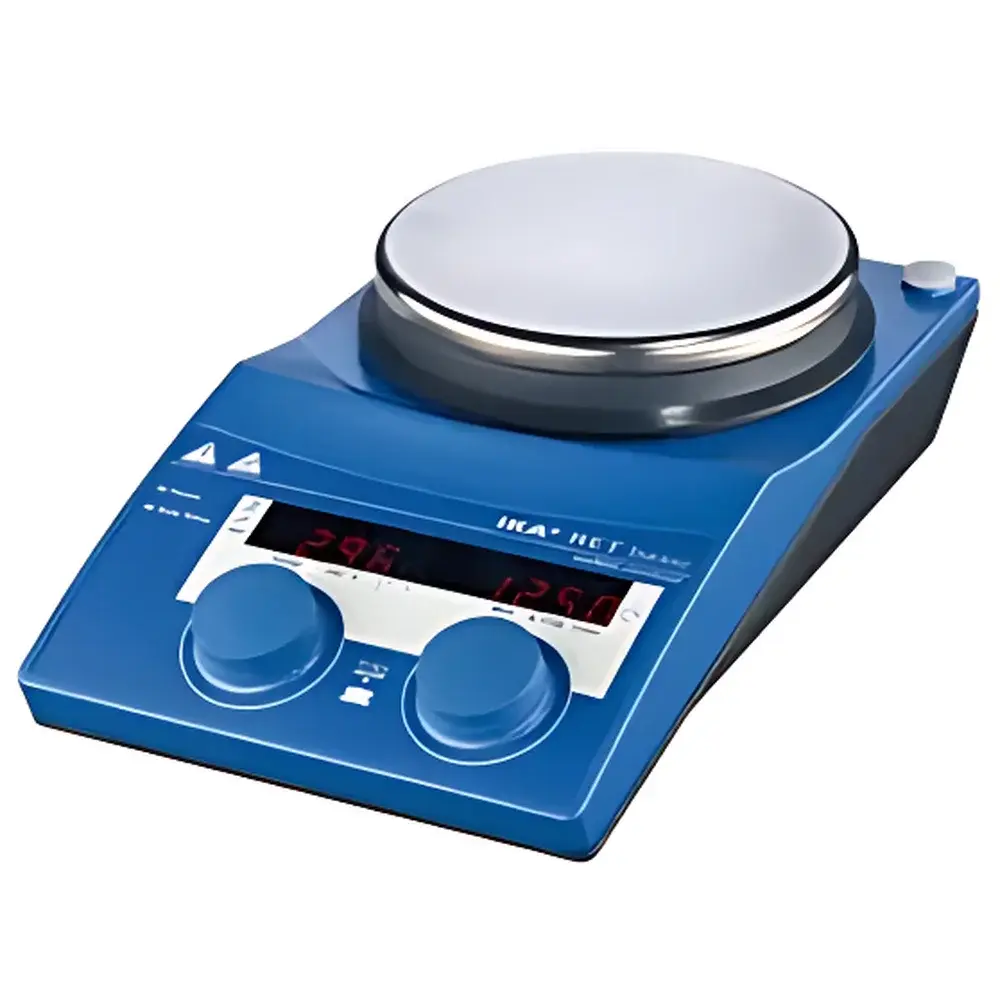
IKA RET Basic Heating Magnetic Stirrer with Stainless Steel Plate
| Brand | IKA |
|---|---|
| Origin | Germany |
| Model | RET Basic |
| Max. Stirring Volume | 20 L |
| Speed Range | 50–1700 rpm |
| Temperature Control Range | Ambient to 340 °C |
| Heating Power | 600 W |
| Plate Material | Stainless Steel 1.4301 (DIN) |
| Protection Class | IP 42 |
| Safety Temp. Limit | 50–360 °C |
| External Sensor Interface | PT1000 |
| Temp. Stability | ±1 K |
| Speed Accuracy | ±5% |
| Dimensions (W×D×H) | 160 × 95 × 270 mm |
| Weight | 2.5 kg |
| Power Supply | 220–230 V / 115 V / 100 V, 50/60 Hz |
Overview
The IKA RET Basic Heating Magnetic Stirrer is an engineered-for-precision laboratory instrument designed for reliable, reproducible mixing and temperature-controlled sample preparation in research, quality control, and teaching laboratories. Based on the Couette flow principle, it employs a rotating magnetic field generated by a high-torque permanent magnet array beneath a corrosion-resistant stainless steel (DIN 1.4301) heating plate to drive magnetic stir bars within vessels. Integrated resistive heating elements deliver rapid thermal response—achieving up to 7 K/min temperature rise in 1 L of water—while dual-loop temperature regulation ensures stability within ±1 K across the full operating range (ambient to 340 °C). Its robust, fully enclosed housing meets IP 42 ingress protection standards, providing resistance against splashes and particulate ingress during extended unattended operation—a critical requirement for GLP-compliant workflows.
Key Features
- Stainless steel heating plate (DIN 1.4301) offering superior corrosion resistance, thermal uniformity, and long-term mechanical integrity
- Wide speed range (50–1700 rpm) with electronic, continuously adjustable control and LED digital display for precise parameter setting
- Dual-mode temperature control: direct plate surface regulation + optional external PT1000 sensor feedback (included as standard: PT1000.60)
- Programmable safety temperature limit (50–360 °C), independently configurable from process temperature, enabling safe overnight or无人值守 operation
- DIN 12878-compatible sensor port for integration with certified contact thermometers (e.g., ETSD5) to meet ISO/IEC 17025 traceability requirements
- High-strength magnetic coupling system optimized for stir bars up to 80 mm in length—minimizing “jumping” even at elevated speeds and viscous loads
- Integrated thermal warning indicator and error-code display (e.g., E1 = overtemperature, E2 = sensor fault) for immediate diagnostic feedback
- Pre-installed H100 protective film safeguards the control panel and housing surface against chemical residue and abrasion
Sample Compatibility & Compliance
The RET Basic accommodates standard laboratory glassware including beakers, flasks, and reaction vessels up to 20 L volume (water-equivalent). Its flat, non-porous stainless steel plate ensures compatibility with borosilicate glass, PTFE-coated containers, and autoclavable accessories. The device complies with IEC 61010-1:2010 (Safety Requirements for Electrical Equipment for Measurement, Control, and Laboratory Use) and carries CE marking per EU Directive 2014/30/EU (EMC) and 2014/35/EU (LVD). Its design supports adherence to Good Laboratory Practice (GLP) and GMP environments through stable thermal performance, repeatable speed delivery, and built-in safety interlocks. While not equipped with RS-232 or analog outputs, its operational parameters are fully auditable via front-panel LED logs and manual record-keeping aligned with FDA 21 CFR Part 11 documentation expectations.
Software & Data Management
As a standalone benchtop instrument, the RET Basic operates without proprietary software or network connectivity. All settings—including speed, target temperature, safety cutoff, and real-time status—are configured and monitored directly via its dual-line LED display. No firmware updates, cloud synchronization, or data export functionality is provided, preserving system simplicity and minimizing cybersecurity exposure. This architecture aligns with risk-based validation strategies outlined in ASTM E2500 and EU Annex 11, where minimal electronic complexity reduces qualification burden. Users maintain full control over calibration records, maintenance logs, and operational SOPs in accordance with internal quality management systems.
Applications
This stirrer serves core functions across analytical chemistry (e.g., dissolution testing per USP , buffer equilibration), pharmaceutical R&D (reaction mixture homogenization under controlled thermal profiles), materials science (polymer solution blending, nanoparticle dispersion), and environmental testing (extraction protocol standardization). Its ability to sustain stable temperatures above 300 °C makes it suitable for high-boiling-point solvent applications such as nitrocellulose dissolution or silicone oil bath conditioning. The DIN 12878 interface further enables use in calorimetric studies requiring direct media temperature feedback—supporting method development compliant with ISO 11357 and ASTM D3418.
FAQ
What is the maximum recommended vessel diameter for optimal stirring performance?
For consistent vortex formation and torque transfer, vessels with base diameters ≤130 mm are recommended when using standard stir bars (e.g., 40–60 mm length); larger volumes should employ optimized bar geometry and lower RPM settings.
Can the RET Basic be used with corrosive reagents such as concentrated acids or halogenated solvents?
Yes—the stainless steel 1.4301 plate and sealed electronics housing provide resistance to common lab chemicals; however, prolonged exposure to hydrofluoric acid or molten alkali metals is not advised.
Is external temperature sensor calibration required prior to use?
Per ISO/IEC 17025, users must verify sensor accuracy against a NIST-traceable reference thermometer before first use and at defined intervals thereafter; the included PT1000.60 sensor is supplied with factory calibration data.
Does the unit support programmable ramp-and-soak temperature profiles?
No—this model implements only static setpoint control; for time-dependent thermal protocols, consider the RET control series with integrated timer and profile programming.
What maintenance is required to ensure long-term accuracy and safety?
Routine inspection of stir bar integrity, cleaning of the plate surface with ethanol or mild detergent, and annual verification of safety cutoff functionality are recommended per IKA Service Bulletin SB-RET-2023.



