
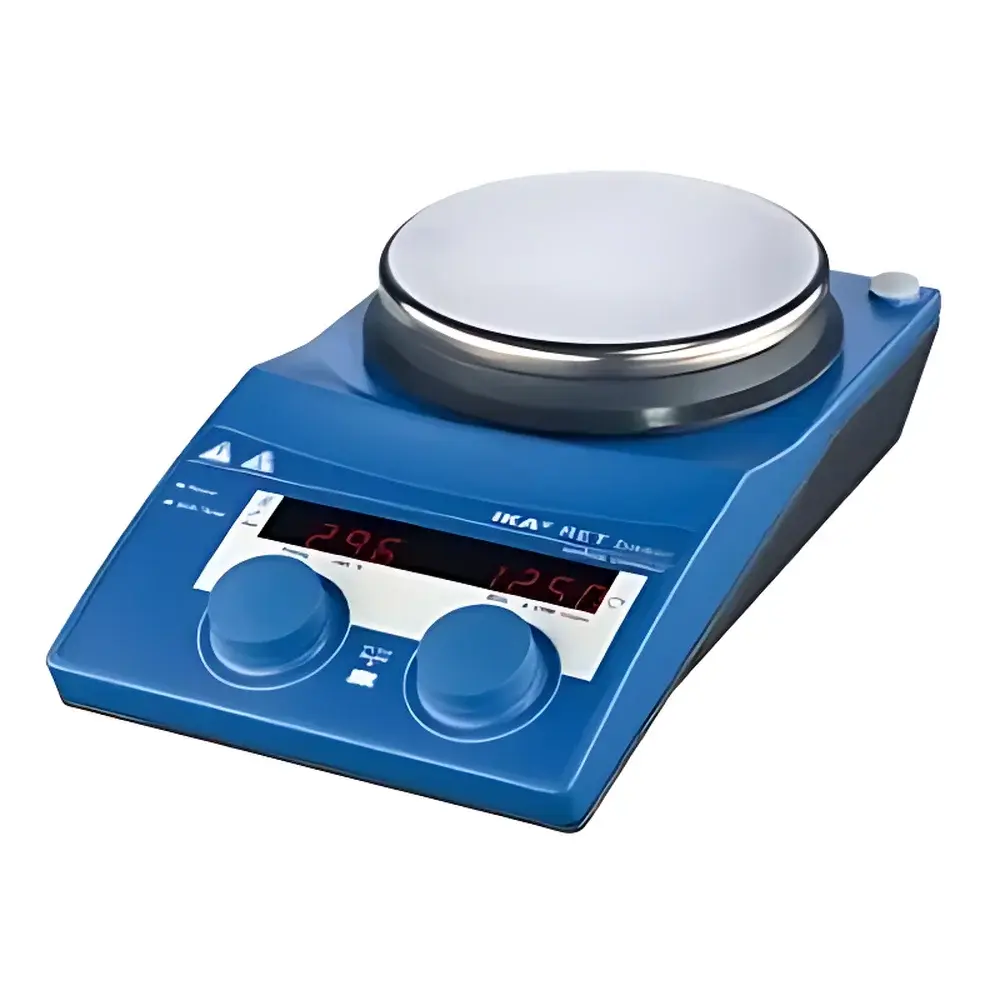
IKA RET Basic Safety-Controlled Magnetic Stirrer
| Brand | IKA |
|---|---|
| Origin | Germany |
| Model | RET Basic (Safety-Controlled) |
| Stirrer Type | Magnetic Stirrer |
| Max. Stirring Volume | 20 L |
| Speed Range | 50–1700 rpm |
| Heating Plate Temperature Range | RT to 340 °C |
| Heating Power | 600 W |
| Safety Temperature Limit | 50–360 °C |
| Temperature Display Range | 50–360 °C |
| Control Accuracy (with PT1000) | ±1 K |
| Control Accuracy (with ETS-D5) | ±0.5 K |
| Heating Rate (1 L H₂O) | 7 K/min |
| Stir Bar Max Size | 80 × 10 mm |
| Housing Protection Rating | IP 42 |
| Dimensions (W × D × H) | 160 × 270 × 95 mm |
| Weight | 2.5 kg |
Overview
The IKA RET Basic Safety-Controlled Magnetic Stirrer is an engineered solution for precise, reliable, and unattended thermal stirring in research laboratories, quality control environments, and industrial R&D settings. Built upon IKA’s decades of expertise in laboratory motion control, this device integrates robust magnetic drive technology with a high-performance heating plate and dual-parameter digital regulation—enabling simultaneous, independent control of rotational speed and surface temperature. Its operation relies on the principle of electromagnetic coupling between the internal rotating magnet assembly and ferromagnetic stir bars, delivering consistent torque transfer without mechanical wear or seal degradation. The heating system employs resistive elements embedded in a stainless-steel plate (Ø135 mm), thermally regulated via PID feedback loops using either integrated or external temperature sensors. Designed for compliance with DIN 12878 standard interfaces, it supports traceable, calibrated temperature monitoring—making it suitable for applications requiring documented thermal consistency under GLP or ISO/IEC 17025 frameworks.
Key Features
- Wide speed range: 50–1700 rpm with electronic digital control and real-time LED display for reproducible mixing across low-viscosity solvents and moderately viscous media
- Independent dual-parameter control: Simultaneous digital setting and monitoring of both stir speed and plate temperature
- Safety-controlled architecture: Programmable safety temperature limit (50–360 °C) prevents overheating during unattended operation; automatic shutdown triggered if set threshold is exceeded
- High-protection enclosure: IP 42-rated sealed housing safeguards internal electronics against dust ingress and vertical water droplets—enhancing longevity in demanding lab environments
- DIN 12878-compliant sensor port: Compatible with certified contact temperature probes including PT1000.60 (included) and optional ETS-D5 for enhanced accuracy (±0.5 K)
- Rapid thermal response: 600 W heating power delivers up to 7 K/min heating rate in 1 L water—reducing experimental cycle times without compromising stability
- Strong neodymium magnet drive: Ensures stable rotation of stir bars up to 80 × 10 mm—even at high speeds and elevated temperatures
- Integrated safety labeling and visual alerts: “Hot surface” warning icon and error code display (e.g., E1 = sensor fault, E2 = overtemperature) support rapid troubleshooting and operator awareness
Sample Compatibility & Compliance
The RET Basic accommodates aqueous and organic solutions, suspensions, and low-to-medium viscosity polymer melts within its 20 L maximum volume capacity. Its stainless-steel heating plate resists corrosion from common reagents, while the included H100 protective film minimizes residue buildup and simplifies cleaning between runs. The unit conforms to DIN EN 60529 (IP 42), DIN 12878 (for external probe interfacing), and IEC 61010-1 for electrical safety in laboratory equipment. When used with validated temperature probes and documented calibration records, it supports audit-ready workflows aligned with FDA 21 CFR Part 11 data integrity requirements—particularly when paired with compliant data logging software.
Software & Data Management
While the RET Basic operates as a standalone instrument with no built-in PC connectivity, its digital interface supports manual documentation of setpoints and operational logs. For integration into automated lab systems, optional accessories—including RS232-to-USB adapters and IKA LabWorldSoft-compatible modules—enable remote parameter configuration and time-stamped event recording. All temperature and speed values are displayed with 1 °C and 1 rpm resolution respectively, supporting traceability when logged alongside batch identifiers or SOP references. Audit trails may be maintained externally via LIMS or ELN platforms compliant with ALCOA+ principles.
Applications
- Precipitation and crystallization studies requiring controlled nucleation kinetics
- Standardized dissolution testing per USP and Ph. Eur. 2.9.3 protocols
- Buffer preparation and pH adjustment workflows where thermal homogeneity impacts ionization equilibrium
- Preparative synthesis involving exothermic or temperature-sensitive reactions
- Viscosity benchmarking of Newtonian fluids under isothermal conditions
- Calibration verification of secondary temperature sensors using reference-grade PT1000 probes
FAQ
What safety certifications does the RET Basic hold?
It complies with IEC 61010-1 for electrical safety and carries CE marking for conformity with EU directives. Its IP 42 rating meets DIN EN 60529 for protection against solid objects >1 mm and vertically falling water drops.
Can the unit maintain temperature stability during extended overnight operation?
Yes—the safety temperature limit function, combined with PID-regulated heating and thermal cut-off redundancy, enables secure unattended use for durations exceeding 12 hours, provided ambient conditions remain within 5–40 °C and ≤80% RH.
Is the included PT1000.60 sensor calibrated and traceable to national standards?
The sensor is factory-tested and supplied with a manufacturer’s calibration certificate. For ISO/IEC 17025 accreditation, users must perform periodic recalibration using a NIST-traceable reference thermometer.
Does the device support external data logging?
Not natively—but with optional RS232 interface hardware and compatible software (e.g., LabWorldSoft), real-time speed and temperature values can be streamed and archived in CSV or database formats.
What is the recommended maintenance interval?
No scheduled maintenance is required beyond routine cleaning of the heating plate and inspection of the protective film. Annual verification of temperature accuracy using a calibrated reference probe is advised for regulated environments.



