
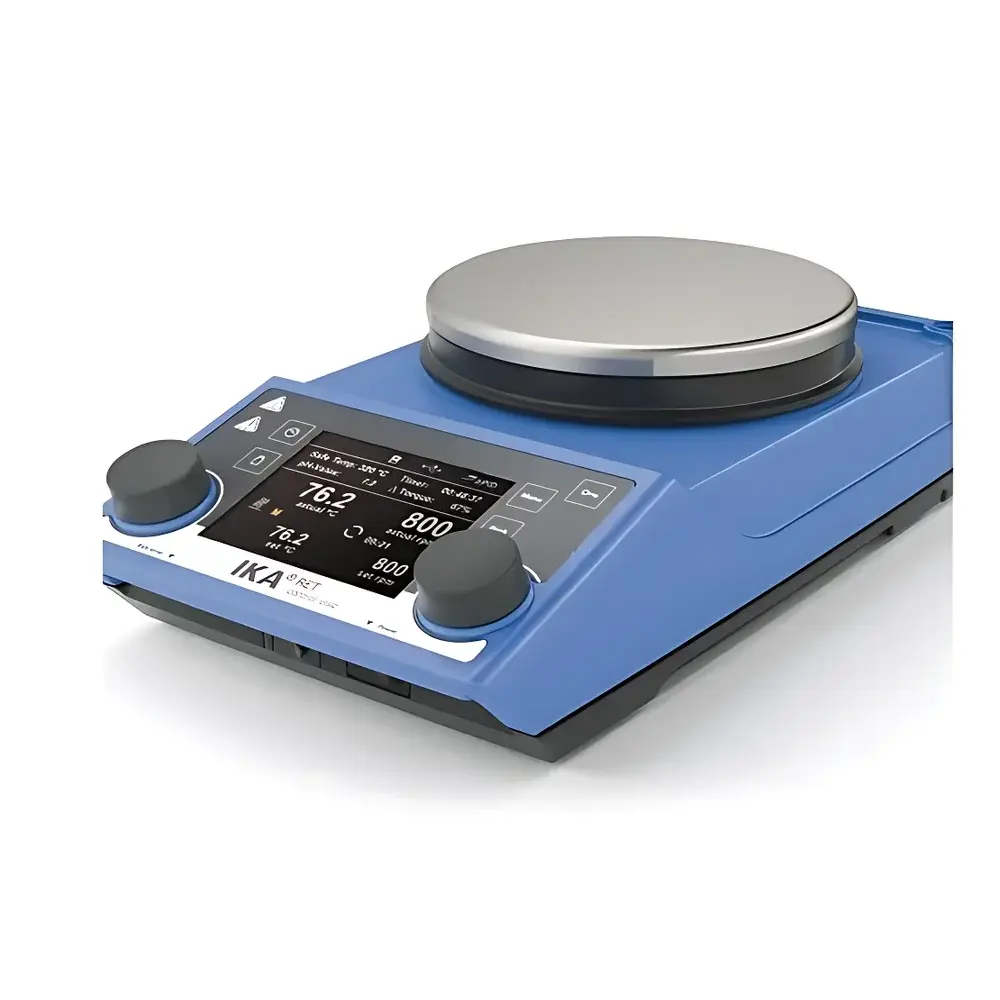
IKA RET control-visc Advanced Heating Magnetic Stirrer with Integrated Precision Weighing
| Brand | IKA |
|---|---|
| Origin | Germany |
| Manufacturer | IKA Werke GmbH & Co. KG |
| Type | Heating Magnetic Stirrer |
| Max. Stirring Volume | 20 L |
| Speed Range | 50–1700 rpm |
| Temperature Control Range | Ambient to 340 °C |
| Integrated Weighing Capacity | 0–5000 g |
| Heating Power | 600 W |
| Plate Material | Stainless Steel 1.4301 (Ø135 mm) |
| Communication Interfaces | RS232, USB |
| Safety Temp. Range | 50–380 °C |
| IP Rating | IP42 |
| Dimensions | 160 × 85 × 270 mm |
| Weight | 3 kg |
Overview
The IKA RET control-visc is an advanced heating magnetic stirrer engineered for precision, safety, and traceable operation in regulated laboratory environments. Designed around Couette-type magnetic coupling and resistive plate heating principles, it delivers reproducible mixing performance while enabling real-time thermal management of viscous or temperature-sensitive samples. Unlike conventional stirrers, the RET control-visc integrates a calibrated load cell directly beneath the stainless-steel heating plate—enabling simultaneous mass monitoring during stirring and heating. Its dual-temperature control architecture supports both sample-directed (via external PT100 probe) and medium-directed (plate-sensor) regulation, meeting requirements for method validation under GLP and ISO/IEC 17025 frameworks. The device complies with DIN EN 60529 (IP42), ensuring protection against solid ingress and limited water exposure during routine benchtop use.
Key Features
- Integrated high-resolution weighing system (0–5000 g, accuracy: ±1 g below 50 g; ±5 g above) with BNC interface for concurrent pH electrode integration
- TFT display with multilingual UI (English, German, French, Spanish, Chinese) and intuitive parameter navigation
- Dual-mode temperature control: rapid heating (up to 7 K/min in 1 L water) and precision stabilization (±0.2 K with PT100 feedback)
- Intelligent safety architecture: adjustable upper/lower thermal limits (50–380 °C), automatic plate-cooling hold (display persists until <50 °C), and lockable keypad
- Stirring intelligence: jump detection for stir bar misalignment, torque trend logging, intermittent operation scheduling, and real-time viscosity change profiling
- Full digital control via RS232 or USB: remote parameter setting, data export (CSV), firmware updates, and audit-trail-capable operation logs
- Robust stainless-steel (1.4301) ceramic-coated heating plate (Ø135 mm) rated for continuous operation up to 340 °C; compatible with borosilicate glass, metal, and PTFE-coated vessels
Sample Compatibility & Compliance
The RET control-visc accommodates standard laboratory vessels—including round-bottom flasks (up to 5 L), beakers (up to 20 L), and jacketed reactors—with optimal coupling for stir bars up to 80 mm in length. Its wide temperature range (ambient to 340 °C) supports solvent reflux, polymerization initiation, catalyst activation, and high-viscosity resin processing. For regulated workflows, the instrument meets key compliance benchmarks: temperature control traceability aligns with ASTM E2251 (standard practice for calibration of temperature measurement systems); weighing functionality satisfies USP repeatability criteria when used within its specified load range; and electronic logging capabilities support FDA 21 CFR Part 11 readiness when deployed with validated software environments. The IP42 enclosure rating ensures operational integrity in shared lab spaces with moderate humidity (≤80% RH) and ambient temperatures from 5–40 °C.
Software & Data Management
Communication via USB or RS232 enables bidirectional control using IKA Labworldsoft™ (v5.0+), a platform compliant with GxP documentation standards. Users can configure multi-step protocols—including ramp-hold sequences, timed interruptions, and conditional triggers based on torque or temperature deviation. All parameter changes, runtime events, error codes (e.g., “E07: Overtemp”, “E12: Load Cell Fault”), and measured values (speed, plate temp, sample temp, mass, torque) are timestamped and exportable as CSV or PDF reports. Audit trails record operator ID (when integrated with network authentication), session start/end times, and firmware version—supporting internal QA reviews and external inspections under ISO 13485 or ISO 9001.
Applications
- Chemical synthesis requiring precise thermal ramping and stoichiometric mass tracking (e.g., Grignard reactions, transesterification)
- Materials science: dispersion of nanomaterials in high-boiling solvents, prepolymer viscosity profiling during curing
- Pharmaceutical development: dissolution testing with real-time mass correction for solvent evaporation, buffer preparation with pH-stirring synchronization
- Quality control labs: standardized mixing protocols for reference standard preparation per USP or EP 2.9.30
- Academic research: kinetic studies where torque-derived viscosity trends correlate with reaction progress in situ
FAQ
Does the RET control-visc support external PT100 probes for sample temperature feedback?
Yes—via a dedicated analog input port. When enabled, the system prioritizes PT100 readings over plate sensor data for closed-loop temperature control.
Can the weighing function be used simultaneously with heating and stirring?
Yes—the load cell is thermally isolated and actively compensated for plate self-heating (max. +35 °C drift after 1 h at RT), ensuring stable mass readings across the full operating range.
Is firmware update possible without proprietary software?
Yes—USB-based firmware updates can be performed directly using drag-and-drop file transfer; no license or cloud connection required.
What safety certifications does the unit carry?
It bears CE marking per EU Machinery Directive 2006/42/EC and Low Voltage Directive 2014/35/EU, and conforms to IEC 61010-1:2010 for laboratory electrical equipment safety.
How is data integrity ensured during power interruption?
Critical parameters (setpoints, safety limits, timer status) are stored in non-volatile memory; the device resumes last-known operational state upon reboot, with optional auto-restart disable for unattended applications.



