
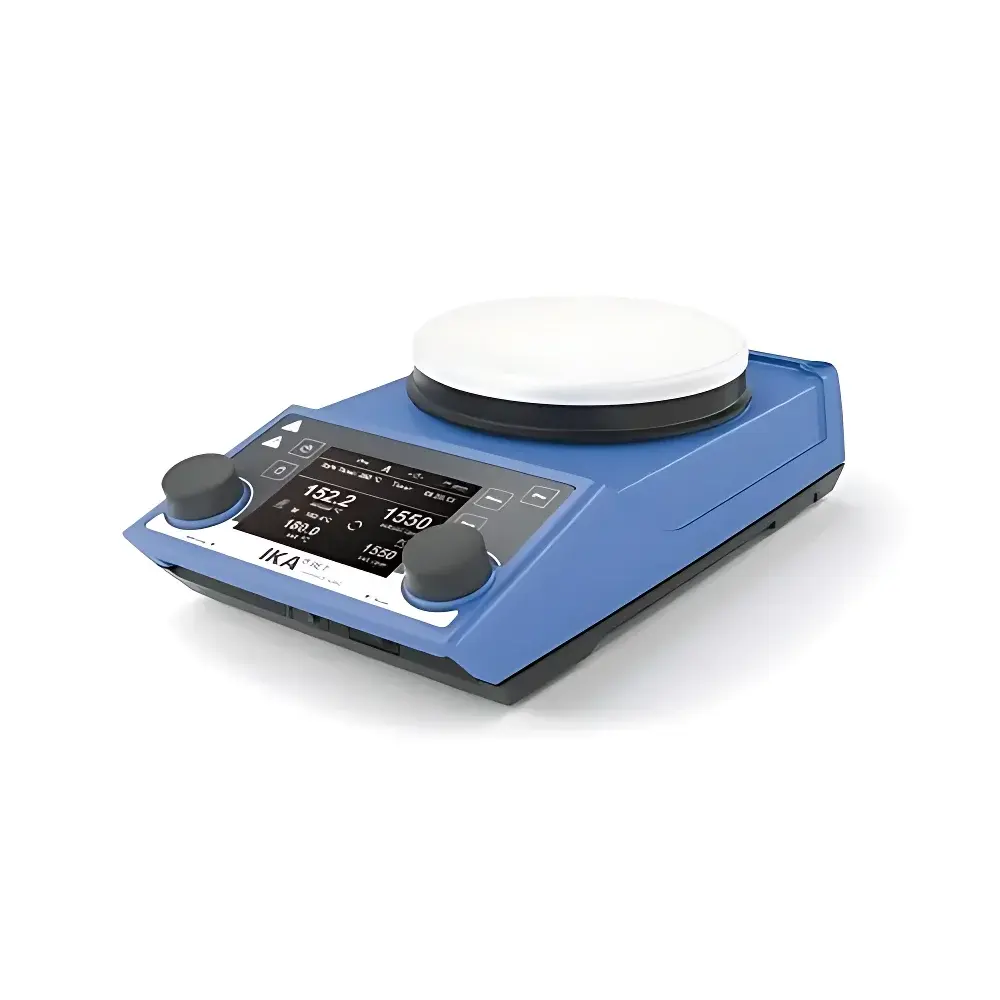
IKA RET control-visc white Heating Magnetic Stirrer
| Brand | IKA |
|---|---|
| Origin | Germany |
| Model | RET control-visc white |
| Stirrer Type | Magnetic Stirrer |
| Max. Stirring Volume | 20 L |
| Speed Range | 50 – 1700 rpm |
| Temperature Control Range | Ambient to 340 °C |
| Heating Power | 600 W |
| Weighing Function | Yes (0–5000 g, accuracy ±1 g <50 g, ±5 g >50 g) |
| Display | TFT touchscreen with multilingual UI |
| Interface | RS232 & USB (for remote control, data export, firmware update) |
| Safety Features | Adjustable safety temperature limit (50–380 °C), hotplate residual heat display, stir bar deviation detection, lock key, transparent safety shield |
| Compliance | IP42 ingress protection, DIN EN 60529, CE, RoHS |
| Plate Material | Stainless steel 1.4301 (Ø135 mm) |
| Dimensions (W×H×D) | 160 × 270 × 85 mm |
| Weight | 3 kg |
| Power Supply | 220–240 V / 115 V / 100 V, 50/60 Hz |
| Input Power | 650 W |
Overview
The IKA RET control-visc white is an advanced heating magnetic stirrer engineered for precision, safety, and operational autonomy in demanding laboratory environments. Unlike conventional magnetic stirrers, this instrument integrates three core functional domains—magnetic stirring, programmable resistive heating, and real-time mass monitoring—within a single compact platform. Its measurement principle relies on permanent magnet coupling for torque transmission, PID-controlled resistive heating of a stainless-steel ceramic-coated plate (material grade 1.4301), and electromagnetic force compensation for high-resolution weighing (0–5000 g). Designed for applications requiring strict thermal and mechanical reproducibility—such as polymer dissolution, catalyst activation, or temperature-dependent solubility studies—the RET control-visc white supports unattended operation via configurable timers, safety interlocks, and dual-mode temperature control (rapid ramp vs. precision hold). Its architecture meets fundamental requirements for GLP-compliant workflows, including audit-trail-capable parameter locking, error-code diagnostics, and environmental resilience (IP42 rating per DIN EN 60529).
Key Features
- Integrated high-accuracy weighing system (±1 g up to 50 g; ±5 g above 50 g) with BNC interface for optional pH electrode integration
- TFT touchscreen display with multi-language support (English, German, French, Spanish, Chinese, Japanese) and intuitive icon-based navigation
- Dual temperature control architecture: internal plate sensor + external PT100 probe input (optional), enabling simultaneous monitoring of heater surface and sample bulk temperature
- Programmable safety temperature circuit (adjustable range: 50–380 °C) with automatic shutdown and persistent residual heat indication until plate cools below 50 °C
- Stir bar deviation detection algorithm that identifies loss of coupling or vortex instability and triggers audible/visual alerts
- Three operational modes: continuous stirring, intermittent cycling (with user-defined on/off intervals), and torque trend logging for viscosity estimation
- Full remote operation via RS232 or USB: real-time parameter adjustment, time-stamped data export (speed, temp, torque, weight), and field-upgradable firmware
- Mechanical “lock key” function preventing accidental modification of active parameters during experiments
- Transparent polycarbonate safety shield included as standard equipment to contain splashes and reduce convective heat loss
Sample Compatibility & Compliance
The RET control-visc white accommodates vessels from 10 mL vials to 20 L reactors (water-equivalent capacity), compatible with glass, stainless steel, and PTFE-lined containers. Its 135 mm Ø stainless-steel heating plate tolerates aggressive media and repeated thermal cycling without degradation. The instrument complies with DIN EN 60529 (IP42), ensuring protection against solid objects ≥1 mm and vertically falling water droplets—critical for humid or reagent-handling environments. Electrical safety conforms to IEC 61010-1, and electromagnetic compatibility meets EN 61326-1. While not inherently 21 CFR Part 11 compliant, its USB/RS232 data logging, parameter locking, and error-code traceability support validation under GxP frameworks when deployed with validated software and procedural controls.
Software & Data Management
No proprietary software installation is required: the device appears as a virtual COM port or HID-compliant peripheral upon USB connection. Raw data streams—including timestamped speed (rpm), plate temperature (°C), sample temperature (°C, if PT100 connected), mass (g), and estimated torque—are exportable in CSV format. All settings—including timer profiles, safety limits, and language selection—are retained after power cycling. Firmware updates are performed via USB using IKA’s publicly available update utility (version ≥3.2.1 required for full feature parity). Audit-ready documentation includes built-in error log history (e.g., E01 = overtemperature, E07 = stir bar detection failure), accessible directly from the TFT menu.
Applications
- Controlled dissolution testing of pharmaceutical actives under pharmacopoeial conditions (USP , EP 2.9.3)
- Thermal curing of epoxy resins and silicone elastomers with concurrent mass tracking to quantify solvent evaporation kinetics
- Preparation of homogeneous nanoparticle dispersions where viscosity evolution correlates with aggregation onset
- Standardized calibration of viscometers using Newtonian reference oils across defined temperature ramps
- Long-duration stability studies requiring overnight or weekend operation with automated shutdown and thermal safety fallbacks
- pH-stat titrations integrating real-time mass change (reagent addition) with temperature-compensated electrode readings via BNC interface
FAQ
Can the RET control-visc white be used with non-magnetic vessels such as aluminum or ceramic?
No. Magnetic coupling requires ferromagnetic or diamagnetic vessel bases; aluminum and most ceramics lack sufficient magnetic permeability for reliable stir bar actuation.
Is the weighing function calibrated traceably to national standards?
The integrated scale is factory-calibrated and includes internal self-check routines. For ISO/IEC 17025 traceability, users must perform periodic verification using certified test weights (Class M2 or better) per manufacturer-recommended procedures.
Does the USB interface support direct connection to LIMS systems?
Yes—via ASCII-based serial protocol over USB CDC ACM class. Custom middleware (e.g., Python pySerial scripts or LabVIEW VIs) can parse comma-delimited output and push structured records to LIMS APIs.
What is the maximum recommended container height for stable stir bar operation at 1700 rpm?
For optimal vortex formation and coupling stability, container height should not exceed 3× the internal diameter; for 20 L cylindrical vessels, use stir bars ≤80 mm in length and maintain liquid depth ≥100 mm.
How does the torque trend function estimate viscosity changes?
It records motor current draw (proportional to load torque) under constant speed conditions. While not a substitute for rotational rheometry, it provides comparative, semi-quantitative trends for relative viscosity shifts in homogeneous, low-to-medium viscosity liquids (<5000 mPa·s).



