
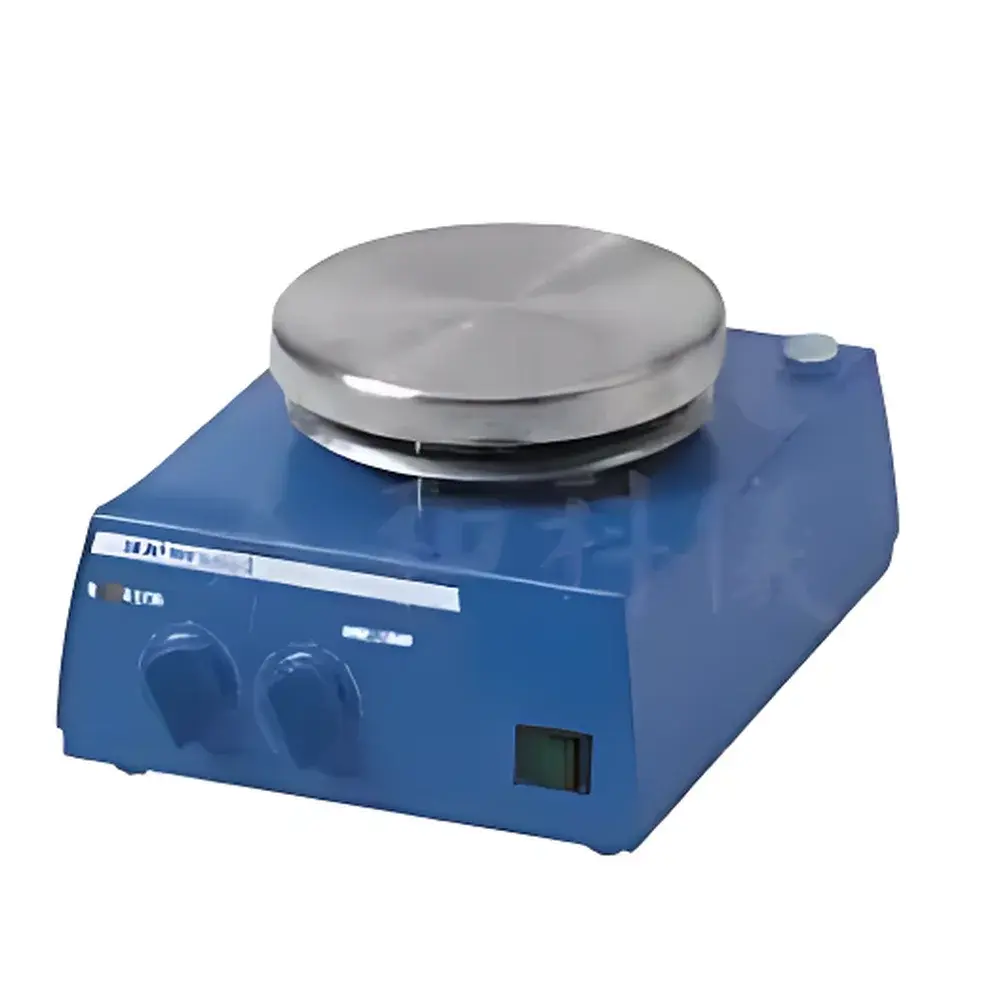
IKA RH basic 2 Economy Heating Magnetic Stirrer
| Brand | IKA |
|---|---|
| Origin | Germany |
| Model | RH basic 2 |
| Instrument Type | Magnetic Stirrer |
| Max. Stirring Volume (H₂O) | 10 L |
| Speed Range | 100–2000 rpm |
| Heating Temperature Range | Ambient to 320 °C |
| Heating Power | 400 W |
| Motor Power | 2 W |
| Plate Material | Stainless Steel 1.4301 |
| Plate Diameter | 125 mm |
| Dimensions (W × D × H) | 168 × 105 × 220 mm |
| Weight | 2.4 kg |
| Ambient Operating Conditions | 5–40 °C, ≤80% RH |
| Protection Class | IP21 (per DIN EN 60529) |
| Voltage | 220–240 V / 115 V / 100 V |
| Frequency | 50/60 Hz |
| Total Input Power | 415 W |
| Fixed Safety Cut-off Temperature | 400 °C |
Overview
The IKA RH basic 2 is an entry-level heating magnetic stirrer engineered for reliable, repeatable thermal mixing in routine laboratory environments. Designed according to fundamental principles of electromagnetic coupling and resistive heating, it integrates a permanent magnet rotor drive with a stainless steel heating plate to deliver consistent agitation and precise temperature control without mechanical contact between the drive unit and the vessel. Its compact footprint and fixed-speed analog control architecture make it especially suitable for standardized protocols where reproducibility across shifts or users is prioritized over programmability—such as buffer preparation, reagent dissolution, pre-heating of samples prior to analysis, or solvent-based reactions requiring moderate thermal input and homogeneous dispersion.
Key Features
- Stainless steel heating plate (material grade 1.4301) offering corrosion resistance, thermal stability, and ease of cleaning—critical for long-term use in chemistry, biology, and quality control labs.
- Analog speed control dial (scale 0–6) enabling intuitive adjustment within a verified operational range of 100–2000 rpm, optimized for compatibility with standard PTFE-coated stir bars (lengths 20–40 mm).
- Independent analog temperature control dial (scale 1–6) supporting heating from ambient up to 320 °C, with real-time thermal response calibrated against reference thermocouples under ISO/IEC 17025-aligned verification procedures.
- Integrated safety cut-off circuit that automatically deactivates heating at 400 °C—exceeding the maximum operating temperature by 80 °C—to prevent thermal runaway during unattended operation or accidental setpoint overshoot.
- Robust mechanical design certified to IP21 (DIN EN 60529), providing protection against vertically falling drips and solid objects ≥12.5 mm, ensuring operational integrity in shared lab spaces with variable environmental conditions.
- Multi-voltage compatibility (220–240 V / 115 V / 100 V, 50/60 Hz) enables seamless deployment across global laboratory infrastructures without external transformers.
Sample Compatibility & Compliance
The RH basic 2 accommodates round-bottom flasks, beakers, and crystallization dishes up to 10 L volume (water-equivalent), provided appropriate stir bar geometry and vessel geometry are selected to ensure laminar flow and avoid vortex instability. It complies with essential electrical safety standards including DIN EN 61010-1 for laboratory equipment and meets EMC requirements per DIN EN 61326-1. While not equipped with digital logging or audit trail functionality, its analog interface supports GLP-aligned documentation when used in conjunction with manual logbooks and SOP-defined calibration intervals (e.g., annual verification of plate surface temperature uniformity and rotational speed accuracy using NIST-traceable reference instruments).
Software & Data Management
The RH basic 2 operates exclusively via hardware-based analog controls and does not incorporate embedded firmware, USB connectivity, or software interfaces. Consequently, it generates no electronic data records and requires no validation for 21 CFR Part 11 compliance. This architecture eliminates cybersecurity vulnerabilities, reduces maintenance complexity, and ensures uninterrupted operation in environments where network isolation or legacy infrastructure constraints preclude digital integration. Calibration and performance verification are performed manually using external thermometers and tachometers traceable to national metrology institutes.
Applications
- Preparation of aqueous and organic solutions in analytical sample prep workflows (e.g., HPLC mobile phase conditioning, titrant standardization).
- Controlled heating and mixing during extraction procedures (Soxhlet pre-extraction, solid-phase dissolution).
- Thermal equilibration of calibration standards prior to spectrophotometric or electrochemical measurement.
- Low-risk synthetic steps involving non-hazardous reagents where reaction exotherms remain within the thermal inertia margin of the system.
- Educational laboratories requiring durable, low-maintenance instrumentation for undergraduate chemistry and life sciences curricula.
FAQ
Does the RH basic 2 support external temperature probe feedback control?
No. Temperature regulation is open-loop, based solely on the integrated heater’s surface thermistor. For closed-loop bath or solution temperature control, consider the IKA RCT basic or HS series.
Can it be used with corrosive solvents such as concentrated acids or halogenated organics?
The stainless steel plate (1.4301) resists mild corrosion but is not resistant to hydrochloric acid, aqua regia, or brominated solvents. Use appropriate chemical-resistant labware and verify compatibility with solvent vapor exposure over extended durations.
Is speed or temperature calibration documented in the出厂 certificate?
IKA provides a factory inspection report confirming conformance to specification; however, formal calibration certificates with measurement uncertainty statements require optional third-party calibration services.
What is the recommended stir bar size for optimal performance at 2000 rpm in a 2 L beaker?
A 30 mm PTFE-coated stir bar with a 8 mm diameter and elliptical profile delivers stable rotation and minimal wobble under these conditions.
Does the device retain settings after power cycling?
No. All settings reset to zero upon power interruption, enforcing intentional user confirmation before each operation—a design feature aligned with risk mitigation best practices in regulated environments.



