
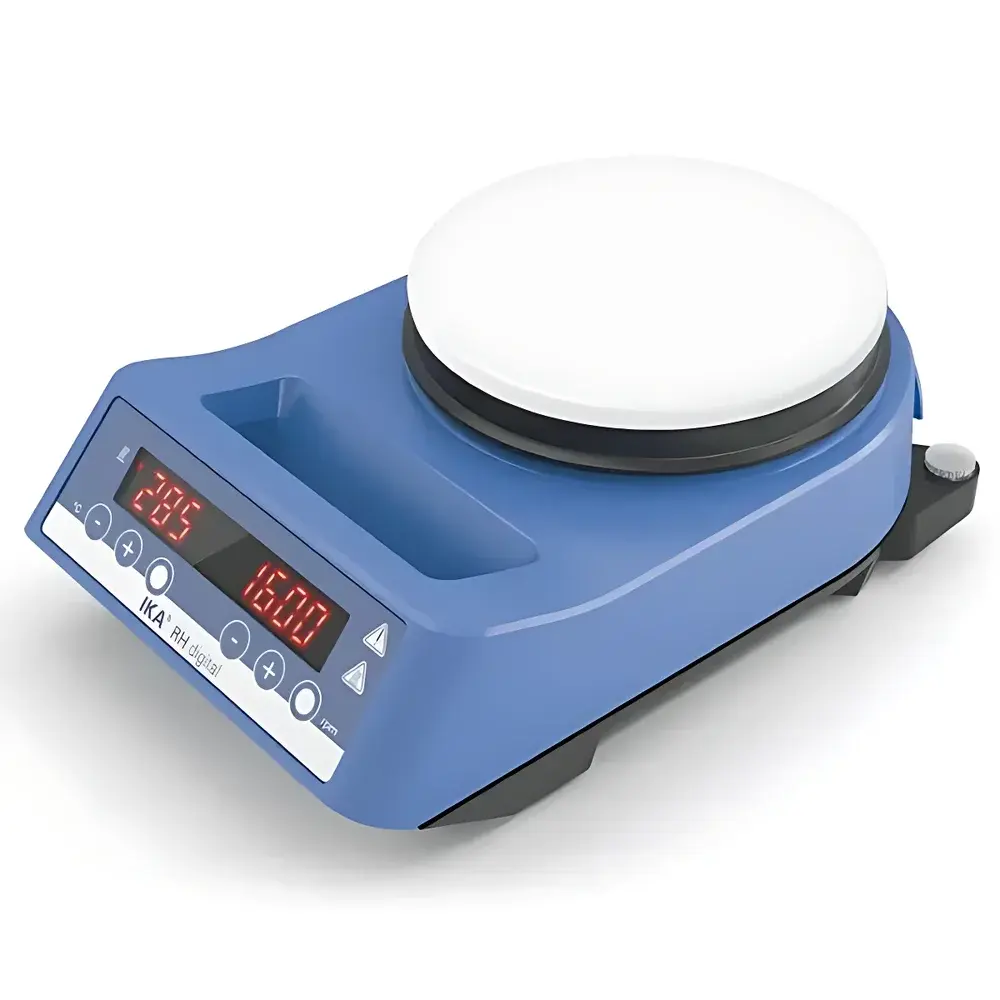
IKA RH digital white Magnetic Stirrer
| Brand | IKA |
|---|---|
| Origin | Germany |
| Model | RH digital white |
| Motor Output Power | 2 W |
| Max. Stirring Volume (H₂O) | 15 L |
| Speed Range | 100–2000 rpm |
| Speed Setting Resolution | 50 rpm |
| Stir Bar Length Compatibility | 20–80 mm |
| Heating Power | 600 W |
| Heating Temperature Range | 50–320 °C |
| Heating Rate | 6 K/min |
| Safety Temperature Limit Range | 100–360 °C |
| Plate Material | Enamel-coated Ceramic |
| Plate Diameter | Ø 135 mm |
| Dimensions (W × D × H) | 160 × 100 × 250 mm |
| Weight | 3.845 kg |
| Ambient Operating Temperature | 5–40 °C |
| Relative Humidity Limit | ≤80 % RH |
| Protection Class | IP21 (per DIN EN 60529) |
| Voltage | 230 V AC |
| Frequency | 50/60 Hz |
| Total Input Power | 620 W |
| External Temperature Sensor Interface | ETS-D5 compatible |
| Compliance | DIN 12878, DIN EN 60529 |
Overview
The IKA RH digital white is a high-performance magnetic stirrer engineered for precision temperature-controlled mixing in research laboratories, quality control environments, and routine analytical workflows. Utilizing robust permanent magnet coupling and a digitally regulated DC motor, it delivers consistent torque across its full speed range (100–2000 rpm) while maintaining low thermal drift and minimal mechanical noise. Its integrated heating plate—constructed from chemically resistant enamel-coated ceramic—operates independently of stirring functions, enabling simultaneous precise heating and homogeneous agitation of aqueous and low-viscosity media up to 15 L. The device conforms to DIN 12878 for compatibility with standardized electronic temperature sensors (e.g., ETS-D5), allowing direct in-solution temperature feedback and closed-loop thermal regulation—a critical requirement for applications governed by GLP, ISO/IEC 17025, or pharmacopeial methods (e.g., USP & EP dissolution testing protocols).
Key Features
- Digital LED display for real-time monitoring of both set and actual speed (100–2000 rpm) and temperature (50–320 °C), with 50 rpm incremental resolution and ±2 °C typical thermal accuracy at steady state
- Soft-start motor control minimizes splashing during initiation and ensures reproducible start-up conditions across repeated experiments
- High-strength magnetic field optimized for stable coupling with stir bars ranging from 20 mm to 80 mm in length—even under elevated viscosity or vessel wall thickness variations
- Adjustable safety temperature limit (100–360 °C) with automatic cut-off and error-code indication (e.g., “E1” for sensor fault, “E2” for overtemperature), supporting risk-mitigated operation per IEC 61010-1
- Tactile membrane keypad with dedicated function buttons for speed, temperature, and safety limit—designed for glove-compatible use and resistance to common lab solvents
- IP21-rated enclosure ensures protection against vertically falling drips and solid objects ≥12.5 mm, suitable for standard laboratory benchtop deployment
Sample Compatibility & Compliance
The RH digital white accommodates standard round-bottom flasks, beakers, and crystallization dishes up to 15 L volume when used with appropriately sized stir bars and adequate thermal insulation. Its enamel-coated ceramic plate resists corrosion from acids, bases, and organic solvents encountered in synthesis, buffer preparation, and extraction workflows. As a DIN 12878-compliant device, it interfaces seamlessly with calibrated Pt100-based external sensors (e.g., ETS-D5), fulfilling traceability requirements for temperature-critical SOPs. The unit is CE-marked and designed in accordance with EN 61326-1 (EMC) and EN 61010-1 (safety), making it suitable for installation in ISO-classified cleanrooms and regulated manufacturing environments operating under FDA 21 CFR Part 11–aligned data integrity frameworks.
Software & Data Management
While the RH digital white operates as a standalone instrument without proprietary PC software, its digital interface supports manual documentation of setpoints and observed values for audit-ready recordkeeping. When paired with an ETS-D5 sensor and optional IKA Labworldsoft® (via RS232 or USB-to-serial adapter), users may log time-stamped temperature and speed profiles—enabling export to CSV for integration into LIMS or ELN systems. All parameter changes—including safety limit adjustments—are retained in non-volatile memory, and error events are timestamped and stored for root-cause analysis during internal QA reviews or regulatory inspections.
Applications
- Preparation of homogeneous calibration standards and reference solutions in analytical chemistry labs
- Controlled heating and mixing during titration, digestion, or enzymatic reaction kinetics studies
- Buffer equilibration and pH adjustment under thermostatic conditions prior to HPLC or electrophoresis
- Solubility testing and supersaturation maintenance in pharmaceutical formulation development
- Small-scale solvent-based extractions and catalyst suspension in synthetic organic chemistry
- Routine QC mixing of reagents, diluents, and media in food, environmental, and clinical testing laboratories
FAQ
Does the RH digital white support external temperature feedback control?
Yes—it features a dedicated analog input for Pt100-based sensors compliant with DIN 12878, enabling true sample-core temperature regulation rather than plate-surface estimation.
What is the maximum recommended vessel height for optimal stirring performance?
For consistent vortex formation and heat transfer uniformity, vessel height should not exceed 300 mm when using a 60–80 mm stir bar at speeds above 1200 rpm.
Can the safety temperature limit be locked to prevent accidental adjustment?
No physical lockout is provided; however, procedural controls (e.g., SOP-defined access tiers) and audit-trail-capable logging via Labworldsoft® support compliance with ALCOA+ data integrity principles.
Is the unit suitable for use with aggressive solvents such as chloroform or concentrated nitric acid?
The enamel-coated plate demonstrates high resistance to short-term exposure, but prolonged contact with strong oxidizers or halogenated solvents is not recommended—consult IKA’s chemical compatibility guide for validated exposure durations.
How frequently should calibration verification be performed?
Per ISO/IEC 17025, verify speed accuracy annually using a certified tachometer and temperature accuracy quarterly using a NIST-traceable thermometer immersed in a stirred water bath.



