
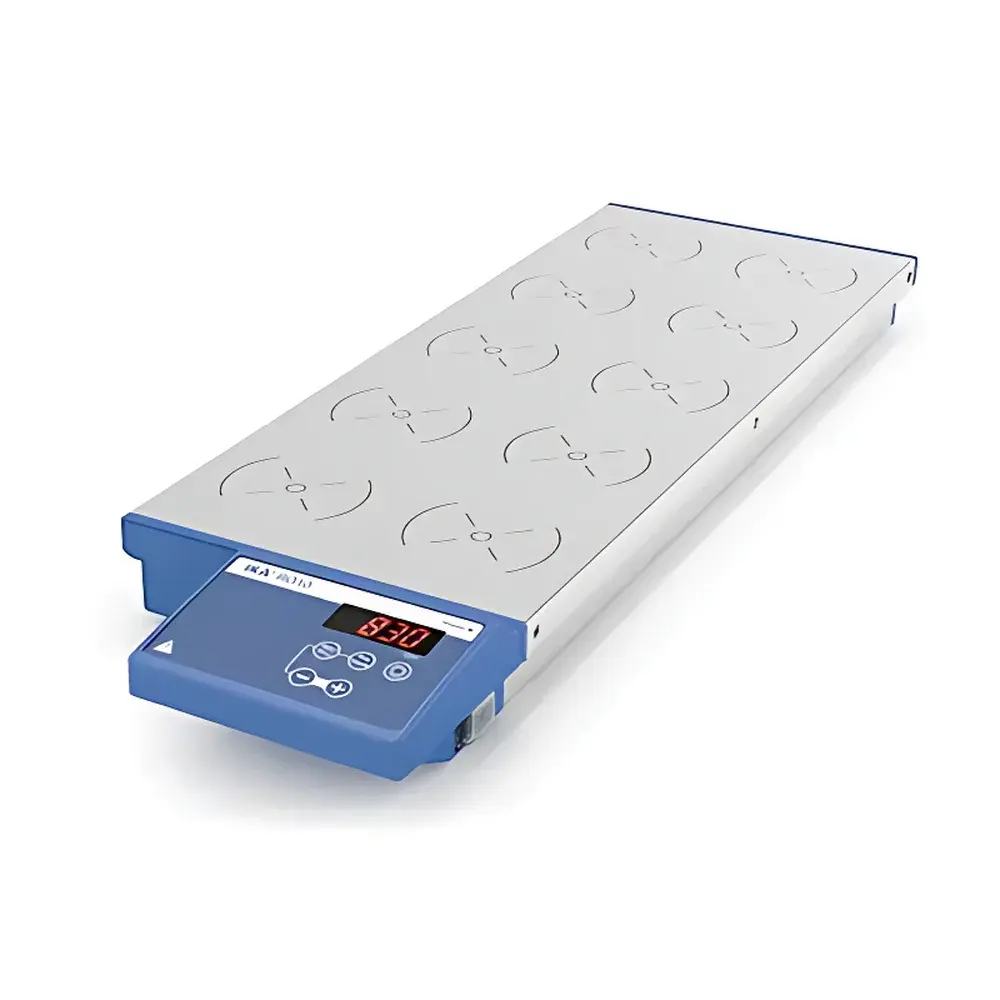
IKA RO 10 Multi-Point Magnetic Stirrer
| Brand | IKA |
|---|---|
| Origin | Germany |
| Manufacturer | IKA-Werke GmbH & Co. KG |
| Product Type | Magnetic Stirrer |
| Model | RO 10 |
| Max. Stirring Volume per Position | 0.4 L (H₂O) |
| Total Max. Capacity | 4 L (10 positions × 0.4 L) |
| Speed Range | 0–1200 rpm |
| Speed Resolution | 10 rpm steps |
| Stirring Points | 10 |
| Inter-point Spacing | 90 mm |
| Speed Deviation per Position | ±0% (synchronized control) |
| Stir Bar Length Compatibility | 25–30 mm |
| Plate Material | Stainless Steel 1.4301 (AISI 304 equivalent) |
| Plate Dimensions | 190 × 470 mm |
| Overall Dimensions | 190 × 60 × 570 mm (W × H × D) |
| Weight | 5 kg |
| Ambient Operating Conditions | 5–40 °C, ≤80% RH |
| Ingress Protection | IP40 (DIN EN 60529) |
| Power Supply | 100–240 V AC, 50/60 Hz |
| Input Power | 25 W |
| DC Output | 24 V =, 1000 mA |
Overview
The IKA RO 10 Multi-Point Magnetic Stirrer is an engineered solution for high-throughput laboratory environments requiring precise, synchronized, and maintenance-free agitation across ten independent positions. Designed and manufactured in Staufen, Germany, the RO 10 operates on contactless magnetic coupling—utilizing a proprietary non-wearing coil architecture that eliminates mechanical wear, audible vibration, and electromagnetic noise typically associated with conventional stirrer motors. Unlike single-position or analog multi-stirrers, the RO 10 delivers true digital synchronization: all ten stirring points maintain identical rotational speed within ±0% deviation—even under dynamic load changes—ensuring experimental reproducibility across parallel sample sets. Its compact, sealed housing (IP40-rated per DIN EN 60529) prevents liquid ingress into internal electronics, supporting compliance with GLP-aligned lab hygiene protocols. The absence of integrated heating distinguishes the RO 10 as a dedicated agitation platform—ideal for temperature-sensitive applications where thermal stability is externally controlled.
Key Features
- Digital 10-point synchronization with zero-speed deviation between positions, enabling statistically valid parallel experiments.
- Non-wearing magnetic drive system delivering silent, continuous operation over extended duty cycles—no brush degradation or coil fatigue.
- Touch-sensitive control panel with real-time error code display (e.g., overload, communication fault, sensor timeout) for rapid troubleshooting.
- Adjustable forward/reverse rotation mode to prevent vortex collapse or sediment re-agglomeration in viscous or particulate suspensions.
- Stainless steel 1.4301 (AISI 304) stirring plate—chemically resistant, non-magnetic, and compatible with routine decontamination protocols including ethanol wipe-downs and mild alkaline cleaning agents.
- Removable transparent anti-slip mat providing positional stability for vessels while permitting visual monitoring of stir bar motion and sample homogeneity.
- Energy-efficient design: 25 W nominal input power with regulated 24 V DC output ensures stable torque delivery without thermal drift.
Sample Compatibility & Compliance
The RO 10 accommodates standard laboratory glassware (e.g., beakers, flasks, vials) up to 400 mL per position, with optimal performance observed using PTFE- or glass-coated stir bars sized 25–30 mm. Its fixed 90 mm inter-point spacing aligns with common rack-based workflows and modular benchtop layouts. As a Class I electrical appliance conforming to IEC 61010-1, the device meets essential safety requirements for laboratory use—including dielectric strength, creepage distance, and protective earthing. While not certified for hazardous area operation (e.g., ATEX), its IP40 enclosure provides adequate protection against solid objects ≥1 mm and vertically falling droplets—suitable for general-purpose wet labs. The unit supports audit-ready documentation practices: all operational parameters (speed, direction, runtime) are locally retained and can be logged externally via optional RS232 interface (not included).
Software & Data Management
The RO 10 operates as a standalone instrument with no embedded software stack or network connectivity. All configuration and status data reside locally on the device’s microcontroller; no firmware updates, cloud dependencies, or proprietary drivers are required. For laboratories implementing electronic lab notebooks (ELNs) or LIMS integration, the optional RS232 port (available via accessory kit) enables ASCII-based command/response communication for speed setpoint transmission, status polling (e.g., “RUN”, “STOP”, “ERR”), and basic event logging. This architecture aligns with FDA 21 CFR Part 11 principles for traceability when paired with validated third-party middleware—supporting signature-captured parameter recording and immutable audit trails during GxP-regulated processes.
Applications
- Parallel dissolution testing in pharmaceutical QC labs (e.g., USP compliance verification across 10 vessels).
- High-throughput buffer equilibration for chromatography column preparation.
- Synchronized pH adjustment or titrant addition in multi-vessel enzymatic assays.
- Cell culture media mixing prior to sterile filtration—minimizing shear-induced protein denaturation via low-noise, consistent agitation.
- Standardization of suspension homogeneity in nanoparticle dispersion studies prior to DLS or TEM analysis.
- Environmental water sample agitation for heavy metal extraction protocols (EPA Method 3050B).
FAQ
Does the RO 10 support external temperature monitoring or feedback control?
No. The RO 10 is a non-heating stirrer; it lacks integrated temperature sensors or PID loops. Temperature regulation must be performed externally (e.g., using a recirculating chiller or environmental chamber).
Can the stirring speed be individually adjusted per position?
No. All ten positions operate at the same digitally set speed—this synchronization is fundamental to the RO 10’s design for comparative experimentation.
Is the transparent anti-slip mat autoclavable?
No. The mat is made from food-grade polymer rated for ambient-temperature chemical resistance only; autoclaving will deform it. Wipe cleaning with 70% isopropanol is recommended.
What stir bar geometries are validated for use with the RO 10?
Cross-shaped and oval stir bars (25–30 mm length, ≤8 mm diameter) demonstrate optimal centering and torque transfer. Avoid cylindrical bars longer than 30 mm due to resonance risk at >800 rpm.
Does the RO 10 comply with ISO/IEC 17025 calibration requirements?
While the device itself is not a measuring instrument, its speed accuracy (±10 rpm tolerance per step) is factory-verified per IKA’s internal metrology procedure. External calibration using a traceable tachometer is recommended annually for accredited labs.



