
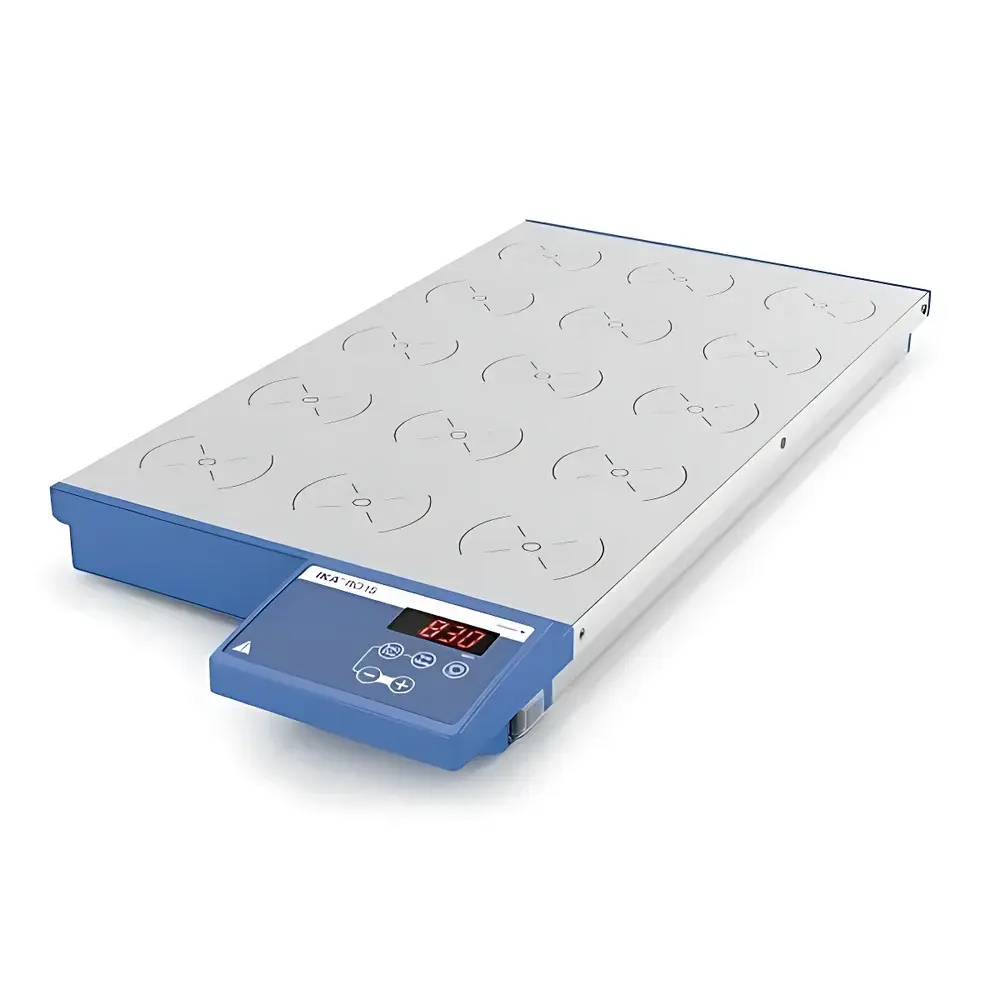
IKA RO 15 Digital Multi-Position Magnetic Stirrer
| Brand | IKA |
|---|---|
| Origin | Germany |
| Model | RO 15 |
| Stirring Positions | 15 |
| Position Spacing | 90 mm |
| Speed Range | 0–1200 rpm |
| Speed Resolution | 10 rpm steps |
| Speed Stability | ±0% deviation per position under load |
| Max. Stirring Volume (H₂O) | 0.4 L per position |
| Stir Bar Length Compatibility | 25–30 mm |
| Plate Material | Stainless Steel 1.4301 (AISI 304) |
| Plate Dimensions | 280 × 470 mm |
| Device Dimensions (W × H × D) | 280 × 60 × 570 mm |
| Weight | 8.627 kg |
| Ambient Operating Temperature | 5–40 °C |
| Relative Humidity Limit | ≤80 % RH (non-condensing) |
| Ingress Protection | IP40 (DIN EN 60529) |
| Input Voltage | 100–240 V AC, 50/60 Hz |
| Power Consumption | 40 W |
| DC Supply | 24 V =, 1500 mA |
| Control Interface | Touch-sensitive keypad with alphanumeric error code display |
| Rotation Direction | Adjustable forward/reverse |
| Drive Technology | Contactless, wear-free magnetic coil array |
| Additional Features | Removable transparent anti-slip mat, compact sealed housing for liquid splash resistance, continuous-duty rated |
Overview
The IKA RO 15 is a high-precision, 15-position digital magnetic stirrer engineered for reproducible, synchronized agitation across multiple samples in parallel laboratory workflows. Unlike conventional single-station stirrers or mechanically coupled multi-point systems, the RO 15 employs a proprietary contactless magnetic drive architecture—comprising 15 independently energized, low-noise magnetic coils embedded beneath a seamless stainless-steel work surface. This design eliminates mechanical wear, electromagnetic interference between positions, and speed drift under variable load conditions. Each stirring point maintains exact rotational fidelity (0% speed deviation) across its full 0–1200 rpm range, enabling rigorous method standardization in applications requiring inter-sample comparability—such as reagent preparation, buffer equilibration, enzymatic reaction setup, and quality control batch testing. The unit operates without heating functionality, prioritizing thermal stability and minimizing convective artifacts in temperature-sensitive protocols.
Key Features
- 15 independent stirring positions with uniform 90 mm center-to-center spacing—optimized for compatibility with standard microtiter plates, test tubes, and 50 mL centrifuge tubes.
- True digital speed control with 10 rpm resolution and real-time feedback stabilization, ensuring consistent shear input regardless of viscosity changes or stir bar alignment.
- Sealed, low-profile housing (IP40-rated) constructed from corrosion-resistant stainless steel 1.4301 (equivalent to AISI 304), facilitating rapid wipe-down and resistance to incidental liquid ingress during routine lab use.
- Integrated touch keypad with intuitive icon-based navigation and alphanumeric error code display (e.g., E01 for overload, E02 for sensor fault), supporting rapid troubleshooting without service intervention.
- Reversible rotation mode programmable per session—critical for preventing vortex collapse in low-volume samples or promoting homogeneous suspension of dense particulates.
- Included removable transparent anti-slip mat provides secure sample vessel positioning while permitting visual monitoring of stir bar motion and bubble formation.
Sample Compatibility & Compliance
The RO 15 accommodates common laboratory vessels up to 0.4 L volume per position when using stir bars sized 25–30 mm in length. Its non-heating configuration ensures compliance with environments where exothermic reactions, thermolabile compounds, or strict ambient temperature control are required—such as GLP-regulated stability studies or ISO/IEC 17025-accredited calibration labs. The device meets DIN EN 60529 (IP40) for protection against solid objects ≥1 mm and splashing water, and conforms to IEC 61010-1:2010 for electrical safety in laboratory equipment. While not certified for cleanroom use (ISO 14644), its sealed construction and absence of moving external parts minimize particle generation—making it suitable for Class D and lower controlled environments.
Software & Data Management
The RO 15 operates as a standalone instrument with no embedded data logging or PC connectivity. All operational parameters—including set speed, direction, runtime, and fault history—are retained locally via non-volatile memory and accessible through the front-panel interface. For laboratories requiring audit trails under FDA 21 CFR Part 11 or EU Annex 11, external validation protocols must be implemented using calibrated tachometers and documented user training records. The unit supports integration into broader lab infrastructure via manual SOP linkage; its consistent performance profile enables straightforward inclusion in analytical method validation packages (e.g., ICH Q2(R2)) for sample homogenization steps.
Applications
- High-throughput reagent and standard solution preparation across QC/QA labs.
- Synchronized agitation of biological samples (e.g., cell suspensions, antibody dilutions) prior to spectrophotometric or ELISA analysis.
- Controlled mixing in environmental testing workflows—e.g., soil leachate extraction, wastewater homogenization per EPA Method 1311.
- Pharmaceutical pre-formulation studies involving solubility screening or crystallization induction under constant agitation.
- Academic teaching labs requiring robust, maintenance-free multi-vessel stirring for undergraduate chemistry and biochemistry curricula.
FAQ
Does the RO 15 support external timer or PC-based control?
No—the RO 15 is a manually operated, stand-alone instrument with no RS-232, USB, or Ethernet interfaces. Timing must be managed externally using laboratory timers or process logs.
Can it accommodate stir bars longer than 30 mm?
Stir bar lengths exceeding 30 mm may cause mechanical interference with adjacent positions due to the fixed 90 mm spacing; optimal performance is guaranteed only within the specified 25–30 mm range.
Is the stainless-steel plate resistant to strong acids or bases?
The 1.4301 stainless steel surface offers good resistance to diluted organic solvents and mild aqueous solutions, but prolonged exposure to concentrated HCl, HNO₃, or NaOH is not recommended without immediate rinsing and drying.
What maintenance is required for long-term reliability?
No scheduled maintenance is needed. Routine cleaning with ethanol or isopropanol and periodic inspection of the anti-slip mat for wear constitute best practices. The wear-free magnetic drive eliminates bearing or gear servicing.
How is speed accuracy verified during IQ/OQ qualification?
Speed verification requires a traceable optical tachometer (e.g., NIST-calibrated) measuring actual rpm at each position under defined load conditions (e.g., 50 mL water + 30 mm stir bar); deviations must remain within ±1 rpm of setpoint across the operating range.



