
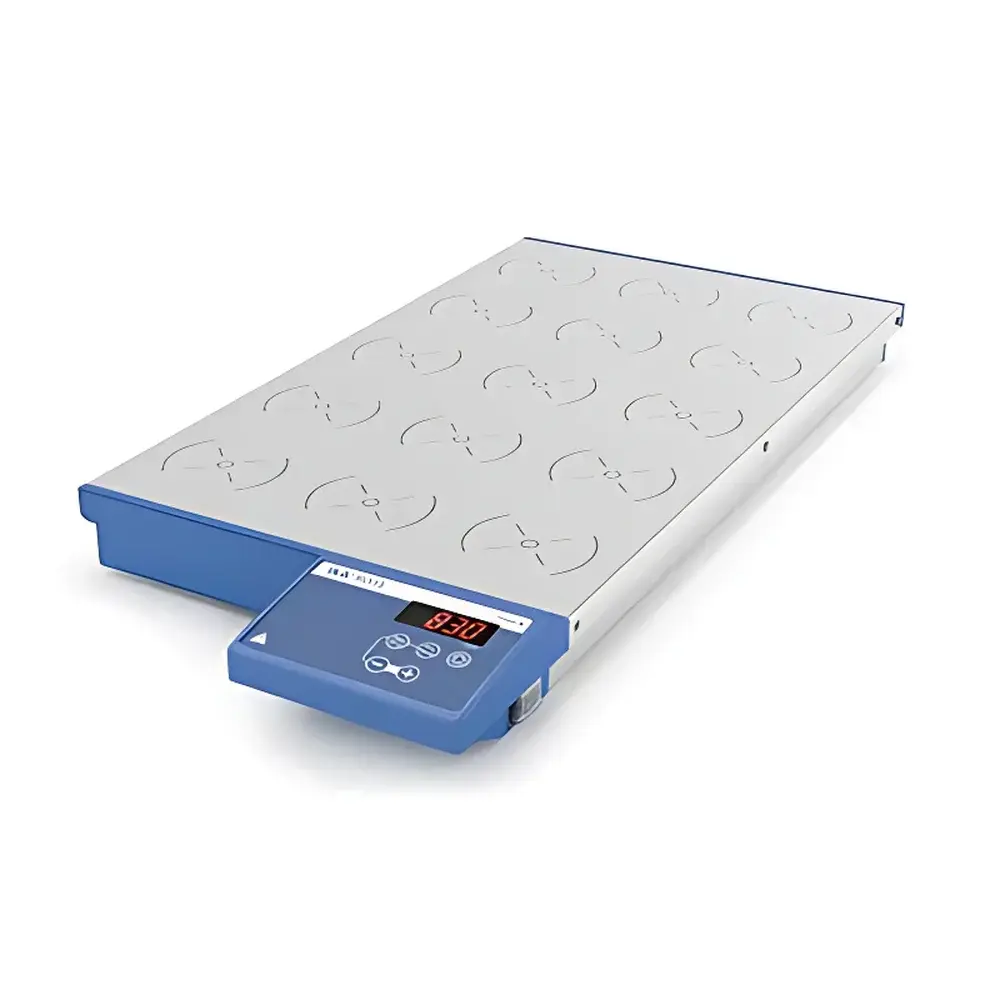
IKA RO 15 Multi-Point Magnetic Stirrer
| Brand | IKA |
|---|---|
| Origin | Germany |
| Manufacturer | IKA Werke GmbH & Co. KG |
| Type | Magnetic Stirrer |
| Model | RO 15 |
| Max. Stirring Volume (per position) | 0.4 L |
| Total Max. Stirring Capacity | 6 L |
| Speed Range | 0–1200 rpm |
| Speed Resolution | 10 rpm steps |
| Number of Stirring Positions | 15 |
| Position Spacing | 90 mm |
| Speed Deviation per Position | 0 % |
| Stir Bar Length Compatibility | 25–30 mm |
| Plate Material | Stainless Steel 1.4301 |
| Plate Dimensions | 280 × 470 mm |
| Device Dimensions (W×H×D) | 280 × 60 × 570 mm |
| Weight | 8.627 kg |
| Ambient Operating Temperature | 5–40 °C |
| Relative Humidity Limit | ≤80 % (non-condensing) |
| Protection Class | IP40 (DIN EN 60529) |
| Power Supply | 100–240 V AC, 50/60 Hz |
| Input Power | 40 W |
| DC Output | 24 V =, 1500 mA |
Overview
The IKA RO 15 Multi-Point Magnetic Stirrer is an engineered solution for high-throughput laboratory environments requiring precise, synchronized, and maintenance-free agitation across multiple samples. Designed and manufactured in Staufen, Germany, the RO 15 operates on contactless magnetic coupling—utilizing a patented wear-free coil system that eliminates mechanical brushes, gear trains, or rotating shafts. This architecture ensures silent, vibration-minimized operation and exceptional long-term speed stability—even under variable load conditions. Unlike conventional multi-stirrers relying on shared motor torque distribution, the RO 15 employs a distributed electromagnetic field generated by 15 individually optimized coil segments beneath a single stainless-steel work surface. Each position delivers independent, drift-free rotational control without cross-talk or speed deviation (0 % positional variance), enabling true parallel processing for applications such as buffer preparation, cell culture media conditioning, ELISA plate pre-mixing, and reagent batch homogenization.
Key Features
- 15 independently controlled stirring positions with uniform magnetic field strength and zero inter-position speed deviation
- Brushless, wear-free coil technology ensures silent, maintenance-free continuous operation (>20,000 hr MTBF)
- Touch-sensitive membrane keypad with intuitive icon-based navigation and real-time error code display (e.g., overload, sensor fault, thermal warning)
- Programmable bidirectional stirring (forward/reverse) with adjustable dwell time—critical for preventing sedimentation in viscous or particulate-laden suspensions
- IP40-rated enclosure with sealed electronics and sloped, seamless stainless-steel plate (1.4301) to prevent liquid ingress and facilitate rapid decontamination
- Integrated non-slip transparent polymer mat (removable and autoclavable) for secure vessel placement and enhanced positional stability
- Universal power input (100–240 V AC, 50/60 Hz) with internal 24 V DC regulation—optimized for global lab infrastructure and EMI-resilient performance
Sample Compatibility & Compliance
The RO 15 accommodates standard laboratory vessels including glass beakers (50–400 mL), polypropylene tubes (15–50 mL), and multi-well plates (6–96-well format), provided compatible stir bars (25–30 mm length, PTFE- or glass-coated) are used. Its fixed-speed-per-position architecture avoids torque competition between vessels, ensuring reproducible mixing kinetics across all 15 points. The device complies with DIN EN 60529 (IP40), IEC 61010-1 (Safety Requirements for Electrical Equipment for Measurement, Control, and Laboratory Use), and EU Directive 2014/30/EU (EMC Directive). While not equipped with heating elements, its non-thermal design meets strict requirements for temperature-sensitive workflows—including cold-chain sample prep, enzymatic assays, and RNA handling—where exogenous heat introduction must be avoided.
Software & Data Management
The RO 15 operates as a standalone instrument with no proprietary software dependency. All operational parameters—including speed setpoint, direction mode, and runtime—are configured locally via tactile touch controls and retained in non-volatile memory after power cycling. Error states (e.g., “E03: Overload”, “E07: Sensor Fault”) are displayed numerically for rapid troubleshooting and logbook documentation. For laboratories operating under GLP or GMP frameworks, the device supports manual audit trail generation through dated operator logs; optional integration with LabVantage or STARLIMS via digital I/O (0–10 V analog output or relay contact closure) enables basic status monitoring in centralized asset management systems. No FDA 21 CFR Part 11 compliance is applicable, as the unit lacks electronic record creation or user authentication capabilities.
Applications
- High-volume buffer and diluent preparation across QC/QA labs (e.g., PBS, Tris-HCl, saline solutions)
- Synchronized agitation of replicate biological samples during incubation—minimizing inter-sample variability in microbiology and immunoassay workflows
- Pre-analytical mixing of clinical specimens prior to centrifugation or automated analyzer loading
- Uniform dispersion of nanoparticles, liposomes, or polymer emulsions in formulation development
- Stirring of low-viscosity solvents and aqueous solutions in synthetic chemistry screening platforms
- Supporting ISO 17025-accredited testing where equipment calibration records and performance verification (e.g., speed accuracy ±2 rpm at 600 rpm) are maintained per internal SOP
FAQ
Does the RO 15 support temperature control or heating functionality?
No. The RO 15 is a non-heating magnetic stirrer. It is specifically engineered for isothermal mixing applications where thermal input would compromise sample integrity.
What is the maximum recommended viscosity for stable operation at full speed?
The RO 15 maintains rated speed (0–1200 rpm) with aqueous solutions up to ≈15 mPa·s (e.g., 1% CMC or 0.5% agarose). For higher viscosities, speed stability is preserved, though torque-limited stirring may occur above 50 mPa·s depending on vessel geometry and stir bar efficiency.
Can the RO 15 be validated for use in regulated pharmaceutical environments?
Yes—as a Class A laboratory device per ISO/IEC 17025, it supports IQ/OQ protocols. Calibration of speed accuracy (traceable to NIST standards) and verification of positional uniformity are performed using optical tachometry and certified reference stir bars.
Is the stainless-steel work surface resistant to common laboratory solvents?
The 1.4301 (AISI 304) plate exhibits excellent resistance to diluted acids, alkalis, alcohols, and halogenated solvents. Prolonged exposure to concentrated HCl, HNO₃, or hypochlorite solutions is not recommended.
How is cleaning and decontamination performed between runs?
Wipe the plate surface with 70% ethanol or isopropanol; the sealed housing and sloped edges prevent fluid accumulation. The removable anti-slip mat may be autoclaved at 121 °C for 20 min.



