
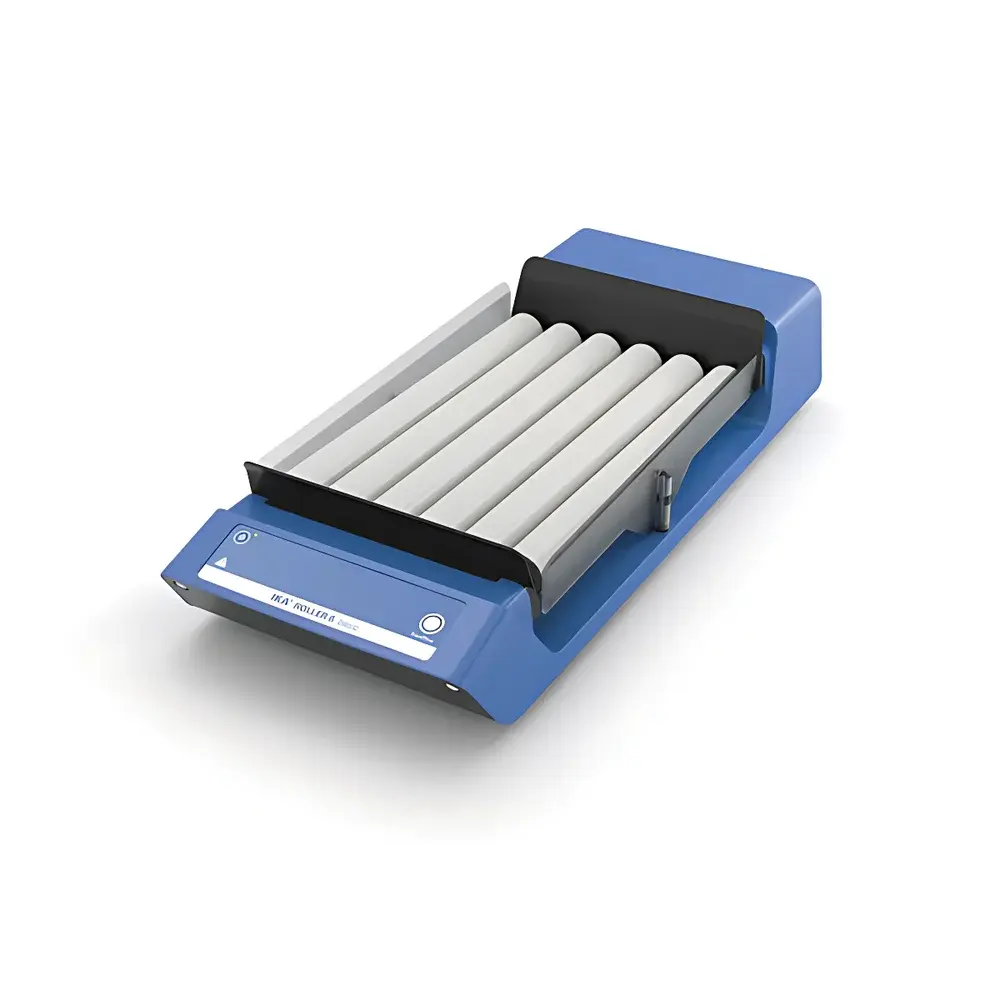
IKA ROLLER 6 basic 6-Axis Rolling Mixer
| Brand | IKA |
|---|---|
| Origin | Germany |
| Manufacturer Type | Manufacturer |
| Origin Category | Imported |
| Model | ROLLER 6 basic |
| Instrument Type | Mixing & Homogenization Equipment |
| Oscillation Angle | 3° |
| Number of Rolling Axes | 6 |
| Operating Temperature Range | 4–50 °C |
| Roll Diameter | 32 mm |
| Roll Length | 327 mm |
| Platform Length | 350 mm |
| Tilt Angle (Fixed) | 3° |
| End-Stroke per Axis | 16 mm |
| Replaceable & Detachable Rolls | Yes |
| Dimensions (W × H × D) | 240 × 115 × 545 mm |
| Weight | 4.563 kg |
| Ambient Temperature Range | 4–50 °C |
| Relative Humidity Limit | 80 % |
| Ingress Protection | IP21 (DIN EN 60529) |
| Input Voltage | 100–240 V AC |
| Frequency | 50/60 Hz |
| Power Consumption | 24 W |
| DC Supply | 24 V = |
| Current Draw | 1000 mA |
| Fixed Speed | 30 rpm |
| Continuous Duty Cycle | 100 % |
| Roll Mounting | Quick-release clamping mechanism |
Overview
The IKA ROLLER 6 basic is a precision-engineered 6-axis rolling mixer designed for gentle, consistent, and contamination-minimized homogenization of sensitive biological samples. Unlike orbital shakers or vortex mixers, this instrument employs a controlled rocking-and-flipping motion—defined by a fixed 3° tilt angle and synchronized 30 rpm rotation—optimized to maintain sample integrity during prolonged incubation-compatible operation. Its mechanical architecture follows the Couette-type rolling principle: cylindrical vessels are secured between parallel, independently mounted rollers that rotate in unison while maintaining constant angular displacement. This motion generates laminar shear profiles ideal for resuspending sedimented cells, rehydrating lyophilized reagents, or homogenizing viscous matrices without foaming or aerosol generation. The device is explicitly engineered for uninterrupted use inside environmental chambers (4–50 °C), making it suitable for applications requiring temperature-stable mixing during enzymatic assays, antigen-antibody incubations, or blood bank sample preparation.
Key Features
- Six independently mounted, quick-release rollers (Ø32 mm × 327 mm) with tool-free detachability for rapid cleaning and sterilization compliance.
- Fixed 30 rpm rotational speed ensures reproducible mixing kinetics across experiments—eliminating variability from manual speed adjustment or timer drift.
- Optimized 3° pitch angle balances gravitational sedimentation control with low-shear fluid dynamics, minimizing cell lysis in whole-blood or PBMC suspensions.
- IP21-rated enclosure (DIN EN 60529) provides protection against vertically falling drips and solid objects >12.5 mm—enabling safe deployment in humid incubator environments or shared core facilities.
- Universal roller compatibility accommodates standard round-bottom tubes (12–50 mL), culture bottles (up to 250 mL), and conical centrifuge tubes without adapter kits.
- Low-power 24 W DC-driven motor enables stable long-term operation with minimal thermal load—critical for maintaining chamber setpoints during multi-hour protocols.
Sample Compatibility & Compliance
The ROLLER 6 basic supports routine handling of clinical, diagnostic, and research-grade specimens including anticoagulated whole blood, serum/plasma aliquots, bacterial culture broths, agarose gels in casting trays, and high-viscosity polymer solutions. Its non-vibrational rolling action avoids particle aggregation in nanoparticle suspensions or antibody-conjugated beads. From a regulatory standpoint, the device meets essential safety requirements under IEC 61010-1 for laboratory equipment and conforms to electromagnetic compatibility standards (IEC 61326-1). While not inherently 21 CFR Part 11-compliant (as it lacks digital logging or user authentication), its mechanical simplicity supports GLP-aligned documentation when integrated into validated workflows—e.g., as a fixed-parameter step in ISO 15189-accredited clinical lab SOPs for hematology sample preparation.
Software & Data Management
The ROLLER 6 basic operates as a standalone electromechanical system with no embedded microprocessor, touchscreen interface, or data output capability. All operational parameters—including fixed 30 rpm speed, continuous duty cycle, and 3° tilt geometry—are mechanically preset at manufacture. This design philosophy prioritizes functional reliability over digital complexity: no firmware updates, no calibration certificates, and zero risk of software-induced timing errors. For laboratories requiring audit trails, integration is achieved externally via environmental chamber loggers or time-stamped video monitoring systems. The absence of programmable timers or variable-speed controls aligns with ISO/IEC 17025 clause 6.4.10 on equipment suitability—ensuring traceability through physical configuration rather than digital configuration management.
Applications
- Clinical diagnostics: Gentle inversion of EDTA-anticoagulated blood tubes prior to automated hematology analyzers to prevent platelet satellitism or fibrin strand formation.
- Biobanking: Uniform resuspension of cryopreserved cell pellets post-thaw without mechanical stress-induced apoptosis markers.
- Immunology: Incubation-mixing of ELISA plates sealed with adhesive films to enhance antigen-antibody binding kinetics while preventing edge effects.
- Microbiology: Homogenization of viscous sputum or stool suspensions for downstream nucleic acid extraction—reducing clogging in automated liquid handlers.
- Quality control: Standardized mixing of reference standards and calibrators in ISO 17511-compliant assay validation protocols.
FAQ
Does the ROLLER 6 basic support programmable speed or timing control?
No. It operates exclusively at a fixed 30 rpm with continuous duty cycle—designed for protocol reproducibility, not flexibility.
Can it be used inside a CO₂ incubator?
Yes, provided the internal ambient conditions remain within 4–50 °C and relative humidity ≤80 %. Verify chamber ventilation does not exceed IP21 ingress limits.
Are replacement rollers available as spare parts?
Yes. IKA supplies OEM roller assemblies (Order No. 0000101234) with identical 32 mm diameter and 327 mm length specifications.
What tube sizes are compatible without adapters?
Standard round-bottom tubes (12–50 mL), 100–250 mL glass or PETG culture bottles, and 15–50 mL conical centrifuge tubes—secured via friction-fit clamping.
Is electrical certification provided for global laboratory use?
Yes. The unit carries CE marking (EU Directive 2014/30/EU EMC & 2014/35/EU LVD) and complies with UL 61010-1 for North American markets upon import registration.





