
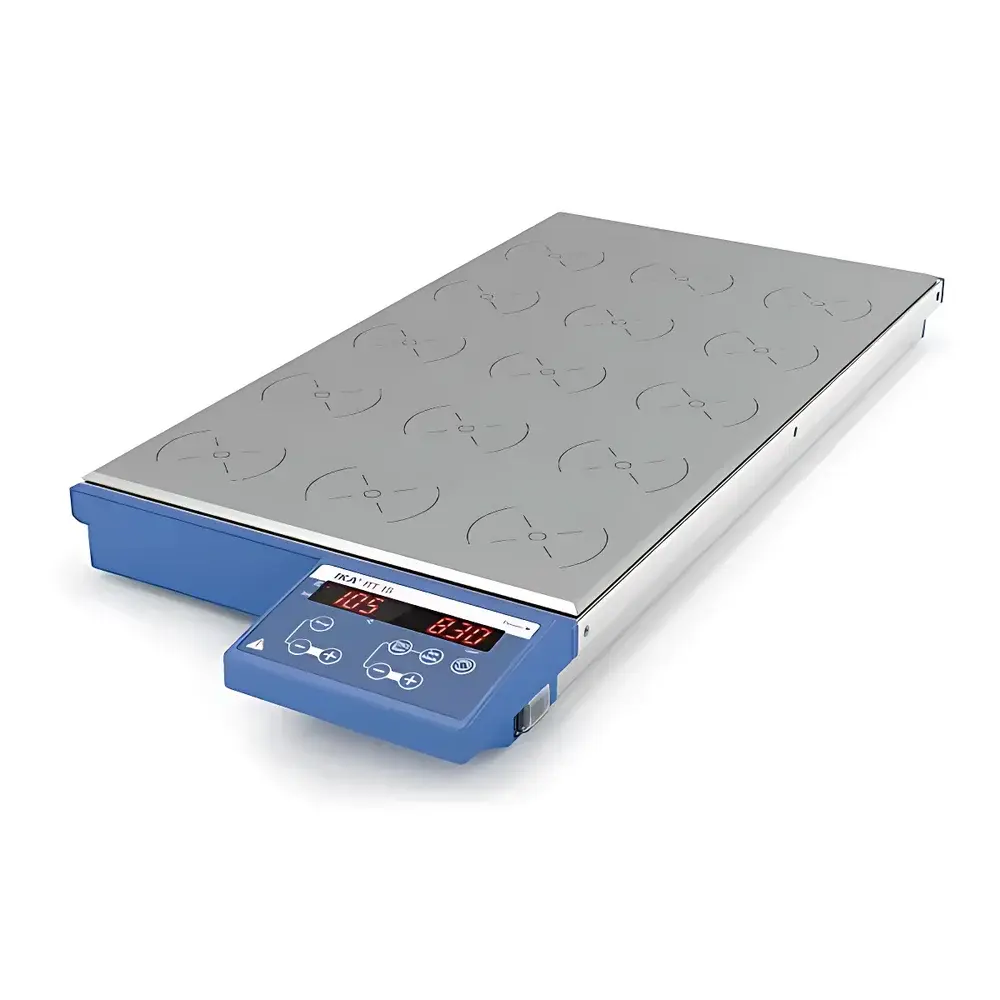
IKA RT 15 Multi-Point Digital Heating Magnetic Stirrer
| Brand | IKA |
|---|---|
| Origin | Germany |
| Model | RT 15 |
| Speed Range | 0–1000 rpm (in 10 rpm increments) |
| Max. Stirring Volume (H₂O) | 0.4 L per position |
| Number of Stirring Positions | 15 |
| Position Spacing | 90 mm |
| Stirrer Bar Length Compatibility | 25–30 mm |
| Heating Power Output | 580 W |
| Heating Temperature Range | Ambient to 120 °C |
| Heating Rate | 3 K/min |
| Adjustable Safety Temperature Limit | 50–150 °C |
| Plate Material | Anodized Aluminum |
| Plate Dimensions | 270 × 495 mm |
| Overall Dimensions | 280 × 60 × 610 mm |
| Weight | 10.5 kg |
| Ambient Operating Conditions | 5–40 °C, ≤80 % RH |
| Protection Class | IP 40 (DIN EN 60529) |
| Supply Voltage | 230 V, 50/60 Hz |
| Input Power | 620 W |
| Fuse | 1× T6.3A, 250 V |
| Control Interface | Touch-sensitive keypad with LED temperature display |
| Rotation Direction | Forward/reverse selectable |
| Operation Mode | Continuous duty cycle |
| Speed stability | ±0 % deviation under load variation |
Overview
The IKA RT 15 is a precision-engineered, 15-position digital heating magnetic stirrer designed for high-throughput laboratory workflows requiring simultaneous, independent thermal and mechanical control across multiple samples. Utilizing robust copper coil-based magnetic drive technology—free of mechanical wear or brush contact—the instrument delivers silent, maintenance-free operation with exceptional torque consistency across all positions. Each stirring point operates with zero speed deviation (<±0.0 rpm) even under dynamic load changes, ensuring reproducible mixing performance critical for kinetic studies, dissolution testing, reagent preparation, and parallel synthesis protocols. The anodized aluminum heating plate provides uniform thermal distribution (±1.5 °C across surface at 100 °C), with fine-resolution temperature control (0.1 °C resolution, LED-displayed) up to 120 °C. While the plate surface reaches 120 °C, achievable sample temperatures depend on vessel geometry, material, and volume; typical aqueous solutions in standard glass beakers reach up to 70 °C under optimized conditions. Its compact footprint (280 × 610 mm) and low-profile design (60 mm height) facilitate integration into fume hoods, laminar flow cabinets, or crowded benchtop environments.
Key Features
- 15 independently controllable stirring positions spaced precisely at 90 mm intervals for standardized multi-vessel alignment
- True constant-speed regulation: no speed drift under variable viscosity or mass loading—validated per DIN 12878 requirements for reproducibility
- Dual-mode rotation control: forward and reverse direction selection supports particle suspension, homogenization, and anti-settling applications
- Intelligent heating architecture: programmable safety cutoff (50–150 °C), auto-low-power preheating, and real-time error-code diagnostics (e.g., E1 = overtemperature, E2 = sensor fault)
- Touch-sensitive membrane keypad with tactile feedback and LED status indicators—designed for glove-compatible operation and long-term reliability
- Energy-efficient continuous-duty design: optimized thermal inertia and power modulation reduce standby consumption by >40% versus legacy analog systems
- IP 40-rated enclosure ensures protection against solid objects ≥1 mm and limited vertical water drip—compliant with general laboratory environmental specifications (IEC 60529)
Sample Compatibility & Compliance
The RT 15 accommodates standard laboratory vessels including 10–100 mL glass beakers, test tubes, and round-bottom flasks. Compatible stir bars range from 25 to 30 mm in length and are optimized for medium-viscosity aqueous and organic media (up to ~500 mPa·s). The unit meets essential electrical safety and electromagnetic compatibility standards: EN 61010-1 (Safety Requirements for Electrical Equipment for Measurement, Control, and Laboratory Use), EN 61326-1 (EMC for Laboratory Instruments), and RoHS 2011/65/EU. It is suitable for use in GLP-compliant environments where documented operational parameters (speed, temperature, duration) are maintained manually or via external logging; while the device itself does not feature FDA 21 CFR Part 11-compliant audit trails, its stable output enables traceable process execution when paired with validated SOPs and external data capture systems.
Software & Data Management
The RT 15 operates as a standalone, embedded-control instrument without proprietary software dependency. All settings—including speed (0–1000 rpm in 10-rpm increments), plate temperature (ambient to 120 °C), safety limit, and rotation direction—are configured directly via the front-panel interface. No drivers, USB connections, or cloud services are required. For laboratories implementing digital lab notebooks (ELN) or LIMS integration, the device’s deterministic behavior (e.g., fixed ramp rates, repeatable setpoint accuracy, error-state transparency) supports manual entry validation. Optional external PT100 probes (not included) may be used for independent sample temperature verification during method development.
Applications
- High-throughput buffer and media preparation in molecular biology and cell culture labs
- Parallel dissolution testing of pharmaceutical formulations under USP and Ph. Eur. 2.9.3 guidelines
- Controlled heating and agitation during catalyst screening and small-molecule synthesis
- Standardized sample conditioning prior to spectroscopic, chromatographic, or rheological analysis
- Quality control workflows requiring identical thermal-mechanical treatment across replicate samples (e.g., ASTM D2196 viscosity prep)
- Teaching laboratories emphasizing reproducible experimental technique and parameter documentation
FAQ
Can the RT 15 be used with non-aqueous solvents such as ethanol or acetone?
Yes—provided the vessel is chemically compatible and stir bar coating (e.g., PTFE or glass-coated) resists solvent degradation. Avoid prolonged exposure above 60 °C with low-boiling solvents due to evaporation and vapor pressure risks.
Is the heating plate surface temperature the same as the sample temperature?
No. Plate temperature reflects surface thermistor reading. Sample temperature depends on thermal conductivity, vessel wall thickness, fill level, and ambient draft. Empirical calibration with a calibrated probe is recommended for critical thermal protocols.
Does the RT 15 support external temperature probe feedback control?
No—the unit uses only internal plate-sensor feedback. For closed-loop sample temperature control, external PID controllers with compatible analog outputs must be integrated separately.
What is the expected service life of the magnetic drive system?
The solid-state coil design has no moving parts or consumables. With proper ventilation and adherence to ambient operating limits (5–40 °C, ≤80 % RH), mean time between failures exceeds 20,000 hours under continuous operation.
Can the RT 15 be stacked or mounted under a shelf?
No—its rear ventilation grilles require unobstructed airflow. Minimum clearance of 10 cm on all sides, especially rear and top, is mandatory to prevent thermal shutdown or component derating.



