
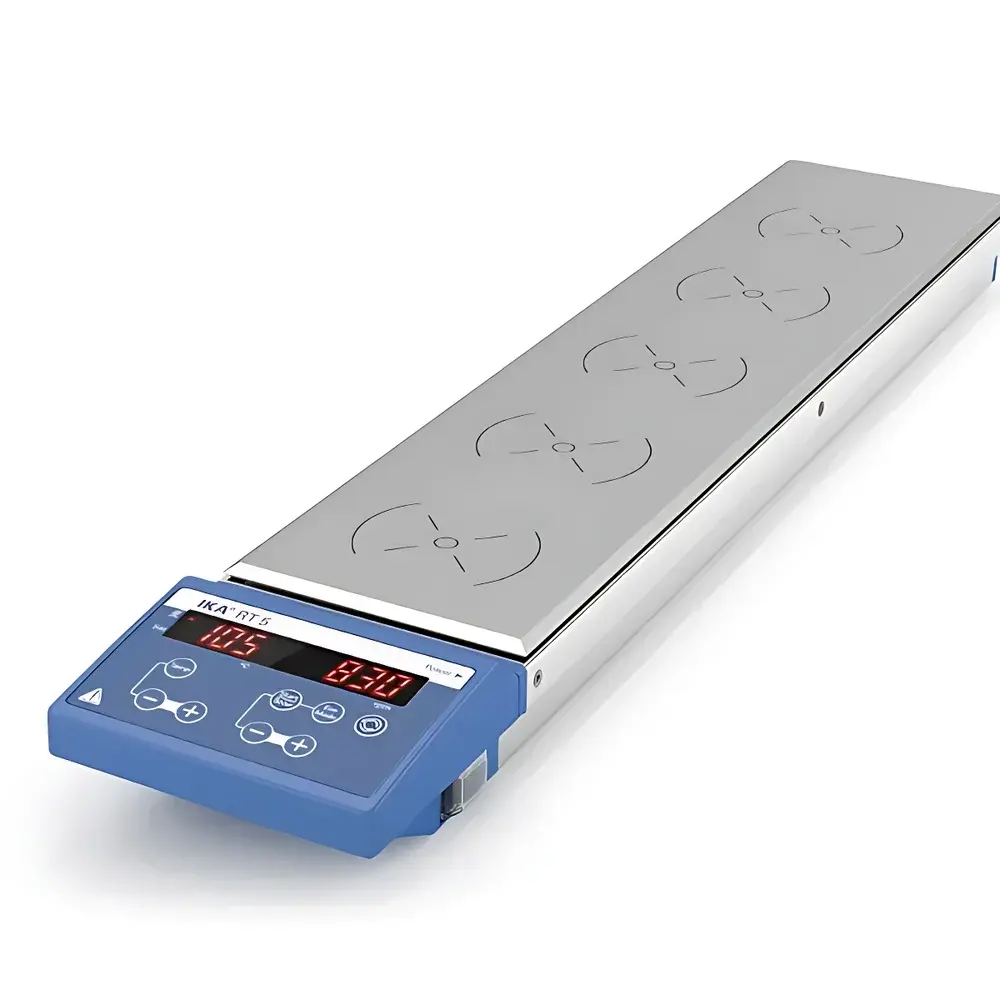
IKA RT 5 Five-Position Digital Heating Magnetic Stirrer
| Brand | IKA |
|---|---|
| Origin | Germany |
| Model | RT 5 |
| Speed Range | 0–1000 rpm (10 rpm increments) |
| Max. Stirring Volume (H₂O) | 0.4 L per position |
| Stir Bar Length Compatibility | 25–30 mm |
| Heating Power Output | 175 W |
| Heating Temperature Range | Ambient to 120 °C |
| Heating Rate | 3 K/min |
| Adjustable Safety Temperature Limit | 50–150 °C |
| Plate Material | Anodized Aluminum |
| Plate Dimensions | 110 × 495 mm |
| Overall Dimensions | 120 × 60 × 610 mm |
| Weight | 4 kg |
| Permissible Ambient Temperature | 5–40 °C |
| Relative Humidity Limit | ≤80 % RH |
| Protection Class | IP 40 (DIN EN 60529) |
| Voltage | 230 V, 50/60 Hz (optional 115 V / 100 V versions available) |
| Input Power | 200 W |
| Display | LED |
| Control Interface | Touch-sensitive buttons |
| Operation Modes | Forward/Reverse, Eco Mode, Auto-Low-Temp Preheat |
| Features | Error Code Display, Uniform Magnetic Field Distribution, Load-Independent Speed Stability, Homogeneous Plate Temperature Profile |
Overview
The IKA RT 5 is a precision-engineered five-position digital heating magnetic stirrer designed for reproducible, simultaneous thermal and mechanical conditioning of multiple samples in analytical, quality control, and synthetic laboratories. Utilizing advanced coil-based magnetic drive technology—distinct from permanent magnet arrays—the RT 5 generates a uniform, low-noise rotating magnetic field across all five independent stirring positions. This architecture ensures consistent torque delivery and eliminates positional speed drift, even under variable load conditions or extended operation (>24 h). Unlike single-point stirrers, the RT 5’s distributed coil system avoids localized hotspots and magnetic saturation effects, enabling stable agitation of viscous or heterogeneous media without slippage. The unit operates on a closed-loop temperature control principle: an integrated Pt100 sensor continuously monitors plate surface temperature, feeding real-time data to a microprocessor that modulates power output to maintain setpoint accuracy within ±1.5 °C across the full 0–120 °C range. Maximum sample temperature is typically limited to ~70 °C due to convective and conductive losses inherent in standard glassware configurations—a constraint explicitly accounted for in method development protocols compliant with ISO 17025 and ASTM E29.
Key Features
- Five independent stirring positions with fixed 90 mm center-to-center spacing—optimized for compatibility with standard 50–250 mL round-bottom flasks and beakers.
- True digital speed control in 10 rpm increments (0–1000 rpm), with <0.5% speed deviation across all positions under static and dynamic loading conditions.
- Anodized aluminum heating plate offering superior thermal conductivity and corrosion resistance; surface temperature homogeneity ≤±2.0 °C across entire working area at 100 °C setpoint.
- Programmable safety temperature limit (50–150 °C) with automatic cut-off and visual error code display (e.g., “E1” = overtemperature, “E2” = sensor fault).
- Forward/reverse rotation mode for improved suspension stability and particle dispersion in colloidal or precipitate-forming systems.
- Eco Mode reduces standby power consumption by >65% while retaining full thermal readiness; Auto-Low-Temp Preheat initiates gentle warming (≤30 °C) upon startup to minimize thermal shock during cold-start experiments.
- Touch-sensitive control panel with LED status indicators—designed for glove-compatible operation and resistant to chemical splashes per IEC 60529 IP40 rating.
Sample Compatibility & Compliance
The RT 5 accommodates standard laboratory vessels including borosilicate glass flasks (up to 500 mL total volume across five positions), polypropylene centrifuge tubes, and stainless-steel reaction vials. Stir bar length compatibility (25–30 mm) aligns with common PTFE-coated and PTFE/Samarium magnets used in GMP-grade synthesis workflows. All electrical and thermal performance parameters conform to EN 61010-1:2019 (Safety Requirements for Electrical Equipment for Measurement, Control, and Laboratory Use) and electromagnetic compatibility standards per EN 61326-1:2021. The device supports audit-ready documentation requirements under FDA 21 CFR Part 11 when integrated with validated LIMS or ELN platforms—particularly relevant for pharmaceutical dissolution testing (USP ) and catalyst screening protocols governed by ISO 14001 environmental management frameworks.
Software & Data Management
While the RT 5 operates as a standalone instrument with no built-in data logging, its analog/digital hybrid interface enables seamless integration with external acquisition systems via optional RS232 or USB-to-serial adapters (sold separately). IKA LabWorld software (v3.2+) supports remote parameter configuration, real-time temperature/speed monitoring, and time-stamped event logging—including safety limit triggers and error codes—for GLP-compliant record retention. All operational metadata (e.g., cumulative run time, max temperature achieved, number of reverse cycles) can be exported in CSV or PDF format for inclusion in SOP appendices or regulatory submissions.
Applications
- Synchronous optimization of reaction kinetics across five parallel catalytic conditions in organic synthesis.
- Dissolution profile studies per USP Apparatus II, where consistent agitation intensity and thermal uniformity are critical for Q1/Q2 similarity assessment.
- Buffer equilibration and reagent stock preparation in molecular biology labs requiring trace-metal-free handling.
- Accelerated stability testing of emulsions and suspensions under controlled thermal stress (ICH Q1A).
- Preparation of calibration standards for ICP-MS and HPLC analysis, where homogeneous mixing prevents analyte stratification.
- Cell culture media pre-warming with minimal shear-induced protein denaturation—leveraging low-RPM Eco Mode operation.
FAQ
Can the RT 5 be used with non-standard voltages such as 115 V or 100 V?
Yes—select configurations support 115 V (North America) and 100 V (Japan) input; voltage must be specified at time of order and cannot be field-converted.
What is the maximum recommended vessel height for reliable stirring?
Vessels exceeding 180 mm in height may reduce magnetic coupling efficiency; optimal performance is achieved with heights between 80–140 mm.
Does the RT 5 meet requirements for use in cleanroom environments?
The unit complies with ISO 14644-1 Class 8 (100,000) particulate limits when operated outside the cleanroom air-handling zone; surface materials are non-shedding and compatible with IPA-based disinfection.
Is calibration certificate included with shipment?
A factory-issued calibration report (traceable to DAkkS-accredited standards) is available upon request at time of purchase; annual recalibration is recommended per ISO/IEC 17025 Clause 6.5.
How does the safety temperature circuit interact with sample temperature monitoring?
The safety loop monitors only the heating plate surface—not sample temperature—and serves as an independent hardware-level cutoff to prevent thermal runaway; it does not replace process-specific probe-based monitoring.



