
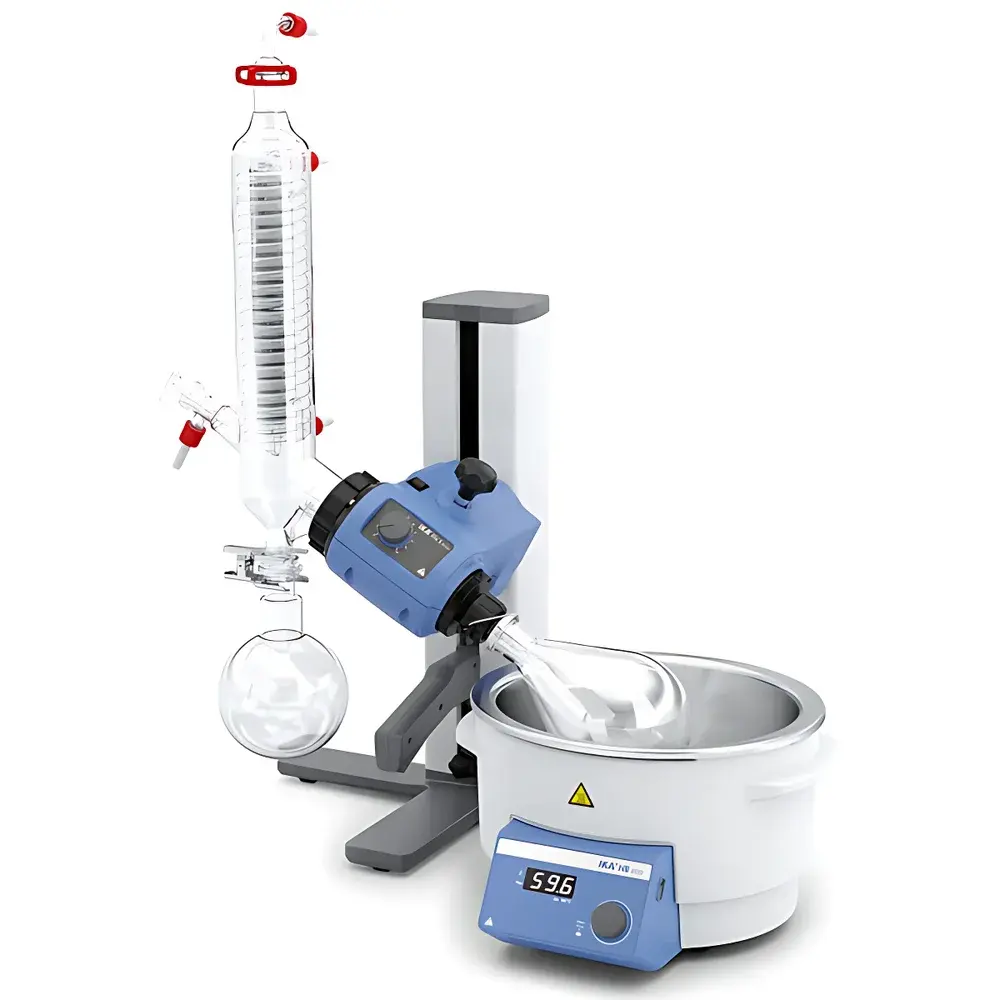
IKA RV3 V Rotary Evaporator
| Brand | IKA |
|---|---|
| Origin | Guangdong, China |
| Manufacturer Type | Authorized Distributor |
| Origin Category | Domestic (China-made) |
| Model | RV3 V |
| Price | USD 2,100 (approx.) |
| Evaporation Flask Capacity | 3 L |
| Ultimate Vacuum | 2 mbar |
| Rotation Speed | 20–300 rpm |
| Bath Temperature Range | RT to 99 °C |
| Temperature Control Accuracy | ±1 °C |
| Condenser Surface Area | 1600 cm² |
Overview
The IKA RV3 V Rotary Evaporator is a robust, entry-level yet highly capable benchtop system engineered for reliable solvent removal, concentration, and gentle distillation under reduced pressure. Based on the fundamental principle of rotary evaporation—where simultaneous rotation, heating, and vacuum lower the boiling point of solvents—the RV3 V delivers consistent performance across R&D, QC, and pilot-scale production environments in chemical synthesis, pharmaceutical development, and biotechnology applications. Its modular architecture integrates seamlessly with standard IKA RV10-series glassware, enabling rapid method transfer and scalability. Designed for operational safety and long-term stability, the unit operates at 24 V DC for motor control and features a grounded 220–240 V AC heating bath compliant with IEC 61000-3-2 (harmonic current emissions) and Energy Efficiency Level VI standards.
Key Features
- Triple-layer vertical condenser with full coolant circulation across all surfaces—total effective condensation area ≥1600 cm²—ensuring high recovery efficiency even with low-boiling or volatile solvents (e.g., diethyl ether, dichloromethane, ethyl acetate).
- 4 L stainless steel heating bath with digital temperature display, precise PID-controlled heating (RT to 99 °C, ±1 °C accuracy), and 1400 W power output—compatible with both standard and oversized 4 L distillation setups without adapter kits.
- Motorized rotation drive with brushless DC motor, offering smooth start-up at low speeds (≥100 rpm stable operation prevents splashing) and infinitely variable speed control from 20 to 300 rpm via calibrated dial.
- Manual lift mechanism with 150 mm vertical travel; endpoint limit adjustable between 60 mm and 215 mm above bath base—prevents collision between evaporating flask and heating surface during descent.
- Dual-locking vapor tube assembly: primary mechanical lock plus secondary safety latch; unlatched status indicated by visible red indicator—reducing risk of accidental disconnection under vacuum.
- Ergonomic design elements: integrated bottle-release lever for one-handed flask mounting/removal, tiltable motor head (0–60°), and insulated carrying handle on heating bath for safe repositioning.
- Chemically resistant sealing system: PTFE gaskets combined with stainless steel spring clips ensure long-term vacuum integrity and corrosion resistance against common organic solvents and mild aqueous media.
Sample Compatibility & Compliance
The RV3 V accepts standard ISO-K 29/32 and ISO-K 24/29 ground-glass joints, ensuring full interoperability with IKA RV10-series flasks (up to 4 L), receiving flasks, and optional accessories such as chiller interfaces or vacuum controllers. All wetted parts—including condenser tubing, vapor duct, and sealing components—are constructed from borosilicate glass (DIN ISO 3585), PTFE, and 316 stainless steel to meet material compatibility requirements per ASTM D4291 and USP . The instrument conforms to IEC 61010-1:2010 for laboratory electrical equipment safety and supports GLP-compliant documentation when paired with external vacuum gauges or temperature loggers meeting FDA 21 CFR Part 11 data integrity criteria.
Software & Data Management
While the RV3 V operates as a stand-alone analog/digital hybrid system without embedded firmware or network connectivity, its temperature and rotation controls are fully manual and traceable via front-panel indicators. For regulated environments, users may integrate third-party digital controllers (e.g., IKA RV10 Digital or Vacuubrand VRV) to enable audit-trail-capable parameter logging, remote monitoring, and electronic record retention aligned with GMP Annex 11 and ISO/IEC 17025 requirements. All calibration points—including bath temperature verification using NIST-traceable PT100 probes and rotational speed validation via optical tachometer—are accessible per manufacturer-recommended intervals.
Applications
- Solvent removal from reaction mixtures post-synthesis (e.g., THF, DMF, toluene) in medicinal chemistry labs.
- Concentration of heat-sensitive biomolecules—including peptides, oligonucleotides, and natural product extracts—under controlled low-temperature vacuum conditions.
- Removal of residual solvents from API intermediates prior to crystallization or lyophilization, supporting ICH Q3C compliance.
- Routine QC testing of excipient blends, where uniform solvent evaporation ensures reproducible solid-state characterization (e.g., XRPD, DSC).
- Pilot-scale process development for continuous downstream purification workflows, leveraging modularity with larger RV10 platforms.
FAQ
Is the RV3 V compatible with vacuum pumps from other manufacturers?
Yes—the unit features a standard ISO-K 29/32 vacuum port and operates effectively with diaphragm, scroll, or oil-sealed pumps delivering ≤2 mbar ultimate vacuum.
Can the heating bath accommodate custom-sized flasks beyond 3 L?
Yes—its 4 L capacity and extended bath geometry support direct use of 4 L flasks without adapters, provided joint compatibility (ISO-K 29/32) is maintained.
What maintenance intervals are recommended for optimal vacuum integrity?
PTFE seals should be inspected quarterly; replace if cracked or compressed beyond 20% of original thickness. Condenser coolant lines require annual descaling if using tap water.
Does the RV3 V meet CE or UKCA marking requirements?
As distributed by authorized IKA partners in EEA/UK markets, units carry CE marking per Machinery Directive 2006/42/EC and EMC Directive 2014/30/EU—documentation available upon request.
How is temperature calibration verified?
Use a NIST-traceable immersion thermometer or PT100 probe placed centrally in the bath fluid; deviation >±1.5 °C warrants adjustment via internal calibration offset per service manual Section 5.2.
Related Products



