
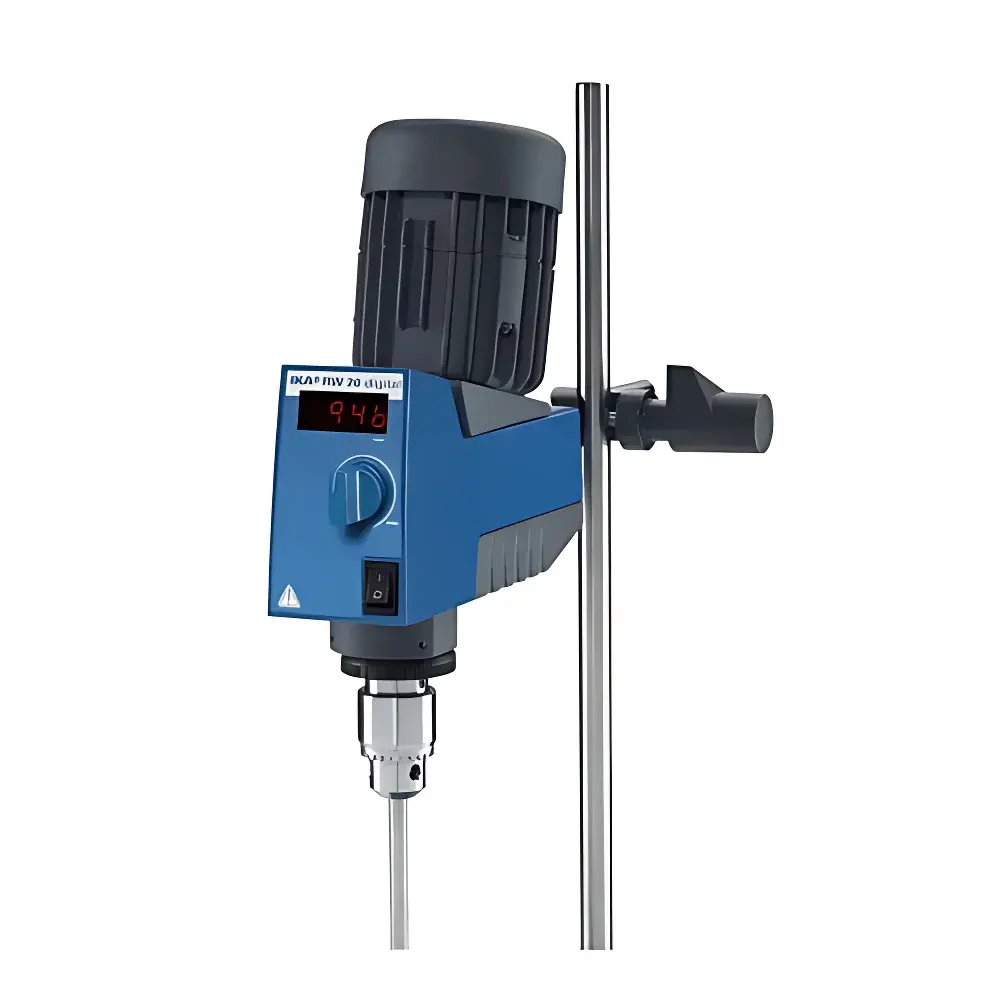
IKA RW 20 digital Overhead Stirrer
| Brand | IKA |
|---|---|
| Origin | Germany |
| Manufacturer | IKA-Werke GmbH & Co. KG |
| Model | RW 20 digital |
| Motor Input Power | 70 W |
| Motor Output Power | 35 W |
| Max. Stirring Volume (H₂O) | 20 L |
| Speed Range | 60–2000 rpm |
| Speed Display | LED |
| Speed Control | Stepless Mechanical |
| Max. Viscosity | 10,000 mPa·s |
| Max. Torque (at 60 rpm) | 300 N·cm |
| Max. Torque (at 100 rpm) | 150 N·cm |
| Max. Torque (at 1000 rpm) | 24 N·cm |
| Shaft Output Power | 26 W |
| Duty Cycle | 100 % |
| Shaft Clamp Range | Ø 0.5–10 mm |
| Hollow Shaft ID | 10.5 mm |
| Extension Arm Diameter | 13 mm |
| Extension Arm Length | 160 mm |
| Dimensions (W×H×D) | 88 × 294 × 212 mm |
| Weight | 3.1 kg |
| Ambient Temperature Range | 5–40 °C |
| Relative Humidity Limit | 80 % |
| Protection Class | IP20 |
| Voltage | 220–240 V / 100–115 V |
| Frequency | 50/60 Hz |
| Rated Torque | 1.5 N·m |
Overview
The IKA RW 20 digital is a high-performance overhead stirrer engineered for precision, reliability, and long-term operational stability in demanding laboratory environments. Designed and manufactured in Staufen, Germany, it operates on the principle of direct-drive mechanical torque transmission—eliminating belt slippage and ensuring consistent rotational energy delivery across its full speed range. Its dual-speed-range architecture (60–500 rpm and 240–2000 rpm at 50 Hz) enables optimized control for both low-shear homogenization and high-torque dispersion tasks. With a maximum stirring capacity of 20 L in water and capability to handle media up to 10,000 mPa·s viscosity, the RW 20 digital supports scalable process development—from small-batch formulation to pilot-scale mixing validation. Its robust aluminum housing, integrated thermal protection, and 100% duty cycle rating ensure uninterrupted operation under continuous load conditions typical in QC labs, pharmaceutical R&D, and chemical synthesis workflows.
Key Features
- Stepless mechanical speed control with ±1 rpm setting resolution and ±30 rpm measurement deviation—optimized for reproducible method transfer between instruments.
- Dual-range gear mechanism providing high-torque low-speed mode (60–500 rpm) and high-speed dispersion mode (240–2000 rpm), each calibrated per IEC 61000-4 standards.
- Hollow stainless-steel stirring shaft (ID 10.5 mm) compatible with temperature probes, pH electrodes, or inline sensors—enabling real-time process monitoring without disassembly.
- Ergonomic vertical chassis (294 mm height) with integrated LED speed display, reducing visual fatigue during extended operation.
- Self-centering chuck with 0.5–10 mm clamping range and automatic torque compensation—minimizing wobble and shaft runout even at 2000 rpm.
- IP20-rated enclosure compliant with DIN EN 60529, suitable for standard laboratory ambient conditions (5–40 °C, ≤80% RH).
- Universal voltage input (100–115 V / 220–240 V, 50/60 Hz) with internal auto-sensing circuitry—ensuring seamless deployment across global facilities without external transformers.
Sample Compatibility & Compliance
The RW 20 digital accommodates a broad spectrum of sample types—including aqueous suspensions, polymer melts, non-Newtonian gels, and abrasive slurries—when paired with chemically resistant stirring elements (e.g., PTFE-coated anchors, glass propellers, or Hastelloy blades). Its torque profile meets ASTM D1893 requirements for viscometric mixing consistency and aligns with ISO 8502-7 for reproducible dispersion testing in coating and adhesive development. While not intrinsically rated for explosive atmospheres, it complies with EU Machinery Directive 2006/42/EC and carries CE marking for safe integration into GLP- and GMP-regulated environments. All electrical components conform to RoHS 2011/65/EU and REACH SVHC screening protocols.
Software & Data Management
As a standalone analog-digital hybrid instrument, the RW 20 digital does not feature embedded firmware or network connectivity. However, its stable analog signal path and repeatable mechanical feedback support integration with third-party data acquisition systems via optional analog output modules (e.g., 0–10 V speed feedback interface, sold separately). Laboratories requiring audit-trail compliance may log operational parameters—including start/stop timestamps, speed setpoints, and duration—using external LabVantage or Thermo Fisher SampleManager LIMS platforms. The device’s mechanical design inherently supports 21 CFR Part 11–compatible procedural controls when operated within documented SOPs governing equipment calibration, preventive maintenance, and user access authorization.
Applications
- Pharmaceutical: Dissolution testing of solid oral dosage forms using USP Apparatus II configurations; buffer and media preparation for cell culture applications.
- Chemical R&D: Emulsion polymerization, catalyst suspension, and solvent-based resin blending where shear-sensitive intermediates require precise rpm ramping.
- Food & Beverage: Viscosity stabilization trials for sauces, dressings, and dairy alternatives—leveraging high-torque low-speed mode for minimal air entrapment.
- Materials Science: Homogenization of nanoparticle dispersions in ethanol or ethylene glycol prior to TEM sample preparation.
- Academic Teaching Labs: Demonstrating Newtonian vs. pseudoplastic behavior through controlled shear-rate sweeps using calibrated viscometer couplings.
FAQ
Is the RW 20 digital compatible with explosion-proof environments?
No—it lacks ATEX or IECEx certification and is intended for use in non-hazardous laboratory zones only.
Can the hollow shaft accommodate a Pt100 temperature probe during operation?
Yes, provided the probe diameter is ≤10 mm and its sheath material is chemically inert to the sample; insertion must occur only when the shaft is stationary.
What maintenance intervals are recommended for continuous 24/7 operation?
IKA recommends biannual inspection of gear lubrication, chuck jaw wear, and motor brush condition—documented per ISO/IEC 17025 calibration management guidelines.
Does the unit include a stand or mounting bracket?
No—the RW 20 digital is supplied as a head-only unit; compatible IKA lab stands (e.g., RCT basic or Eurostar 60) must be ordered separately.
How is speed accuracy verified during IQ/OQ qualification?
Using a traceable optical tachometer (NIST-calibrated) across three points per speed range (low/mid/high), repeated over five cycles, with acceptance criteria of ±3% of setpoint.



