
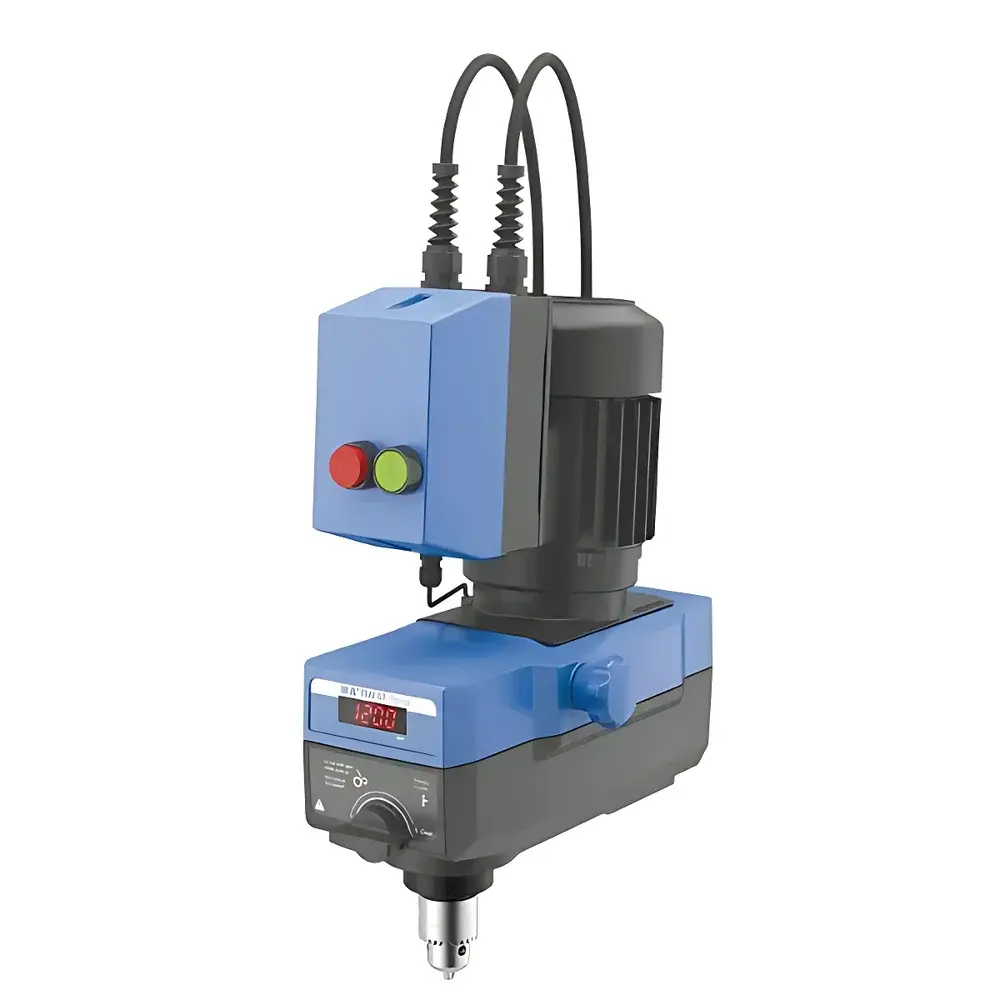
IKA RW 47 digital Overhead Stirrer
| Brand | IKA |
|---|---|
| Origin | Germany |
| Model | RW 47 digital |
| Max. Mixing Volume (H₂O) | 200 L |
| Input Power | 511 W |
| Output Power | 370 W |
| Motor Principle | Three-phase AC |
| Speed Display | LED |
| Speed Range | 57–1300 rpm |
| Max. Viscosity | 100,000 mPa·s |
| Max. Shaft Output Power | 300 W |
| Duty Cycle | 100 % continuous operation |
| Max. Torque (60 rpm) | 4642 N·cm |
| Max. Torque (100 rpm) | 3000 N·cm |
| Max. Torque (1000 rpm) | 285 N·cm |
| Torque Range I | 3000 N·cm |
| Torque Range II | 620 N·cm |
| Speed Range I (50 Hz) | 57–275 rpm |
| Speed Range II (50 Hz) | 275–1300 rpm |
| Speed Control | Continuously variable |
| Speed Setting Accuracy | ±1 rpm |
| Speed Measurement Deviation | ±10 rpm |
| Impeller Mounting | Fixed chuck |
| Chuck Capacity | Ø 3–16 mm |
| Hollow Shaft ID | 13 mm |
| Mounting | Flange |
| Speed Control Type | Mechanical |
| Rated Torque | 30 N·m |
| Housing Material | Cast aluminum with thermoplastic polymer coating |
| Dimensions (W×H×D) | 145 × 478 × 358 mm |
| Weight | 16.6 kg |
| Ambient Temperature Range | 5–40 °C |
| Relative Humidity Limit | 80 % |
| Ingress Protection | IP54 per DIN EN 60529 |
| Voltage | 3 × 400 V |
| Frequency | 50 Hz |
| Instrument Input Power | 513 W |
Overview
The IKA RW 47 digital is a high-performance overhead stirrer engineered for demanding laboratory and pilot-scale mixing applications. Designed around a robust three-phase AC motor architecture, it delivers consistent torque output across wide speed ranges—enabling reliable homogenization, suspension, dissolution, and dispersion of low- to ultra-high-viscosity fluids (up to 100,000 mPa·s). Its dual-range mechanical speed control system (57–275 rpm and 275–1300 rpm) ensures optimal power delivery at both low-speed high-torque and high-speed low-torque operating points. With a maximum mixing capacity of 200 L in aqueous media and full 100% duty cycle capability, the RW 47 digital supports extended unattended operation in R&D labs, quality control environments, and scale-up facilities where reproducibility and mechanical stability are critical.
Key Features
- Two independent torque ranges: up to 4642 N·cm at 60 rpm (Range I) and 620 N·cm at high speeds (Range II), optimized for viscous and low-viscosity regimes respectively
- LED digital display with ±1 rpm setting resolution and real-time speed feedback
- Integrated thermal protection circuitry automatically limits motor temperature during prolonged high-load operation
- Cast aluminum housing with thermoplastic polymer coating provides corrosion resistance and mechanical rigidity while minimizing vibration transmission
- Hollow shaft design (13 mm internal diameter) accommodates temperature probes or auxiliary sensors during in-process monitoring
- IP54-rated enclosure ensures operational safety in non-hazardous environments with moderate dust and water exposure
- Ergonomic flange mounting system enables secure attachment to reactor vessels, bioreactors, or custom support frames
- Mechanical speed control offers intrinsic electromagnetic compatibility (EMC) stability—no software dependencies or firmware updates required
Sample Compatibility & Compliance
The RW 47 digital is compatible with standard laboratory impellers (e.g., propeller, anchor, paddle, and helical ribbons) via its fixed chuck (Ø 3–16 mm). Its high starting torque and stable speed regulation make it suitable for shear-sensitive suspensions, polymer melts, ceramic slurries, and pharmaceutical emulsions. The unit complies with DIN EN 60529 (IP54), IEC 61000-6-2/6-4 (EMC), and IEC 61010-1 (safety for electrical equipment used in measurement, control, and laboratory use). While not inherently 21 CFR Part 11 compliant (as it lacks electronic audit trail functionality), its mechanical interface and stable analog control architecture facilitate integration into GLP/GMP workflows when paired with validated external data acquisition systems.
Software & Data Management
As a standalone electromechanical instrument, the RW 47 digital does not incorporate embedded software or network connectivity. All operational parameters—including setpoint speed, actual speed, and error codes—are conveyed through the front-panel LED display. Error codes (e.g., E1 = overload, E2 = overtemperature) aid rapid diagnostics without requiring external tools. For traceable process documentation, users may integrate the stirrer with third-party PLCs or SCADA systems using optional analog 0–10 V or 4–20 mA speed feedback outputs (available via accessory modules). This analog interface supports alignment with FDA-regulated batch records when combined with time-stamped data loggers meeting ALCOA+ principles.
Applications
- Preparation of high-viscosity polymer solutions and adhesives in material science laboratories
- Homogenization of cell culture media and buffer formulations in biopharmaceutical development
- Dispersion of nanoparticles and pigments in coating and ink R&D
- Suspension of insoluble active pharmaceutical ingredients (APIs) during formulation screening
- Mixing of catalyst slurries and heterogeneous reaction mixtures in chemical process development
- Pilot-scale blending of food emulsions and cosmetic bases under controlled shear conditions
FAQ
Is the RW 47 digital suitable for explosive or hazardous atmospheres?
No—it is rated IP54 and designed for general-purpose laboratory use only; it is not ATEX-certified or intrinsically safe.
Can the stirrer be operated in a fume hood or cold room?
Yes, provided ambient temperature remains between 5–40 °C and relative humidity stays below 80 % non-condensing.
Does the unit support RS232 or USB communication?
No—speed control and status indication are fully mechanical and analog; digital interfacing requires optional analog-output add-ons.
What impeller types are recommended for maximum torque utilization?
Anchor, helical ribbon, and double-helical impellers are preferred for high-viscosity applications below 275 rpm; propeller and turbine impellers are optimal above 275 rpm.
Is calibration required before first use?
No routine calibration is specified by IKA; however, users should verify speed accuracy against a certified tachometer as part of IQ/OQ protocols in regulated environments.



