
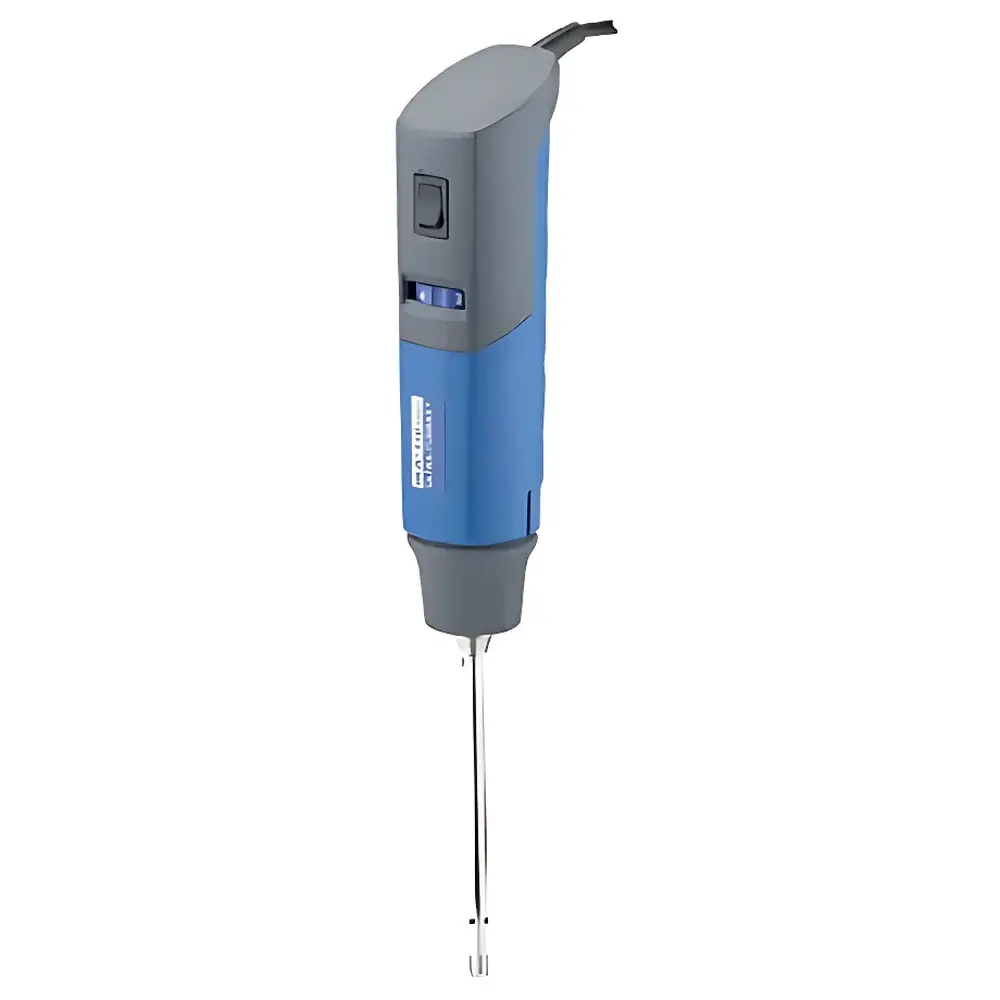
IKA T10 Basic Dispersion Homogenizer
| Brand | IKA |
|---|---|
| Origin | Germany |
| Model | T10 Basic |
| Motor Input Power | 125 W |
| Motor Output Power | 75 W |
| Volume Range (H₂O) | 0.001–0.1 L |
| Max. Viscosity | 5000 mPa·s |
| Speed Range | 8000–26,000 rpm |
| Speed Deviation | ±6 % |
| Speed Display | Analog Scale |
| Speed Control | Continuously Variable |
| Noise Level (without dispersing head) | 65 dB(A) |
| Extension Arm Diameter | 8 mm |
| Extension Arm Length | 100 mm |
| Duty Cycle | 10 min ON / 5 min OFF |
| Dimensions (W×H×D) | 63 × 210 × 57 mm |
| Weight | 0.4 kg |
| Ambient Temperature Range | 5–40 °C |
| Relative Humidity Limit | ≤80 % |
| Ingress Protection | IP30 per DIN EN 60529 |
| Voltage | 220–240 V / 100–120 V |
| Frequency | 50/60 Hz |
Overview
The IKA T10 Basic Dispersion Homogenizer is a compact, high-speed rotor-stator homogenizer engineered for reproducible sample dispersion, emulsification, and cell disruption in research and quality control laboratories. Operating on the principle of high-shear mechanical homogenization, the device generates intense hydrodynamic forces through rapid rotation of a precision-machined dispersing element within a fixed stator sleeve—inducing cavitation, turbulent flow, and localized high-velocity gradients to achieve micron-scale particle size reduction and uniform phase distribution. Designed for small-volume processing (1 mL to 100 mL), it delivers consistent performance across aqueous, low-to-medium-viscosity suspensions and emulsions up to 5000 mPa·s. Its robust aluminum housing, thermally stable motor design, and optimized thermal management support reliable intermittent operation under ISO 17025-aligned laboratory conditions.
Key Features
- High-speed rotor-stator architecture with speed range of 8000–26,000 rpm, enabling precise control over shear intensity for scalable process development
- Analog speed scale with ±6 % deviation tolerance—calibrated for traceable operational consistency without digital feedback circuitry
- Interchangeable dispersing tools—including PCR-specific probes, micro-tips, and standard S-shaped shafts—supporting application-specific optimization per ASTM D4290 and ISO 13320-1 guidelines
- Compact footprint (63 × 210 × 57 mm) and lightweight construction (0.4 kg) facilitate integration into biosafety cabinets, cold rooms, and benchtop workflows
- Duty cycle rated for 10 minutes continuous operation followed by 5-minute thermal recovery—aligned with IEC 61000-3-2 harmonic emission limits for laboratory equipment
- IP30-rated enclosure provides protection against solid objects ≥2.5 mm; suitable for dry, non-corrosive laboratory environments per DIN EN 60529
Sample Compatibility & Compliance
The T10 Basic accommodates samples ranging from 1 mL to 100 mL in volume, with validated performance in water-based matrices, buffered saline solutions, glycerol-water mixtures, and low-viscosity polymer dispersions. It is routinely deployed in pre-analytical sample preparation for downstream techniques including HPLC, DLS, and SEM sample mounting. While not certified for GMP or GLP environments requiring 21 CFR Part 11-compliant audit trails, its mechanical design complies with general safety standards EN 61010-1 (electrical safety) and EN 61326-1 (EMC). Users performing regulated work should implement external documentation protocols for speed setting verification and maintenance logging.
Software & Data Management
The T10 Basic operates as a standalone analog instrument with no embedded microprocessor, RS232 interface, or data output capability. Speed is set manually via the continuously variable control knob and read from a fixed analog scale—eliminating firmware dependencies and ensuring long-term operational stability. This architecture supports laboratories prioritizing simplicity, minimal validation overhead, and immunity to software obsolescence. For traceable calibration, users may pair the unit with an external tachometer (e.g., ISO 5326-compliant optical sensor) and log settings manually in accordance with internal SOPs.
Applications
- Routine homogenization of tissue lysates, bacterial pellets, and plant extracts prior to nucleic acid or protein isolation
- Preparation of stable oil-in-water emulsions for cosmetic formulation screening and food science studies
- Dispersion of nanomaterials (e.g., carbon nanotubes, metal oxides) in aqueous surfactant systems for toxicity assessment
- Fragmentation of agarose gels and soft hydrogels for microscopy embedding and rheological characterization
- PCR tube homogenization using dedicated micro-probes—ensuring uniform reagent mixing without cross-contamination risk
FAQ
Is the T10 Basic compatible with corrosive solvents such as chloroform or acetone?
No—only stainless steel dispersing elements are supplied; prolonged exposure to halogenated or strong organic solvents may compromise shaft integrity and seal performance.
Can the speed be accurately repeated across multiple operators?
Yes, when using the analog scale with proper training; however, for quantitative method transfer, independent tachometric verification is recommended per ISO/IEC 17025 clause 7.7.
Does the unit include overload or thermal shutdown protection?
No—thermal management relies solely on passive cooling and adherence to the specified duty cycle; exceeding 10 min ON time risks irreversible motor winding degradation.
Are replacement dispersing tools calibrated or serialized?
Dispersing tools are mechanically interchangeable but not individually calibrated; users must validate performance per application using reference standards (e.g., polystyrene latex suspensions per ISO 13320).
What maintenance intervals are recommended for routine use?
Visual inspection before each use; lubrication-free design requires only periodic cleaning of the shaft and stator sleeve with ethanol or isopropanol—no scheduled servicing per manufacturer guidance.
Related Products



