
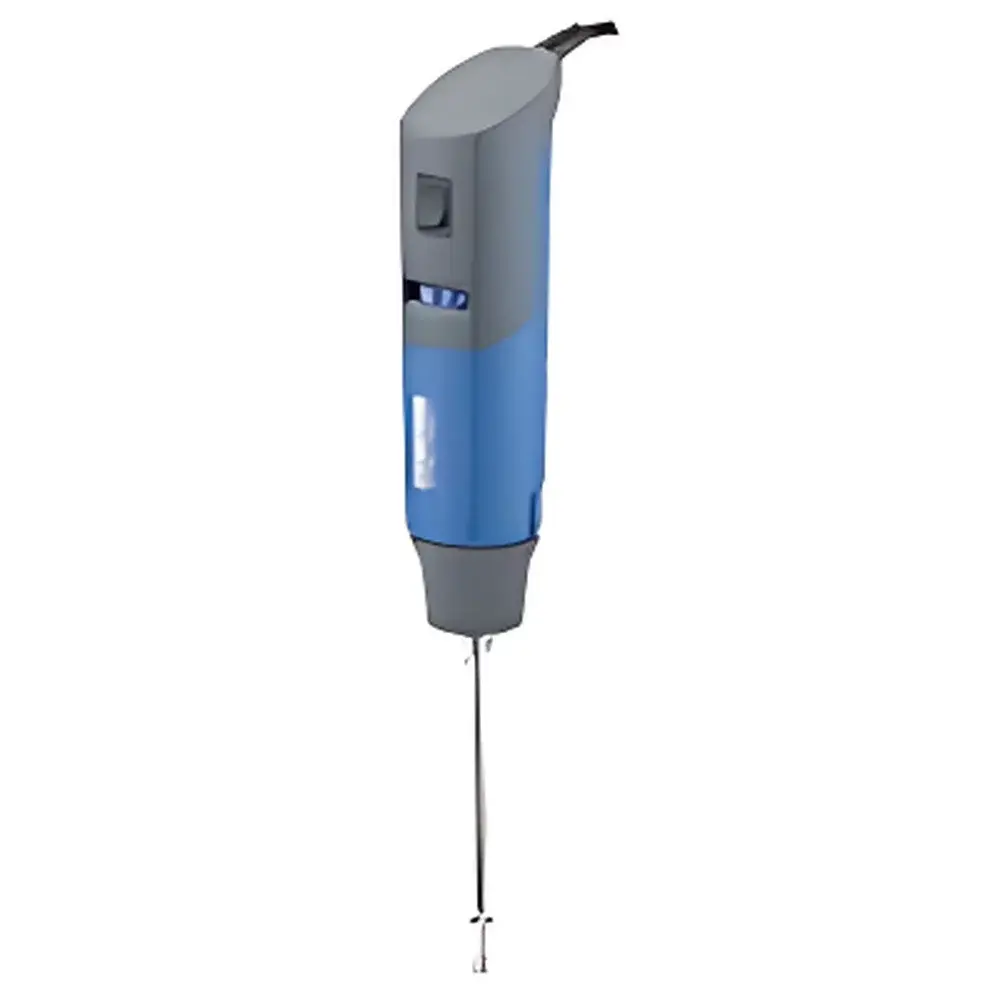
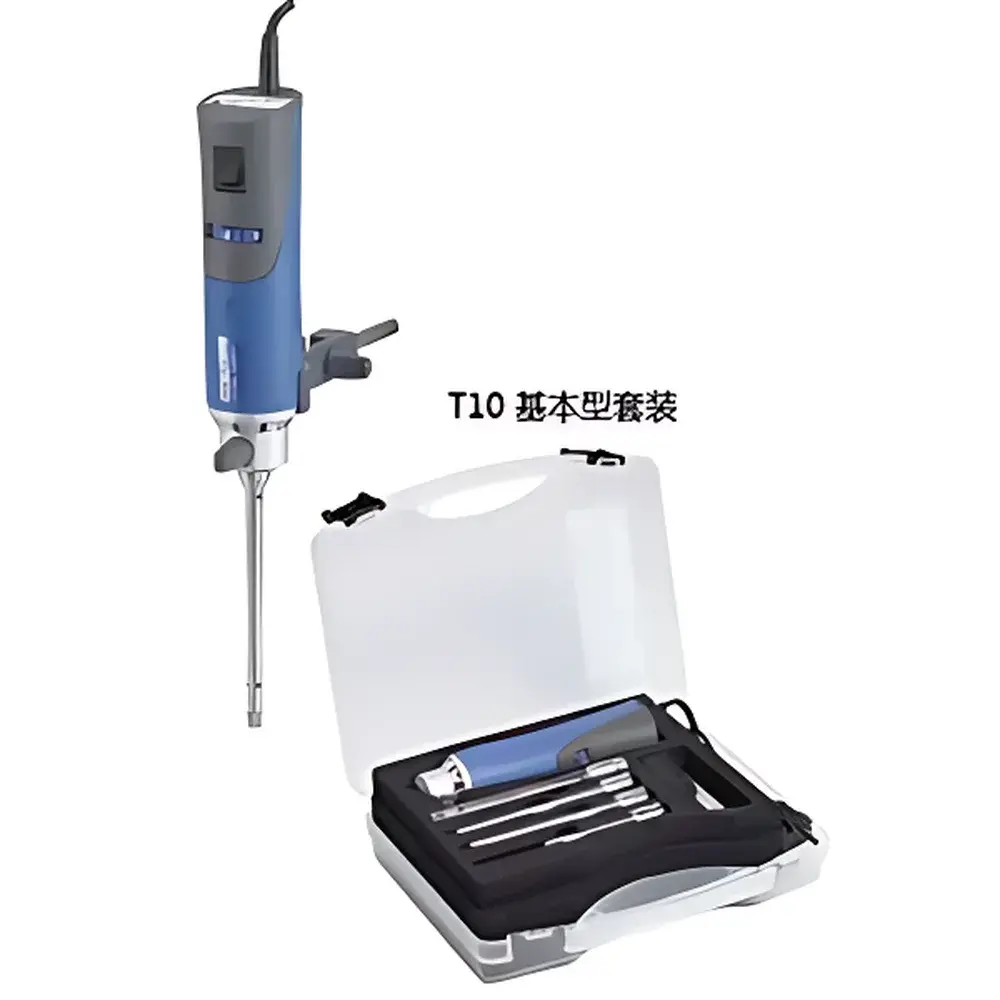
IKA T10 Basic High-Speed Dispersion Homogenizer
| Brand | IKA |
|---|---|
| Origin | Germany |
| Model | IKA T10 Basic Kit |
| Motor Input Power | 125 W |
| Motor Output Power | 75 W |
| Speed Range | 8,000–30,000 rpm |
| Speed Control | Continuously Variable |
| Display | Analog Speed Scale |
| Max. Capacity (H₂O) | 0.1 L |
| Min. Capacity (H₂O) | 0.5 mL |
| Max. Viscosity | 5,000 mPa·s |
| Noise Level (no dispersing element) | 65 dB(A) |
| Dimensions (W×D×H) | 46 × 201 × 57 mm |
| Weight | 0.4 kg |
| IP Rating | IP30 |
| Operating Temperature | 5–40 °C |
| Relative Humidity | ≤80 % |
| Voltage | 230 / 115 / 100 V |
| Frequency | 50/60 Hz |
| Duty Cycle | 10 min ON / 5 min OFF |
| Shaft Diameter | 8 mm |
| Shaft Length | 100 mm |
| Process Type | Batch |
| Dispersing Elements | Stainless Steel (Ø5 mm, Ø8 mm, Ø10 mm) & Disposable Plastic (KS 65, KS 110) |
| Compliance | DIN EN 60529, IEC 61000-6-3, IEC 61000-6-2 |
Overview
The IKA T10 Basic High-Speed Dispersion Homogenizer is a compact, handheld laboratory instrument engineered for precise batch processing of small-volume samples in life science, pharmaceutical, and analytical laboratories. Based on high-shear rotor-stator dispersion principles, the T10 delivers reproducible homogenization, emulsification, cell lysis, and suspension preparation across volumes ranging from 0.5 mL to 100 mL. Its core architecture integrates a thermally stable 75 W output motor with a robust 125 W input rating, enabling consistent rotational performance even under variable load conditions—critical for applications involving viscous or heterogeneous matrices up to 5,000 mPa·s. Designed for ergonomic manual operation and benchtop adaptability, the T10 operates at speeds from 8,000 to 30,000 rpm, generating high tip speeds essential for efficient micro-scale particle size reduction and cellular disruption without cavitation-induced degradation.
Key Features
- Continuously variable speed control via analog dial, ensuring fine-tuned adjustment for sensitive sample types including nucleic acid preparations and protein suspensions.
- Ergonomic handheld design with low center of gravity and lightweight construction (0.4 kg), minimizing operator fatigue during extended use.
- Quick-release coupling system enables tool-free exchange of dispersing elements—stainless steel probes (Ø5 mm, Ø8 mm, Ø10 mm) and disposable plastic heads (KS 65, KS 110)—within seconds.
- IP30-rated housing provides protection against solid ingress and meets basic environmental safety requirements per DIN EN 60529.
- Integrated thermal management supports duty cycles of 10 minutes ON / 5 minutes OFF, sustaining motor longevity under routine laboratory workloads.
- Modular accessory compatibility: includes universal clamp holder (H44), adjustable support stand (R104), and transparent storage case for organized workflow integration.
Sample Compatibility & Compliance
The T10 accommodates a broad spectrum of sample types—including tissue homogenates, bacterial lysates, polymer dispersions, and nanoparticle suspensions—across aqueous, organic, and mildly corrosive media. Its stainless steel dispersing elements conform to ISO 8502-3 for surface cleanliness validation, while disposable plastic heads eliminate cross-contamination risks in PCR-grade workflows. The device complies with electromagnetic compatibility standards IEC 61000-6-2 (immunity) and IEC 61000-6-3 (emissions), and its electrical safety design adheres to IEC 61010-1 for laboratory equipment. Though not inherently 21 CFR Part 11 compliant, audit-ready documentation packages (including calibration certificates and maintenance logs) can be generated in conjunction with validated SOPs for GLP/GMP environments.
Software & Data Management
The T10 Basic model operates as a standalone analog instrument without digital connectivity or embedded software. However, its repeatable speed settings and mechanical stability enable seamless integration into documented laboratory processes. Users may record operational parameters—including speed setting, duration, probe type, and sample volume—in electronic lab notebooks (ELNs) or paper-based logbooks aligned with ISO/IEC 17025 traceability requirements. For laboratories requiring electronic data capture, the T10 can be paired with external tachometers or video-based motion analysis tools to verify rotational fidelity during method validation.
Applications
- Routine homogenization of soft tissues (e.g., liver, brain) for RNA extraction and qPCR analysis.
- Preparation of uniform emulsions in formulation development for topical and oral dosage forms.
- Disruption of Gram-negative bacteria (e.g., E. coli) for soluble protein recovery prior to affinity chromatography.
- Dispersion of nanomaterials (e.g., carbon nanotubes, metal oxides) in aqueous surfactant systems.
- Homogenization of soil and sediment extracts for environmental contaminant analysis (e.g., PAHs, heavy metals).
- Cell suspension maintenance in primary culture protocols requiring gentle yet effective mixing.
FAQ
What is the minimum and maximum sample volume the T10 can process?
The T10 is validated for batch processing between 0.5 mL and 100 mL of aqueous media; optimal performance for viscous or particulate-laden samples is achieved within 1–50 mL using appropriately sized dispersing elements.
Can the T10 be used for sterile applications?
Yes—autoclavable stainless steel dispersing elements (S 10 N series) withstand standard autoclave cycles (121 °C, 20 min); disposable plastic heads (KS 65/KS 110) are gamma-irradiated and certified for single-use sterile workflows.
Is the T10 suitable for continuous operation?
No—the T10 is designed for intermittent batch use with a defined duty cycle of 10 minutes ON followed by 5 minutes OFF to prevent thermal overload.
How does the T10 compare to the T18 or T25 models in terms of scalability?
The T10 serves micro-to-small-scale applications (<100 mL); the T18 (up to 1.5 L) and T25 (up to 20 L) extend capacity and torque for larger-volume or higher-viscosity tasks, maintaining identical dispersion physics but differing in motor power and shaft geometry.
Does the T10 require calibration?
While no factory calibration certificate is supplied, users should perform periodic speed verification using a certified optical tachometer, especially after prolonged use or following maintenance—recommended annually per ISO/IEC 17025 guidelines.



