
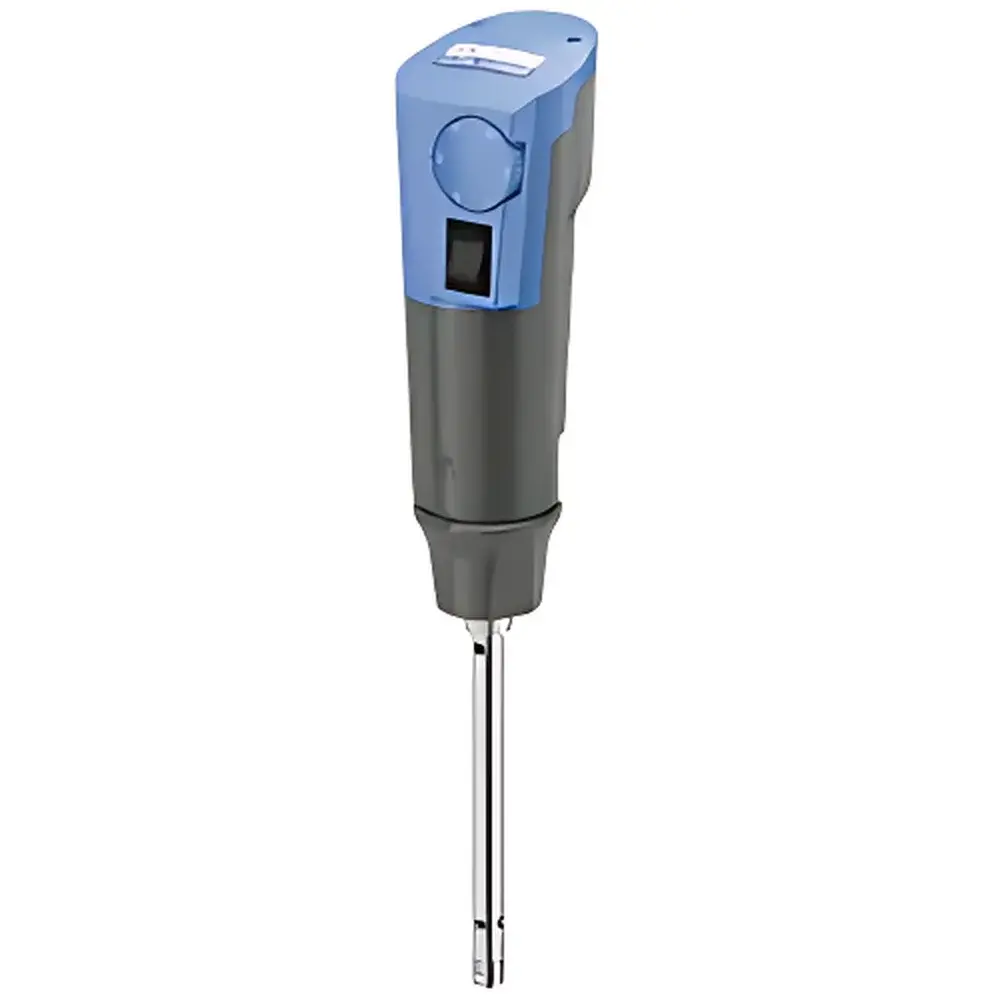
IKA T10 basic ULTRA-TURRAX® Handheld Homogenizer
| Brand | IKA |
|---|---|
| Origin | Germany |
| Manufacturer | IKA-Werke GmbH & Co. KG |
| Product Type | Handheld Homogenizer |
| Model | T10 basic ULTRA-TURRAX® |
| Sample Volume | 0.5–100 mL |
| Motor Input Power | 125 W |
| Motor Output Power | 75 W |
| Speed Range | 8,000–30,000 rpm |
| Max. Viscosity | 5,000 mPa·s |
| Speed Control | Continuous (analog dial) |
| Noise Level (no dispersing tool) | 65 dB(A) |
| Protection Rating | IP30 |
| Dimensions (W×H×D) | 56 × 178 × 66 mm |
| Weight | 0.61 kg |
| Ambient Temperature Range | 5–40 °C |
| Relative Humidity Limit | ≤80 % |
| Voltage | 230 / 115 / 100 V |
| Frequency | 50/60 Hz |
| Duty Cycle | 10 min ON / 5 min OFF |
| Shaft Diameter | 8 mm |
| Shaft Length | 100 mm |
Overview
The IKA T10 basic ULTRA-TURRAX® is a compact, handheld high-shear homogenizer engineered for precise and reproducible batch processing of small-volume liquid and semi-liquid samples in research laboratories, quality control environments, and routine analytical workflows. Based on the proven ULTRA-TURRAX® rotor-stator principle—where intense mechanical shear forces are generated through high-speed rotation of a precision-machined rotor within a fixed stator—the instrument achieves efficient cell disruption, emulsification, suspension stabilization, and particle size reduction across diverse sample matrices. Its design prioritizes ergonomic handling, rapid tool interchangeability, and operational simplicity without compromising mechanical robustness or speed stability. The device operates without external power adapters, supporting direct connection to standard laboratory mains (100–230 V AC), and complies with DIN EN 60529 (IP30) for protection against solid objects larger than 2.5 mm—suitable for controlled indoor lab use under GLP-aligned conditions.
Key Features
- High-performance brush motor delivering consistent 75 W output power and stable rotational speeds from 8,000 to 30,000 rpm—enabling scalable shear intensity across viscosity ranges up to 5,000 mPa·s
- Ergonomic handheld housing (56 × 178 × 66 mm; 0.61 kg) with non-slip grip and balanced weight distribution for extended manual operation
- Quick-release coupling system enabling tool changes in seconds—no tools required for disassembly or cleaning of stainless-steel dispersing elements
- Two standardized shaft options: 8 mm diameter × 100 mm length rigid shaft for general-purpose homogenization; compatible with both reusable and single-use dispersing tools
- Analog continuous speed control via calibrated dial—providing intuitive, repeatable setting without digital interface dependency
- Low-noise operation at ≤65 dB(A) (measured without dispersing tool installed), minimizing acoustic interference in shared lab spaces
- Duty-cycle optimized for intermittent use: 10 minutes active operation followed by 5 minutes cooling interval—ensuring thermal management and long-term motor reliability
Sample Compatibility & Compliance
The T10 basic supports sample volumes from 0.5 mL to 100 mL in glass, plastic, or polypropylene vessels—including microcentrifuge tubes, Eppendorf tubes, and small beakers. It accommodates a range of IKA-certified dispersing tools: stainless-steel S-shaped and Y-shaped rotors for viscous or fibrous samples; disposable polymer-tipped probes for PCR-grade applications requiring cross-contamination avoidance. All metal components comply with ISO 8502-3 for surface cleanliness and are autoclavable (121 °C, 20 min). The unit meets CE marking requirements per EU Directive 2014/30/EU (EMC) and 2014/35/EU (LVD), and conforms to IEC 61000-6-3 for emission limits. While not validated for GMP production environments, its mechanical repeatability and traceable speed calibration support data integrity in GLP-regulated studies per OECD Principles of Good Laboratory Practice.
Software & Data Management
As a manually operated analog instrument, the T10 basic does not integrate digital connectivity, firmware, or embedded software. Speed settings are recorded manually alongside experimental logs; no electronic audit trail or 21 CFR Part 11 compliance is provided. For laboratories requiring electronic recordkeeping, integration is achieved externally via documented SOPs that specify speed, duration, tool type, vessel geometry, and sample temperature—ensuring procedural consistency and retrospective review capability. Optional accessories include calibrated tachometers for independent speed verification and temperature probes for real-time monitoring during exothermic dispersion processes.
Applications
- Cell lysis and nucleic acid extraction from bacterial, yeast, and mammalian cultures
- Preparation of homogeneous suspensions for particle size analysis (e.g., DLS, laser diffraction)
- Rapid emulsification of oil-in-water and water-in-oil systems in formulation development
- Homogenization of tissue homogenates for ELISA, Western blotting, or metabolite profiling
- Dispersion of nanomaterials, pigments, and pharmaceutical excipients in low-volume R&D batches
- PCR sample preparation using sterile, single-use dispersing tools to prevent carryover contamination
FAQ
What is the maximum recommended viscosity for continuous operation?
For optimal thermal management and rotor-stator longevity, continuous operation is advised only up to 2,000 mPa·s; higher viscosities (up to 5,000 mPa·s) require adherence to the specified 10-min ON / 5-min OFF duty cycle.
Can the T10 basic be used in explosion-proof environments?
No—it lacks ATEX or IECEx certification and contains a brushed motor generating potential spark sources; it is intended for standard laboratory atmospheres only.
Are replacement dispersing tools traceable to lot-specific certificates of conformance?
Yes—reusable stainless-steel tools are supplied with material test reports (MTRs); single-use probes include lot-numbered packaging with biocompatibility documentation per ISO 10993-5.
Does the device support variable torque feedback or overload protection?
No—torque response is purely mechanical; sustained overload may trigger thermal cut-off, but no active electronic protection circuitry is integrated.
Is calibration of the speed dial traceable to national standards?
IKA provides factory calibration using NIST-traceable tachometry; users may perform periodic verification with third-party optical or contact tachometers per internal QA protocols.



