
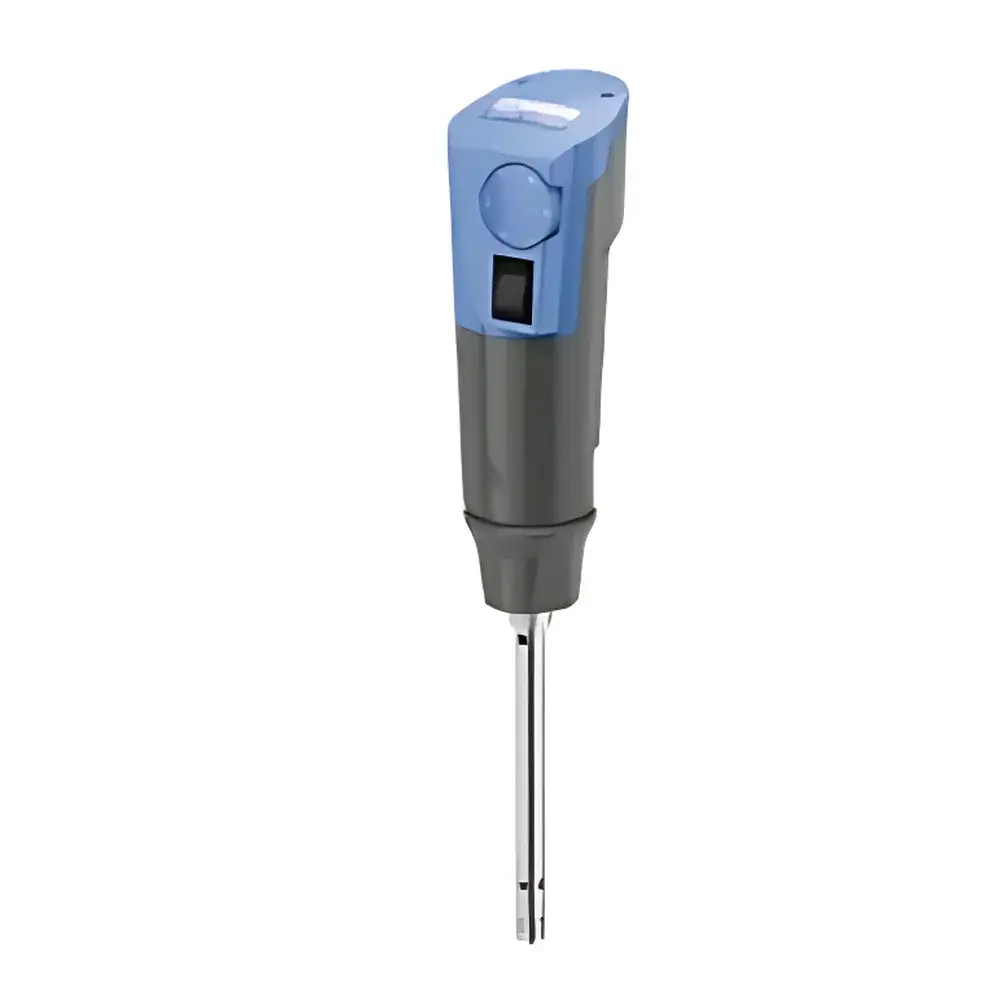
IKA T10 basic ULTRA-TURRAX® Handheld Homogenizer
| Brand | IKA |
|---|---|
| Origin | Germany |
| Model | T10 basic ULTRA-TURRAX® |
| Instrument Type | Handheld Homogenizer |
| Instrument Category | Adjustable High-Speed Disperser |
| Sample Volume Range | 0.5–100 mL |
| Motor Input Power | 125 W |
| Motor Output Power | 75 W |
| Speed Range | 8,000–30,000 rpm |
| Speed Control | Continuously Variable |
| Speed Display | Graduated Scale |
| Max. Viscosity | 5,000 mPa·s |
| Noise Level (no dispersing head) | 65 dB(A) |
| Shaft Diameter | 8 mm |
| Shaft Length | 100 mm |
| Dimensions (W × H × D) | 56 × 178 × 66 mm |
| Weight | 0.5 kg |
| Operating Temperature | 5–40 °C |
| Relative Humidity Limit | 80 % |
| Ingress Protection | IP30 (DIN EN 60529) |
| Voltage | 230 / 115 / 100 V |
| Frequency | 50/60 Hz |
| Duty Cycle | 10 min ON / 5 min OFF |
| Minimum Sample Volume (H₂O) | 0.0005 L |
| Maximum Sample Volume (H₂O) | 0.1 L |
Overview
The IKA T10 basic ULTRA-TURRAX® is a compact, handheld high-shear homogenizer engineered for precision batch processing of small-volume liquid and semi-liquid samples in research laboratories, quality control environments, and routine analytical workflows. Based on the proven ULTRA-TURRAX® rotor-stator principle—where fluid is subjected to intense mechanical shear, cavitation, and turbulent mixing within the narrow gap between a rotating cutting tool and stationary sleeve—the instrument delivers reproducible particle size reduction, cell lysis, emulsification, and dispersion across diverse sample matrices. Its design prioritizes ergonomic operation, rapid tool interchangeability, and compliance with fundamental safety and performance standards for benchtop laboratory equipment.
Key Features
- Continuously variable speed control (8,000–30,000 rpm) enables precise optimization of shear intensity for sensitive biological samples (e.g., mammalian cells, bacterial suspensions) or viscous formulations (e.g., polymer solutions, pastes up to 5,000 mPa·s).
- Integrated high-efficiency motor with 75 W output power ensures stable rotational speed under load, minimizing drift during extended operation cycles (rated 10 min ON / 5 min OFF).
- Ergonomic housing (56 × 178 × 66 mm; 0.5 kg) facilitates one-handed use and minimizes operator fatigue during repetitive tasks.
- Quick-lock coupling system allows tool-free attachment and removal of stainless-steel dispersing heads—including S-shaped, conical, and saw-tooth geometries—as well as disposable polypropylene probes for PCR-grade applications.
- Direct mains connection (230/115/100 V, 50/60 Hz) eliminates dependency on external power adapters, supporting global lab deployment without voltage conversion hardware.
- Acoustically optimized motor housing limits no-load noise to 65 dB(A), contributing to low-disturbance operation in shared laboratory spaces.
- IP30-rated enclosure (per DIN EN 60529) provides protection against solid objects ≥2.5 mm, suitable for controlled indoor laboratory environments with ambient temperatures of 5–40 °C and relative humidity ≤80 %.
Sample Compatibility & Compliance
The T10 basic supports processing volumes from 0.5 mL to 100 mL of aqueous, organic, or mildly corrosive media—including buffers, tissue homogenates, nanoparticle suspensions, and cosmetic emulsions. Stainless-steel dispersing elements comply with ISO 8504-2 for surface finish and are autoclavable (121 °C, 20 min). Disposable probe options meet ISO 13485 requirements for single-use medical device components and support traceability in molecular diagnostics workflows such as RT-qPCR. While not certified for GMP manufacturing environments, the device’s consistent performance, documented duty cycle, and mechanical robustness align with GLP principles for non-clinical laboratory studies per OECD Series No. 17.
Software & Data Management
As a manually operated analog instrument, the T10 basic does not incorporate digital connectivity, firmware, or onboard data logging. Speed selection is performed via calibrated rotary dial with visual scale indication; no electronic interface or audit trail functionality is provided. Consequently, it is exempt from FDA 21 CFR Part 11 requirements but remains fully compatible with laboratory information management systems (LIMS) when used within documented SOPs that define speed, time, probe type, and sample volume parameters for each protocol.
Applications
- Routine homogenization of soft animal tissues (liver, spleen) and cultured cells prior to nucleic acid or protein extraction.
- Preparation of uniform suspensions for dynamic light scattering (DLS) or laser diffraction particle sizing.
- Dispersion of nanomaterials (e.g., graphene oxide, metal oxides) into aqueous or solvent-based carriers.
- Emulsification of oil-in-water systems in formulation development for pharmaceuticals and cosmetics.
- Disaggregation of aggregated microbial cultures or biofilm fragments for viability assessment.
- Fragmentation of plant material in metabolite extraction protocols compliant with AOAC 990.11 and USP <724>.
FAQ
Is the T10 basic ULTRA-TURRAX® suitable for sterilization?
Yes—stainless-steel dispersing heads can be autoclaved at 121 °C for 20 minutes. Disposable probes are gamma-irradiated and supplied sterile.
Can it process viscous samples above 1,000 mPa·s?
Yes—its 75 W output power and optimized rotor geometry support stable operation up to 5,000 mPa·s, though reduced speed settings and shorter duty cycles are recommended.
What safety certifications does it hold?
It conforms to IEC 61010-1 for electrical safety in laboratory equipment and carries CE marking under the EU Low Voltage Directive (2014/35/EU) and EMC Directive (2014/30/EU).
How is speed accuracy verified during calibration?
Speed consistency is validated using an optical tachometer traceable to national metrology institutes; linearity deviation across the full range is ≤±2 % of setpoint.
Are replacement parts available globally?
Yes—IKA maintains authorized distribution networks in over 80 countries, with standardized spare parts (shafts, O-rings, dispersing heads) stocked under part numbers traceable to the original equipment manufacturer.



