
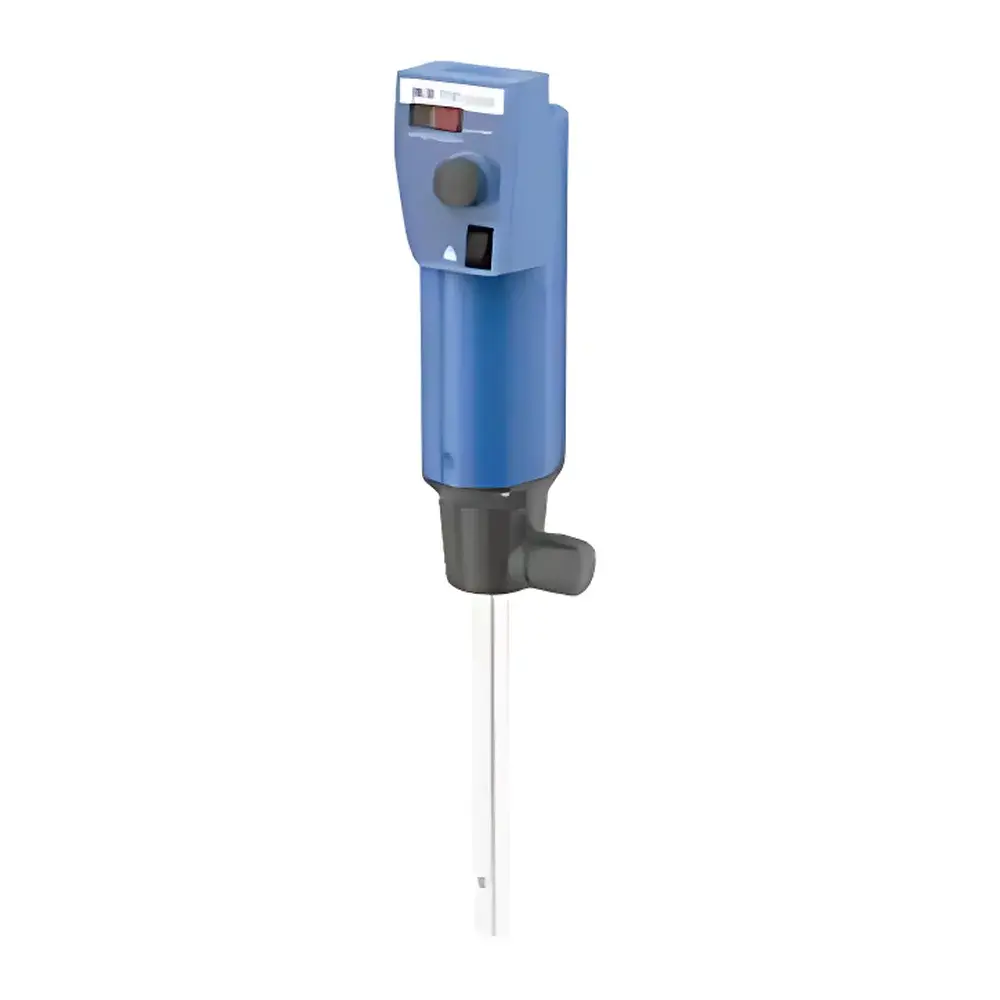
IKA T18 digital ULTRA-TURRAX® High-Performance Digital Dispersion Homogenizer
| Brand | IKA |
|---|---|
| Origin | Germany |
| Model | T18 digital ULTRA-TURRAX® |
| Instrument Type | Probe-type Rotating Rotor-Stator Homogenizer |
| Dimensions (W×D×H) | 87 × 271 × 106 mm |
| Processing Volume Range | 1–1500 mL |
| Motor Input Power | 500 W |
| Motor Output Power | 300 W |
| Speed Range | 3000–25,000 rpm |
| Speed Accuracy | ±1 % |
| Speed Display | LED Digital |
| Speed Control | Continuous (Stepless) Electronic Regulation |
| Max. Viscosity | 5000 mPa·s |
| Min. Sample Volume (H₂O) | 0.001 L |
| Max. Sample Volume (H₂O) | 1.5 L |
| Noise Level (without dispersing tool) | 75 dB(A) |
| Extension Arm Diameter | 13 mm |
| Extension Arm Length | 160 mm |
| Operating Temperature Range | 5–40 °C |
| Relative Humidity Limit | ≤80 % RH |
| Ingress Protection | IP20 (per DIN EN 60529) |
| Electrical Supply | 220–240 V, 50/60 Hz |
| Continuous Duty Cycle | 100 % |
| Weight | 2.5 kg |
| Interface | RS232 |
| Analog Output | None |
| Cleaning | Tool-free disassembly of stainless-steel dispersing tools |
| Disposable Tools | Two standard sizes available |
| Error Code Display | Yes |
| Acoustic Design | Optimized for low-noise laboratory operation |
Overview
The IKA T18 digital ULTRA-TURRAX® is a high-precision, digitally controlled probe-type homogenizer engineered for reproducible mechanical dispersion, emulsification, and cell disruption in research, quality control, and routine laboratory environments. Based on the rotor-stator principle—where a rapidly rotating shaft (rotor) shears fluid against a stationary cylindrical sleeve (stator)—this instrument generates intense hydrodynamic forces including cavitation, turbulence, and high shear gradients. Its 3000–25,000 rpm speed range enables scalable processing across volumes from 1 mL to 1500 mL, supporting both micro-scale sample preparation and benchtop batch homogenization. The T18 digital integrates real-time LED speed monitoring, electronic overload protection, and an IP20-rated enclosure compliant with DIN EN 60529 for safe operation under standard laboratory ambient conditions (5–40 °C, ≤80 % RH). Designed and manufactured in Staufen, Germany, it conforms to IEC 61000-6-3 (EMC) and IEC 61000-6-2 (immunity) standards, ensuring electromagnetic compatibility in shared analytical lab spaces.
Key Features
- Digital speed control with continuous (stepless) regulation and ±1 % speed accuracy—critical for method transfer and SOP compliance
- LED digital display providing real-time rotational speed feedback without external instrumentation
- Stainless-steel dispersing tools featuring tool-free, rapid disassembly for cleaning—reducing cross-contamination risk in regulated workflows
- Two standardized disposable dispersing tool options (S-shaped and conical geometries) to eliminate cleaning validation burden in GLP/GMP settings
- Integrated error-code diagnostics (e.g., overtemperature, motor stall, sensor fault) supporting preventive maintenance and audit-ready traceability
- Low-noise acoustic design (75 dB(A) without dispersing tool) suitable for open-plan labs and adjacent analytical instrumentation zones
- RS232 interface enabling direct connection to LIMS or custom data acquisition software for automated logging of speed, runtime, and fault events
- 100 % duty cycle rating—validated for uninterrupted operation during extended homogenization protocols (e.g., nanoparticle dispersion, tissue lysate preparation)
Sample Compatibility & Compliance
The T18 digital accommodates aqueous, organic, and semi-viscous samples up to 5000 mPa·s, including suspensions, emulsions, crude tissue homogenates, polymer solutions, and colloidal dispersions. Its rotor-stator geometry ensures consistent energy input regardless of vessel geometry (cylindrical, conical, or narrow-necked containers), provided minimum fill volume (1 mL) is maintained to prevent cavitation-induced tool erosion. All stainless-steel wetted parts meet ISO 8502-3 for extractables testing and are compatible with common laboratory sterilants (e.g., 70 % ethanol, 1 % sodium hypochlorite). While not intrinsically rated for hazardous area use, its IP20 housing meets general-purpose electrical safety requirements per IEC 61010-1. For regulatory submissions, raw speed logs exported via RS232 support ALCOA+ data integrity principles when paired with validated software.
Software & Data Management
The T18 digital does not include embedded firmware-based protocol storage; instead, it delivers real-time operational parameters via RS232 serial output (ASCII format, 9600 baud, no parity). This architecture allows seamless integration into existing laboratory informatics systems—including LabVantage, STARLIMS, or custom Python/Node.js daemons—for time-stamped recording of speed setpoints, actual RPM, runtime duration, and diagnostic codes. No proprietary drivers or closed software stacks are required. When used with FDA 21 CFR Part 11-compliant LIMS platforms, audit trails can be generated for each homogenization event, satisfying GxP documentation requirements for method validation and change control.
Applications
- Pre-analytical sample preparation: Homogenization of plant tissues, animal organs, and microbial pellets prior to DNA/RNA extraction or protein quantification
- Nanomaterial dispersion: Deagglomeration of carbon nanotubes, metal oxides, and quantum dots in aqueous or solvent-based media
- Pharmaceutical formulation development: Emulsion stabilization, active pharmaceutical ingredient (API) suspension uniformity testing per USP
- Food & beverage QC: Particle size reduction in sauces, dairy blends, and functional ingredient suspensions
- Environmental analysis: Extraction of microplastics or heavy metals from sediment matrices using high-shear-assisted leaching
- Materials science: Dispersion of graphene flakes and conductive fillers in polymer precursors for rheological characterization
FAQ
What is the maximum recommended viscosity for continuous operation?
The T18 digital is rated for samples up to 5000 mPa·s at 10,000 rpm; above this viscosity, reduce speed incrementally and monitor motor temperature to avoid thermal shutdown.
Can the instrument be validated for GMP environments?
Yes—its digital speed accuracy (±1 %), RS232 data export capability, and stainless-steel tool traceability support IQ/OQ/PQ protocols when integrated with validated software and calibration procedures.
Are replacement dispersing tools supplied with calibration certificates?
No—displacing tools are mechanical components without metrological calibration; however, IKA provides dimensional conformity reports (ISO 9001) for all stainless-steel variants.
Does the device comply with FDA 21 CFR Part 11 requirements?
The hardware itself is not Part 11-certified; compliance depends on the connected software system’s implementation of electronic signatures, audit trails, and access controls.
What maintenance intervals are recommended?
Inspect rotor-stator clearance every 200 operating hours; replace bearings only if axial play exceeds 0.1 mm or noise increases measurably—typical service life exceeds 5000 hours under normal load.



