
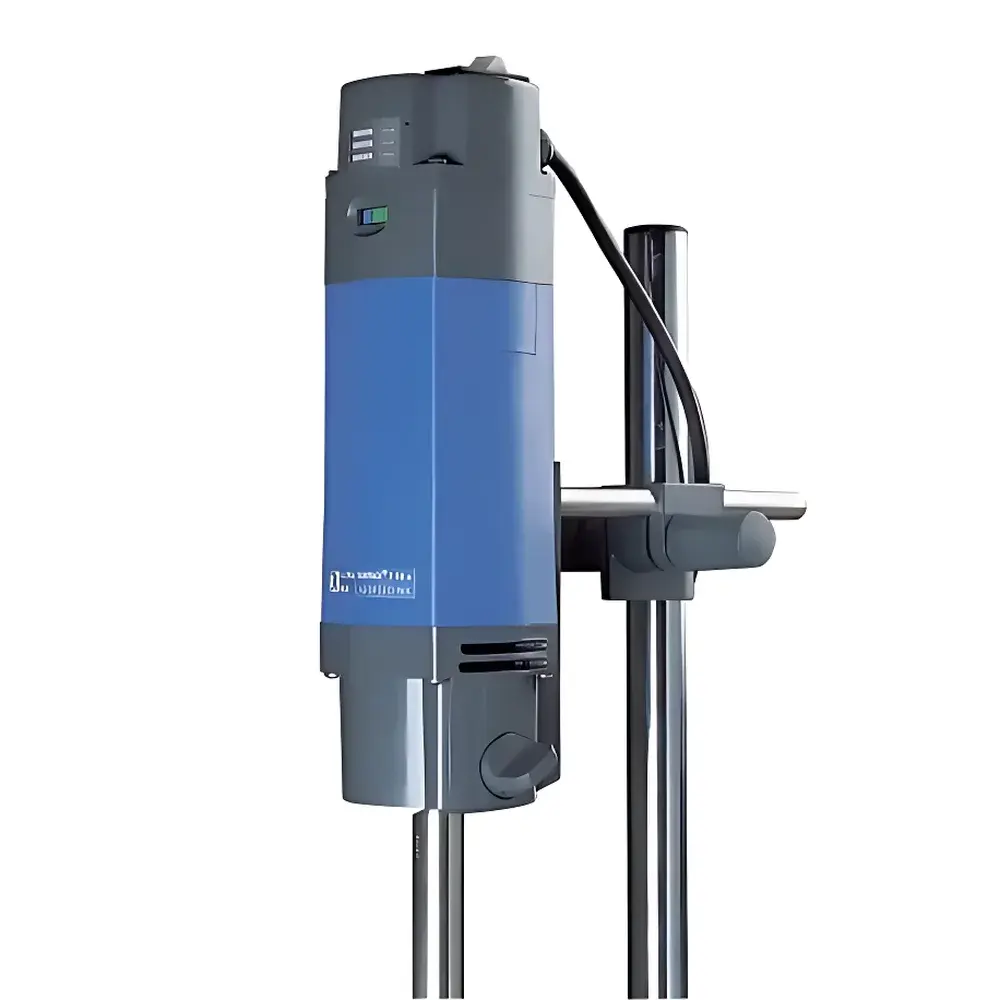
IKA T50 Basic High-Speed Disperser
| Brand | IKA |
|---|---|
| Origin | Germany |
| Model | T50 Basic |
| Motor Input Power | 1100 W |
| Motor Output Power | 700 W |
| Speed Range | 500–10,000 rpm |
| Speed Accuracy | ±1 % |
| Minimum Sample Volume (H₂O) | 0.25 L |
| Maximum Sample Volume (H₂O) | 30 L |
| Max. Viscosity | 5000 mPa·s |
| Drive Type | Three-bearing precision drive |
| Control | Continuous variable speed |
| Display | Analog tachometer scale |
| Noise Level (no dispersing tool) | 72 dB(A) |
| Shaft Diameter | 16 mm |
| Shaft Length | 220 mm |
| Protection Rating | IP20 |
| Operating Temperature | 5–40 °C |
| Relative Humidity Limit | 80 % |
| Voltage | 230 V, 50/60 Hz |
| Dimensions (W×H×D) | 125 × 367 × 120 mm |
| Weight | 6 kg |
| Process Mode | Batch |
Overview
The IKA T50 Basic is a high-performance, benchtop high-speed disperser engineered for reproducible homogenization, emulsification, and particle size reduction in laboratory-scale batch processing. It operates on the principle of rotor-stator shear dispersion: rotational energy from a precisely balanced three-bearing motor drive is transmitted to interchangeable dispersing tools, generating intense hydrodynamic shear forces within the sample. This mechanism enables efficient deagglomeration of powders, stabilization of suspensions and emulsions, and uniform dispersion of pigments, nanoparticles, or active pharmaceutical ingredients (APIs) into liquid matrices. Designed for routine QC, R&D, and formulation development workflows, the T50 Basic delivers consistent mechanical energy input across viscosity ranges up to 5000 mPa·s—ensuring process scalability and method transfer integrity between lab and pilot scale.
Key Features
- Three-point precision bearing system ensures mechanical stability and low-vibration operation at speeds up to 10,000 rpm, minimizing thermal drift and extending service life.
- Continuous variable speed control (500–10,000 rpm) with analog tachometer scale enables precise setpoint selection and real-time speed verification without digital interface dependency.
- Constant-speed regulation maintains nominal rpm ±1 % tolerance even under dynamic viscosity changes—critical for method robustness in non-Newtonian systems such as polymer solutions or colloidal dispersions.
- Quick-release insert-type tool coupling allows rapid interchange of dispersing heads (e.g., S-shaped, toothed, or fine-gap rotors) without tools or alignment fixtures—reducing cross-contamination risk and downtime.
- Integrated safety circuit prevents unintended startup; smooth ramp-up eliminates torque shock during initiation, protecting both operator and sample integrity.
- Standardized 16 mm diameter, 220 mm length extension shaft accommodates deep-vessel processing while maintaining concentricity and torsional rigidity.
- IP20-rated housing meets DIN EN 60529 requirements for indoor laboratory use under controlled environmental conditions (5–40 °C, ≤80 % RH).
Sample Compatibility & Compliance
The T50 Basic supports batch processing of volumes from 0.25 L to 30 L (water-equivalent), making it suitable for applications ranging from small-volume formulation screening to intermediate-scale feasibility studies. Its rotor-stator architecture accommodates a wide range of material classes—including aqueous and organic suspensions, thermosensitive biopolymers, abrasive pigment pastes, and high-solids-content battery electrode slurries—provided appropriate tool geometry and operational parameters are selected. While the unit itself does not carry CE marking for hazardous area use, its electrical design complies with EU Low Voltage Directive 2014/35/EU and EMC Directive 2014/30/EU. When integrated into validated laboratory workflows, the analog speed control and mechanical repeatability support adherence to GLP documentation standards and facilitate audit readiness for ISO/IEC 17025-accredited testing laboratories.
Software & Data Management
The T50 Basic operates as a standalone analog instrument with no embedded microprocessor or digital connectivity. Speed is monitored via a calibrated analog tachometer scale, eliminating software validation requirements under FDA 21 CFR Part 11. For laboratories requiring electronic data capture, optional external tachometer interfaces (e.g., pulse-output sensors compatible with LabVIEW or SCADA systems) may be deployed downstream. All operational parameters—including speed setpoint, duration, vessel geometry, and tool type—are manually recorded per SOP to maintain traceability. The absence of firmware or cloud-based features simplifies IQ/OQ protocols and reduces cybersecurity exposure in regulated environments.
Applications
- Routine quality control of paint, ink, and coating formulations for particle size distribution consistency.
- Preparation of nanocomposite dispersions for materials science research (e.g., graphene oxide in solvents, metal oxide nanoparticles in polymer melts).
- Homogenization of cell lysates and tissue homogenates prior to centrifugation or chromatographic analysis.
- Stabilization of oil-in-water and water-in-oil emulsions in food, cosmetic, and pharmaceutical development.
- Dispersion of conductive additives (e.g., carbon black, CNTs) into battery electrolyte or cathode slurry matrices.
- Deagglomeration of ceramic or pharmaceutical excipients during wet granulation process development.
FAQ
Is the R 50 stirring paddle included with the T50 Basic?
No—the R 50 high-shear stirring paddle is an optional accessory and must be ordered separately. It enables the unit to function as a high-speed overhead stirrer for viscous media, but is not part of the standard configuration.
Can the T50 Basic be used with corrosive solvents?
Material compatibility depends on the selected dispersing tool. Standard stainless steel (1.4404/316) rotors are suitable for most organic solvents and mild acids/bases; halogenated or strongly oxidizing media require Hastelloy or PTFE-coated tool variants (sold separately).
Does the unit support continuous (in-line) operation?
No—the T50 Basic is designed exclusively for batch processing. It lacks inlet/outlet ports, pressure rating, or flow-path engineering required for continuous mode.
What maintenance intervals are recommended?
IKA recommends annual inspection of bearing preload and shaft runout by authorized service personnel. Lubrication is sealed-for-life; no user-serviceable grease points exist.
Is calibration traceable to national standards?
Speed calibration is performed at factory using NIST-traceable tachometers. End users may verify accuracy with secondary handheld optical tachometers; formal recalibration services are available through IKA-certified labs.



