
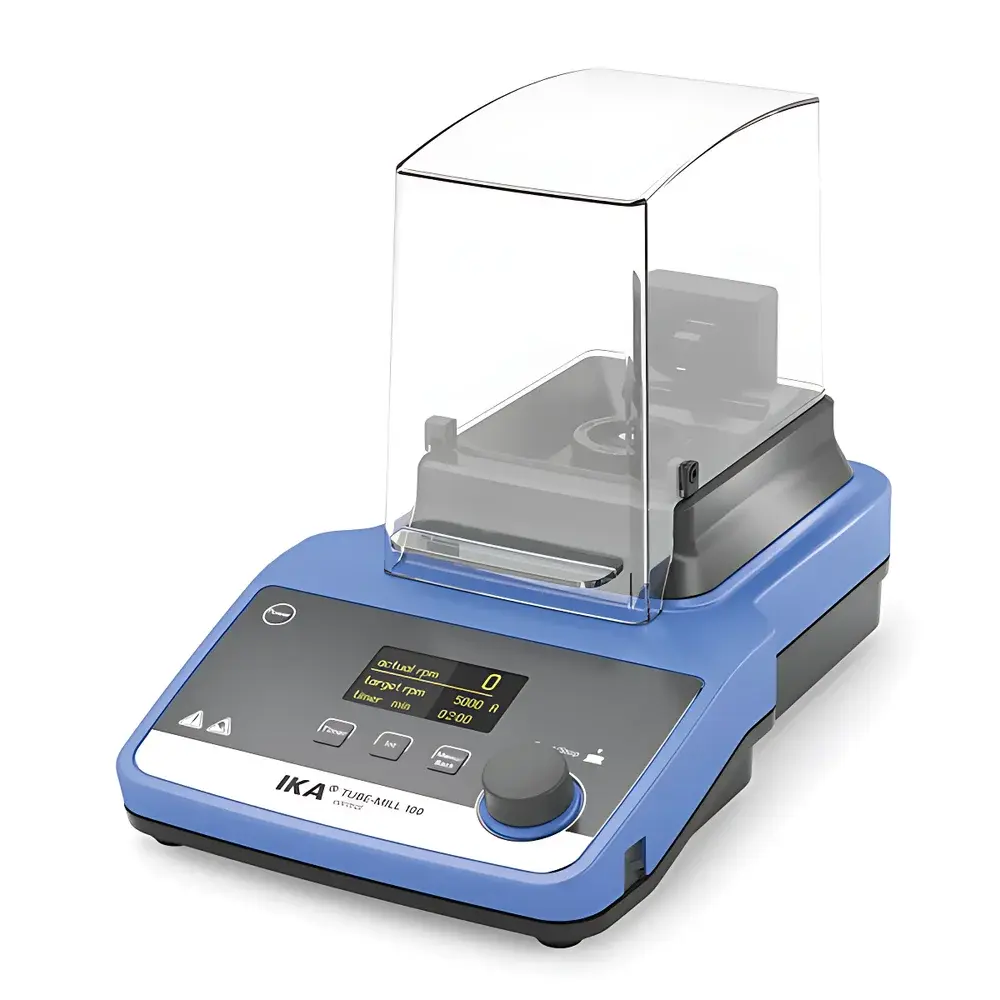
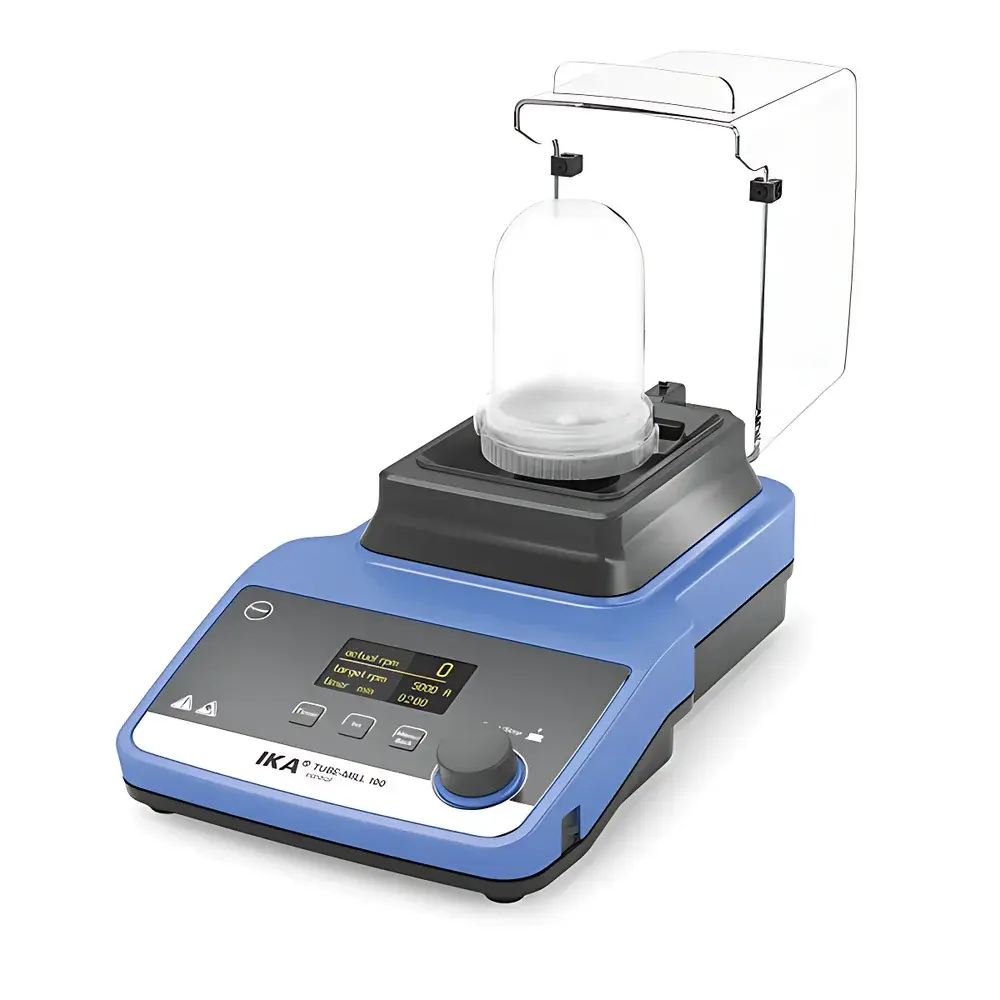
IKA Tube Mill 100 control Benchtop Tube Mill Grinder
| Brand | IKA |
|---|---|
| Origin | Germany |
| Manufacturer | IKA-Werke GmbH & Co. KG |
| Type | Batch-Processing Tube Mill Grinder |
| Model | Tube Mill 100 control |
| Sample Type | Soft to moderately hard, brittle, dry materials (max. 5 Mohs hardness) |
| Max. Feed Size | 10 mm |
| Final Particle Size | <10 µm (down to 0.01 mm) |
| Batch Volume | Up to 100 mL (MT 100 cup) |
| Operating Speed Range | 5,000–25,000 rpm (±2% deviation) |
| Motor Output Power | 80 W |
| Max. Peripheral Speed | 65 m/s |
| Cooling | Optional dry ice cooling in grinding chamber |
| Display | Multilingual OLED with error code logging |
| Control Interface | Touch keypad + USB port for parameter export and firmware updates |
| Safety | Interlocked lid switch (operation only when closed), IP30 rating per DIN EN 60529 |
| Dimensions (W×D×H) | 180 × 212 × 300 mm |
| Weight | 2.8 kg |
| Ambient Operating Conditions | 5–40 °C, ≤80% RH |
| Voltage/Frequency | 100–240 V, 50/60 Hz |
Overview
The IKA Tube Mill 100 control is a precision-engineered, benchtop batch tube mill grinder designed for reproducible, contamination-free size reduction of soft to moderately hard, dry, and brittle samples. It operates on the principle of high-speed rotational impact and shear, where sample material is subjected to intense mechanical forces generated by a rapidly rotating grinding element inside a sealed, disposable polypropylene or stainless-steel grinding cup. Unlike continuous-feed mills, the Tube Mill 100 control processes discrete batches—ensuring full traceability, eliminating carryover between runs, and supporting strict GLP/GMP workflows. Its patented design integrates a rigid, vibration-damped housing with an interlocked safety cover, ensuring operation only when fully closed—a critical feature for laboratory compliance with IEC 61000-3-2 and local occupational safety directives.
Key Features
- Programmable speed control (5,000–25,000 rpm) with ±2% accuracy and adjustable ramp-up/down profiles for optimized particle size distribution.
- Multi-language OLED display with real-time status monitoring, built-in error diagnostics (e.g., lid open, overtemperature, motor stall), and timestamped event logging.
- USB interface enabling configuration export/import, firmware updates, and raw parameter archiving—supporting audit-ready data integrity per FDA 21 CFR Part 11 requirements when paired with validated LIMS integration.
- Three included grinding cups: MT 40 (40 mL), MT 100 (100 mL), and MMT 40 (mini 40 mL with magnetic base)—all made from optically transparent, autoclavable polymer for visual process monitoring and compatibility with solvent-based cleaning protocols.
- Interlocked safety system compliant with EN 60204-1; machine halts immediately upon lid opening and prevents startup unless fully engaged.
- Optional dry ice cooling channel integrated into the grinding chamber wall—enabling cryogenic milling of thermolabile biological matrices (e.g., plant tissues, RNA-rich seeds) without condensation or thermal degradation.
Sample Compatibility & Compliance
The Tube Mill 100 control accommodates samples up to 10 mm in initial particle size and achieves final particle sizes consistently below 10 µm (verified via laser diffraction analysis per ISO 13320). It is validated for use with botanical materials (e.g., maize, wheat, soybean seeds), pharmaceutical excipients, polymers, and ceramic precursors—provided hardness does not exceed 5 Mohs (per ASTM D149). All wetted parts comply with USP Class VI biocompatibility standards. The instrument meets CE marking requirements under the Machinery Directive 2006/42/EC and electromagnetic compatibility per EN 61326-1. Routine calibration checks—using certified reference standards traceable to NIST—ensure long-term measurement stability across laboratories.
Software & Data Management
While the Tube Mill 100 control operates as a standalone unit, its embedded microcontroller supports parameter serialization via USB. Users may store up to 10 user-defined methods—including speed setpoint, duration, pause intervals (for intermittent grinding), and safety thresholds—with automatic recall on power-up. Exported .csv logs include timestamp, RPM profile, runtime, and fault codes—facilitating root-cause analysis during QA investigations. When deployed in regulated environments, these logs integrate natively with electronic lab notebooks (ELNs) and quality management systems (QMS) via secure SFTP or API middleware, satisfying ALCOA+ data governance principles.
Applications
- Pre-analytical sample homogenization prior to HPLC, GC-MS, or elemental analysis (e.g., heavy metal screening in cereals).
- Routine QC grinding of tablet excipients and active pharmaceutical ingredients (APIs) under cGMP Annex 11 guidelines.
- Seed tissue disruption for DNA/RNA extraction—particularly in agrigenomics labs requiring cross-contamination avoidance between cultivars.
- Particle size reduction of brittle ceramics and battery electrode materials for BET surface area analysis (ISO 9277).
- Method development for ASTM D5630 (plastic ash content) and ISO 3452-1 (non-destructive testing penetrant residue removal).
FAQ
What grinding media are compatible with the Tube Mill 100 control?
No external grinding media (e.g., beads or balls) are required—the system relies on rotor-cup impact mechanics. Grinding cups themselves serve as the consumable wear component.
Can the instrument be validated for GMP use?
Yes. IQ/OQ documentation templates are available from IKA upon request, and the device supports 21 CFR Part 11-compliant electronic signatures when used with approved third-party ELN platforms.
Is dry ice cooling mandatory for biological samples?
Not mandatory—but strongly recommended for heat-sensitive matrices. Dry ice maintains sub-zero chamber temperatures (< –20 °C) during operation, preserving nucleic acid integrity and inhibiting protease activity.
How often should the grinding cups be replaced?
MT-series cups are single-use per ISO/IEC 17025:2017 Clause 7.2.2. Reuse introduces risk of microfracture-induced particulate contamination and inconsistent energy transfer.
Does the USB interface support real-time data streaming?
No—it enables batch export of completed run parameters and logs. Real-time telemetry requires optional IKA Labworld software (sold separately) with Ethernet gateway integration.



