
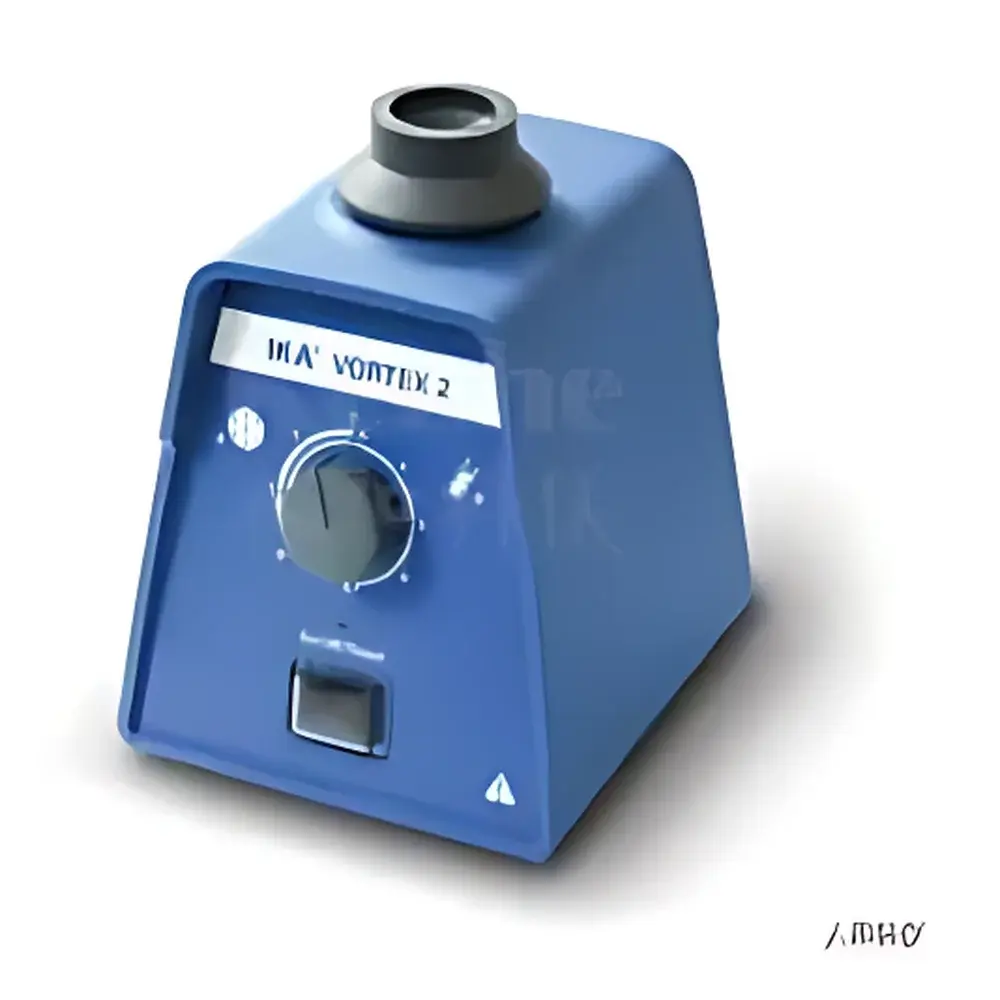
IKA Vortex 2 Orbital Shaker
| Brand | IKA |
|---|---|
| Origin | Germany |
| Model | Vortex 2 |
| Oscillation Frequency | 500–2500 rpm |
| Oscillation Amplitude | 4 mm |
| Temperature Range | 5–40 °C |
| Dimensions (W × D × H) | 120 × 140 × 138 mm |
| Weight | 3.9 kg |
| Max Load Capacity (including fixture) | 0.4 kg |
| Input Power | 60 W |
| Protection Rating | IP21 |
| Operating Ambient Temperature | 5–40 °C |
| Relative Humidity Limit | ≤80 % |
| Voltage | 220–240 V / 115 V / 100 V |
| Frequency | 50/60 Hz |
| Motor Input Power | 39 W |
| Motor Output Power | 9 W |
| Speed Control | Analog dial (0–6 scale) |
| Timer | None |
| Communication Interfaces | None |
| Compliance | DIN EN 60529 |
Overview
The IKA Vortex 2 Orbital Shaker is a compact, high-stability benchtop shaker engineered for precise and reproducible mixing of small-volume samples in life science laboratories. It operates on the principle of orbital motion—generating a consistent 4 mm circular orbit at adjustable speeds between 500 and 2500 rpm—enabling efficient suspension, resuspension, and homogenization of biological suspensions, cell cultures, reagents, and assay components. Designed for continuous or momentary (touch-activated) operation, the unit features an optimized motor cooling architecture that minimizes thermal drift during extended use—a critical factor when handling temperature-sensitive biomolecules or enzymatic reactions. Its rigid metal housing, silicone non-slip feet, and balanced mechanical drive train ensure vibration-free performance even at maximum speed, meeting the mechanical stability requirements outlined in ISO 13732-2 for laboratory equipment used in GLP-compliant environments.
Key Features
- Orbital shaking motion with fixed 4 mm orbit diameter—ideal for uniform sample agitation without foaming or splashing.
- Analog speed control via calibrated dial (0–6 scale), enabling fine-tuned adjustment across the full 500–2500 rpm range.
- Touch-activation mode allows instant start/stop for rapid vortexing of individual tubes without interrupting workflow.
- Robust aluminum alloy chassis with powder-coated steel top plate and integrated silicone anti-slip feet for secure placement on laminar flow hoods or centrifuge benches.
- Thermally optimized brushless motor delivering 9 W mechanical output from 39 W electrical input—ensuring low surface temperature rise (<15 K above ambient after 2 h continuous operation).
- IP21-rated enclosure provides protection against vertically falling drips and solid objects >12.5 mm—suitable for standard wet-lab environments compliant with IEC 61000-6-3 EMC emission limits.
- Rated for 100% duty cycle—capable of uninterrupted operation over multi-shift schedules without derating.
Sample Compatibility & Compliance
The Vortex 2 supports a wide range of common labware configurations through optional, application-specific fixtures—including conical tube holders (e.g., 250 mL Erlenmeyer flasks), microplate clamps (96-well and 384-well formats), and universal adapters for Eppendorf-style tubes (0.2–50 mL). All fixtures mount via standardized M4 threaded inserts and are secured using the VG3.36 retention strap system—designed to prevent lateral displacement under centrifugal loading up to 0.4 kg total mass (fixture + sample). The device conforms to DIN EN 60529 for ingress protection and meets essential safety requirements of the EU Machinery Directive 2006/42/EC. While not equipped with digital audit trails or electronic signature capabilities, its analog interface and stable mechanical design support use in non-regulated research settings and preliminary method development aligned with USP Analytical Instrument Qualification guidelines.
Software & Data Management
The IKA Vortex 2 is a stand-alone analog instrument with no embedded microprocessor, network interface, or data logging capability. It does not feature RS232, USB, or analog output ports; therefore, it is not compatible with laboratory information management systems (LIMS) or electronic lab notebooks (ELN) for automated parameter capture. Speed settings are manually selected and verified visually via the engraved dial scale—making it suitable for applications where procedural consistency relies on operator training and SOP-defined setpoints rather than software-enforced protocols. This architecture eliminates firmware validation requirements under FDA 21 CFR Part 11, simplifying qualification for routine QC tasks in academic and industrial R&D labs operating under basic GLP frameworks.
Applications
- Resuspension of lyophilized proteins, bacterial pellets, and cryopreserved cells prior to downstream analysis.
- Homogenization of immunoassay reagents, ELISA coating solutions, and antibody dilutions.
- Equilibration of PCR master mixes and restriction enzyme digests before thermal cycling.
- Mixing of viscous samples such as agarose gels, glycerol stocks, and high-concentration DNA solutions.
- Pre-incubation agitation of microbial cultures in small-volume flasks during growth curve experiments.
- Supporting sample preparation workflows in biobanking, clinical diagnostics, and pharmaceutical pre-formulation studies.
FAQ
Is the Vortex 2 suitable for temperature-controlled incubation?
No—the unit does not incorporate active heating or cooling elements. It is rated for safe operation within ambient environments of 5–40 °C but does not regulate sample temperature.
Can it accommodate microtiter plates?
Yes—when fitted with the optional 96-well or 384-well microplate clamp (sold separately), it delivers uniform orbital motion across all wells without edge-to-center bias.
What is the maximum permissible load including fixture weight?
The total supported mass—including fixture, vessel, and sample—must not exceed 0.4 kg to maintain mechanical integrity and speed accuracy.
Does it meet regulatory requirements for GMP manufacturing environments?
While mechanically robust and traceable to German manufacturing standards, it lacks electronic audit trail functionality required for full 21 CFR Part 11 compliance; thus, it is recommended for R&D and non-critical QC applications only.
How is speed calibration verified?
Users may validate rotational speed using a certified handheld tachometer referenced to ISO 16063-11; IKA provides factory calibration documentation upon request for IQ/OQ protocols.






