
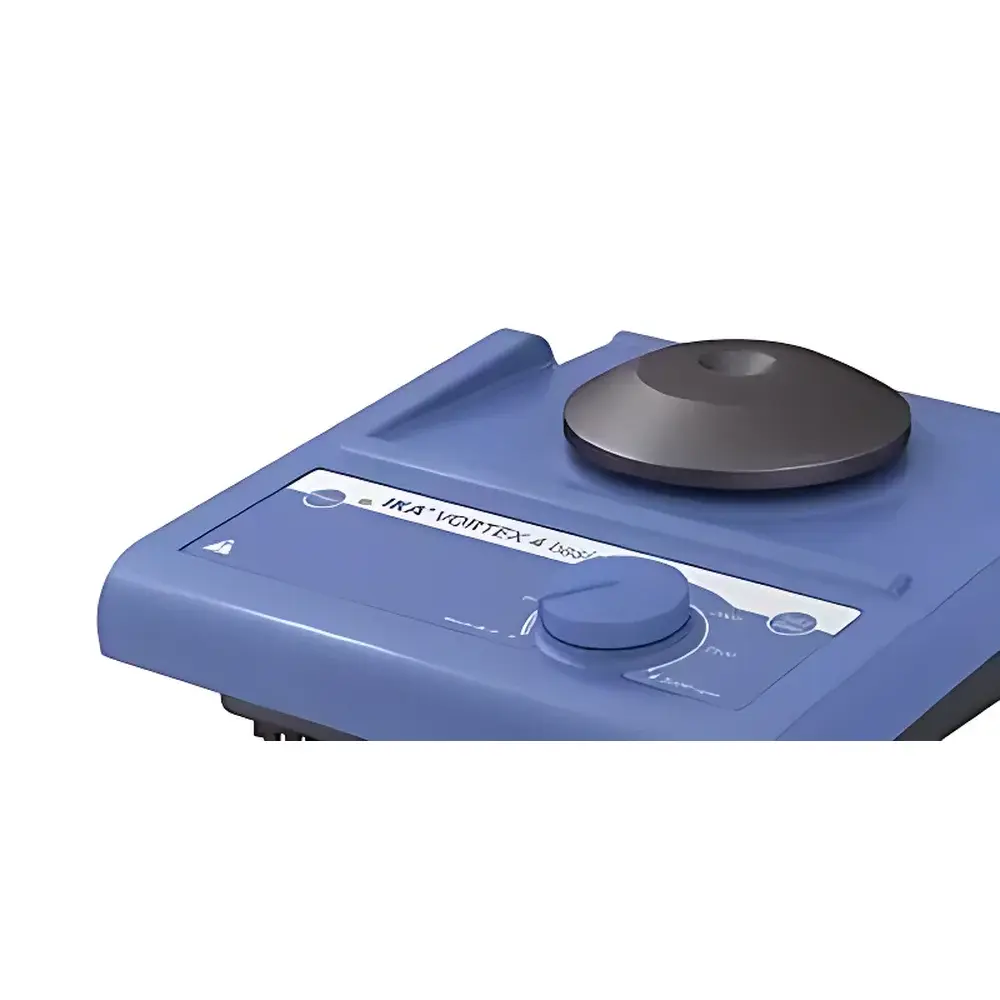
IKA VORTEX 4 basic Vortex Mixer
| Brand | IKA |
|---|---|
| Origin | Germany |
| Model | VORTEX 4 basic |
| Speed Range | 0–3,000 rpm |
| Operating Modes | Continuous / Touch Mode |
| Oscillation Type | Circular |
| Amplitude | 4.5 mm |
| Housing Material | Zinc Alloy Die-Cast |
| Speed Indication | Analog Scale |
| Max Load (incl. foam pad) | 0.5 kg |
| Motor Input Power | 10 W |
| Motor Output Power | 8 W |
| Duty Cycle | 100% |
| Dimensions (W×D×H) | 148 × 205 × 63 mm |
| Weight | 2.9 kg |
| Ambient Temperature Range | 5–40 °C |
| Relative Humidity Limit | ≤80% |
| Protection Class | IP21 |
Overview
The IKA VORTEX 4 basic is a compact, robust benchtop vortex mixer engineered for reliable and reproducible sample homogenization in routine laboratory workflows. Utilizing a motor-driven eccentric drive mechanism, it generates consistent circular oscillation—characterized by a 4.5 mm orbital diameter—to induce turbulent mixing in tubes, vials, and microplates. Designed for continuous-duty operation with no duty-cycle limitations, the instrument delivers stable rotational energy across its full 0–3,000 rpm speed range. Its zinc alloy die-cast housing provides mechanical rigidity and thermal stability, minimizing vibration transmission to the work surface while ensuring long-term dimensional integrity under repeated use. The device operates without electronic speed feedback or digital control circuitry; instead, speed is manually adjusted via a calibrated analog dial, offering intuitive, maintenance-free operation suitable for GLP-compliant environments where simplicity and traceability are prioritized.
Key Features
- Zinc alloy die-cast housing for enhanced durability, thermal mass, and resistance to mechanical deformation
- True 100% continuous-duty rating—no thermal derating or mandatory cooldown periods
- Two operational modes: continuous rotation and momentary touch activation (via integrated pressure-sensitive switch)
- Dual-mode logic architecture: Mode A enables automatic detection of standard IKA foam pads, limiting maximum speed to 3,000 rpm only when certified accessories are present; Mode B bypasses pad detection, permitting full-speed operation (up to 3,000 rpm) with any compatible platform
- Analog speed scale with tactile calibration marks—designed for visual verification and manual repeatability without dependency on firmware or display electronics
- Low-power motor system (10 W input / 8 W output) optimized for energy efficiency and minimal heat generation during extended operation
- IP21-rated enclosure—providing protection against vertically falling drips and solid objects ≥12.5 mm, suitable for standard laboratory ambient conditions (5–40 °C, ≤80% RH)
Sample Compatibility & Compliance
The VORTEX 4 basic accommodates standard 0.2–50 mL tube formats—including conical-bottom centrifuge tubes, PCR strips, and 96-well microplates—when used with appropriate interchangeable platforms (sold separately). Maximum supported load is 0.5 kg, inclusive of adapter weight and sample volume. While the device itself carries no embedded regulatory certification (e.g., CE marking is applied at the system level per EU Directive 2014/30/EU for EMC and 2014/35/EU for LVD), its construction and performance align with general-purpose laboratory equipment requirements under ISO/IEC 17025:2017 clause 6.4 (equipment suitability) and ASTM D2240 (for elastomeric pad hardness verification). It is not intended for use in sterile or explosion-hazardous environments, nor does it comply with FDA 21 CFR Part 11 requirements due to absence of audit-trail-capable software or electronic data capture.
Software & Data Management
The VORTEX 4 basic operates as a standalone electromechanical instrument with no embedded microprocessor, firmware, or connectivity interfaces. Consequently, it does not support software integration, remote control, data logging, or electronic recordkeeping. All operational parameters—including speed setting, mode selection, and runtime—are determined manually and documented externally (e.g., in lab notebooks or LIMS entries). This design eliminates validation complexity associated with electronic systems, simplifying IQ/OQ protocols in regulated QC laboratories where procedural traceability is maintained through operator logs rather than digital audit trails.
Applications
This vortex mixer serves core sample preparation functions across pharmaceutical quality control, clinical diagnostics, molecular biology, and environmental testing labs. Typical applications include resuspension of lyophilized reagents, homogenization of cell suspensions prior to centrifugation, emulsification of immiscible liquid phases in extraction protocols, and thorough mixing of viscous buffers or enzyme solutions. Its consistent orbital motion ensures uniform shear distribution without foaming artifacts commonly observed in high-shear rotor-stator systems. Due to its lack of programmability, it is especially suited for SOP-driven processes where fixed mixing durations and speeds are pre-established and verified during method validation.
FAQ
Does the VORTEX 4 basic include a timer function?
No—the VORTEX 4 basic does not feature an integrated timer or countdown capability. Timing must be managed externally using a stopwatch or laboratory timer.
Can I use non-IKA adapters or custom platforms?
Yes, provided they are mechanically compatible and do not exceed the 0.5 kg total load limit; however, using non-standard pads disables Mode A’s safety-limited speed control, defaulting operation to Mode B.
Is the speed setting repeatable between users?
Yes—repeatability relies on consistent positioning of the analog dial relative to its engraved scale; inter-operator variation can be minimized through standardized training and documented dial-position references.
What maintenance is required?
No scheduled maintenance is specified; periodic inspection of the eccentric drive coupling and cleaning of the housing with isopropyl alcohol is recommended to prevent dust accumulation in moving parts.
Is this instrument suitable for GMP-regulated environments?
Yes—as a Class I, non-critical, manually operated device, it may be included in GMP workflows provided its operational parameters are defined in written procedures and its performance is verified annually via speed calibration using a certified tachometer.



