
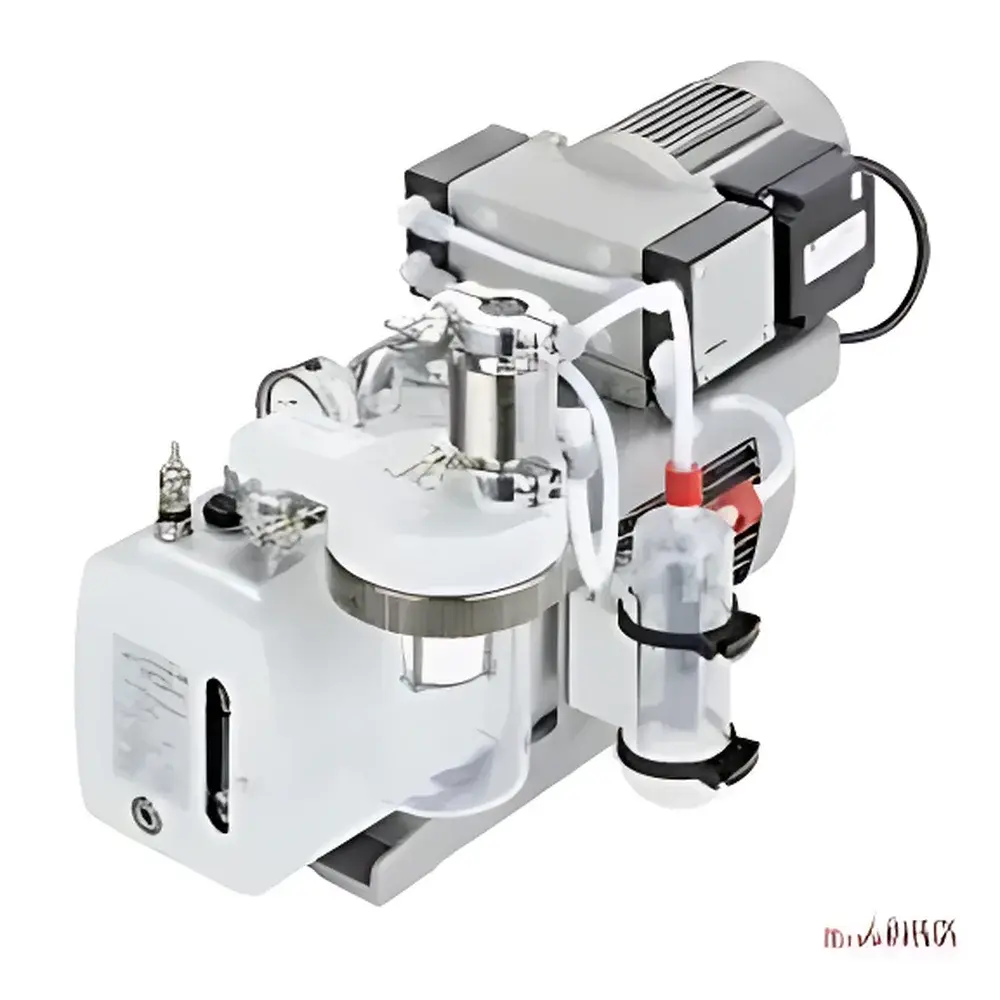
ILMVAC Hybrid Corrosion-Resistant Vacuum Pump P23Z-301
| Brand | ILMVAC |
|---|---|
| Origin | Germany |
| Pump Type | Hybrid (Rotary Vane + Chemically Resistant Diaphragm) |
| Model | P23Z-301 |
| Ultimate Vacuum | < 2 × 10⁻³ mbar |
| Pumping Speed | 21 m³/h |
| Motor Power | 900 W |
| Dimensions (W × D × H) | 590 × 345 × 420 mm |
| Weight | 46 kg |
| Oil Capacity | 1000 mL |
| Electrical Supply | 230 V, 50 Hz |
| Inlet Port | DN 25 KF |
Overview
The ILMVAC P23Z-301 is a purpose-engineered hybrid vacuum pump designed for demanding laboratory and pilot-scale applications involving chemically aggressive vapors and condensable solvents. It integrates two complementary pumping technologies in a single, compact unit: a high-performance oil-lubricated rotary vane pump (primary stage) and a corrosion-resistant diaphragm pump (booster stage). This architecture leverages the rotary vane pump’s ability to achieve deep ultimate vacuum (< 2 × 10⁻³ mbar) and high volumetric throughput (21 m³/h), while the upstream diaphragm stage actively scavenges reactive gases and solvent vapors before they enter the oil-filled chamber. By minimizing residence time and exposure of the rotary vane oil to corrosive species—such as halogenated solvents, organic acids, or acidic process byproducts—the P23Z-301 significantly extends oil service life, reduces maintenance frequency, and preserves long-term vacuum stability. The system operates without external controllers; a single power switch activates both stages synchronously, ensuring coordinated startup and shutdown sequences critical for process repeatability and equipment protection.
Key Features
- Hybrid dual-stage design combining an oil-lubricated rotary vane pump and a chemically inert diaphragm booster—engineered to isolate corrosive media from the oil circuit.
- Integrated pressure relief valve compliant with EN 60204-1, preventing over-pressurization during venting or solvent backstreaming events.
- Dedicated oil aeration chamber that increases oil surface area and accelerates degassing of dissolved volatiles, improving oil longevity and reducing foaming under high vapor load.
- Removable liquid–gas separation bottle with sight glass, capturing condensed solvents and preventing liquid ingress into the rotary vane section.
- DN 25 KF inlet port standardized for compatibility with common laboratory vacuum lines and ISO-KF modular systems.
- Robust cast-aluminum housing with vibration-damped motor mount, optimized for continuous operation in QC labs and R&D environments.
- Full compliance with CE marking requirements, including electromagnetic compatibility (EMC Directive 2014/30/EU) and low-voltage safety (LVD Directive 2014/35/EU).
Sample Compatibility & Compliance
The P23Z-301 is validated for use with a broad spectrum of chemically challenging media, including but not limited to chlorinated hydrocarbons (e.g., chloroform, dichloromethane), carboxylic acids (e.g., acetic, formic), sulfur-containing compounds, and low-boiling-point solvents prone to condensation (e.g., acetone, ethyl acetate, THF). Its diaphragm stage employs FFKM (perfluoroelastomer) elastomers and PTFE-coated components, delivering exceptional resistance to swelling, degradation, and permeation. While the pump itself does not require GLP or GMP certification, its operational consistency, repeatable ultimate vacuum performance, and traceable maintenance intervals support adherence to ISO/IEC 17025-accredited testing workflows. The absence of electronic control logic ensures intrinsic compatibility with environments requiring minimal electromagnetic interference or analog-only integration.
Software & Data Management
The P23Z-301 is a standalone, hardware-controlled vacuum source with no embedded microprocessor or digital interface. All operational parameters—including motor status, thermal cutout activation, and pressure stabilization—are monitored via mechanical gauges and passive safety circuits. This analog architecture eliminates firmware dependencies, cybersecurity concerns, or software validation requirements often associated with digitally managed pumps. For laboratories operating under FDA 21 CFR Part 11 or EU Annex 11, the pump supports audit-ready documentation through manual logbooks recording start/stop times, oil change dates, separator bottle inspections, and observed vacuum decay rates—enabling full traceability without digital signature overhead.
Applications
- Routine solvent removal in rotary evaporation systems handling aggressive chemistries, where conventional single-stage rotary vane pumps suffer rapid oil degradation.
- Vacuum distillation and fractional crystallization of acid-sensitive or halogen-rich compounds in synthetic organic chemistry labs.
- High-vacuum drying of moisture- or solvent-laden samples in pharmaceutical formulation development, particularly when residual solvent profiles must remain below ICH Q3C thresholds.
- Supporting glovebox purging and vacuum transfer lines in battery materials research involving LiPF₆ electrolyte vapors or HF-generating decomposition products.
- Backing diffusion or turbomolecular pumps in analytical instrumentation (e.g., GC-MS, XRD sample chambers) where hydrocarbon backstreaming must be minimized in corrosive ambient conditions.
FAQ
Is the P23Z-301 suitable for continuous duty operation?
Yes—its 900 W motor and thermally stabilized oil circuit are rated for uninterrupted 24/7 operation at ambient temperatures up to 40 °C, provided ambient ventilation meets DIN EN 60034-6 specifications.
What maintenance intervals are recommended for the diaphragm stage?
Under typical lab usage (8 h/day, moderate solvent load), diaphragm replacement is advised every 6,000–8,000 operating hours; the rotary vane oil should be changed every 1,500 hours or after processing ≥50 L of condensable solvent.
Can the pump be used with reactive gases such as Cl₂ or NH₃?
FFKM diaphragms provide excellent resistance to Cl₂ at partial pressures ≤10 mbar; NH₃ requires optional stainless-steel wetted parts upgrade (P23Z-301-SS variant) due to potential elastomer embrittlement.
Does the pump meet vacuum class requirements for ASTM E595 outgassing testing?
While not certified per ASTM E595, its low hydrocarbon emission profile—verified via residual gas analysis (RGA) at 10⁻⁴ mbar—makes it suitable as a backing pump in ultra-high vacuum systems qualifying materials per this standard.
Is a vacuum gauge included with the P23Z-301?
No—vacuum measurement is performed externally; the pump is compatible with all standard analog or digital Pirani, capacitance manometer, or cold cathode gauges via the DN 25 KF port.



