
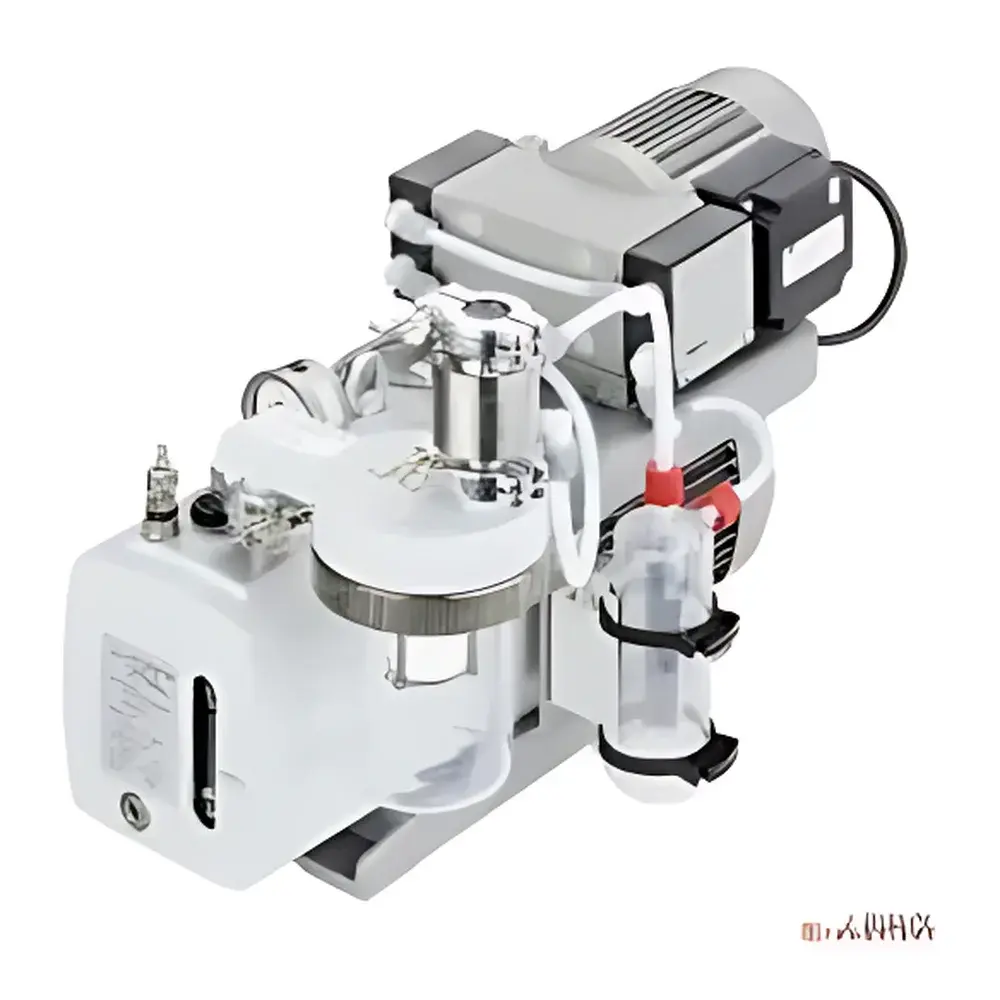
ILMVAC Hybrid Corrosion-Resistant Vacuum Pump P6Z-101
| Brand | ILMVAC |
|---|---|
| Origin | Germany |
| Model | P6Z-101 |
| Pump Type | Hybrid (Rotary Vane + Chemically Resistant Diaphragm) |
| Ultimate Vacuum | <2×10⁻³ mbar |
| Pumping Speed | 5.8 m³/h |
| Dimensions (W×D×H) | 500×330×340 mm |
| Weight | 25.5 kg |
| Motor Power | 400 W |
| Oil Capacity | 1000 mL |
| Electrical Supply | 230 V, 50 Hz |
| Inlet Port | DN 16 KF |
Overview
The ILMVAC P6Z-101 is an engineered hybrid vacuum pump system designed for laboratories and industrial R&D environments where aggressive chemical vapors, condensable solvents, or reactive process gases are routinely handled. It integrates a high-performance oil-lubricated rotary vane pump with a chemically resistant diaphragm pump in a mechanically synchronized configuration—enabling the diaphragm stage to continuously purge residual corrosive gas from the rotary vane chamber before it can react with pump oil or internal surfaces. This architecture preserves the rotary vane pump’s inherent capability to achieve deep ultimate vacuum (<2×10⁻³ mbar) while mitigating chemical degradation of lubricants and critical components. Unlike standalone dry pumps—whose ultimate vacuum and pumping speed degrade significantly under vapor load—the P6Z-101 maintains stable performance across mixed-phase (vapor + non-condensable gas) evacuation scenarios, making it suitable for applications such as solvent distillation, vacuum drying of acidic or halogenated samples, and vacuum-assisted chemical synthesis.
Key Features
- Hybrid dual-stage architecture: Rotary vane pump (primary high-vacuum stage) coupled with a chemically inert diaphragm pump (pre-purge and vapor scavenging stage)
- Corrosion-resistant wetted materials: Fluoroelastomer (FKM) diaphragms, PTFE-coated valves, and stainless-steel oil reservoir components ensure compatibility with HCl, HF, Cl₂, SO₂, organic acids, and halogenated solvents
- Integrated liquid–gas separation bottle: Captures condensed vapors upstream of the rotary vane section, preventing oil contamination and hydraulic lock
- Oil chamber bubble diffuser: Increases oil surface area and residence time, accelerating degassing of dissolved volatiles and minimizing oil foaming during transient vapor loads
- Dedicated pressure relief valve: Automatically vents the oil sump if internal backpressure exceeds safe operational thresholds, complying with EN 60204-1 mechanical safety requirements
- Single-point power control: Unified mains switch activates both pump stages synchronously, ensuring correct startup sequence and eliminating operator-induced sequencing errors
- Oil capacity of 1000 mL with sight glass: Facilitates routine visual inspection and maintenance planning per ISO 55001 asset management guidelines
Sample Compatibility & Compliance
The P6Z-101 is validated for continuous operation with chemically aggressive media commonly encountered in pharmaceutical process development, semiconductor etch residue handling, and academic corrosion science research. Its design meets ISO 8573-1 Class 4 purity requirements for compressed air–adjacent vacuum systems and conforms to CE marking directives (2014/30/EU EMC, 2014/35/EU LVD). The pump’s oil-lubricated rotary vane section operates within ASTM D2889-defined thermal stability limits for mineral-based vacuum oils when used with compatible vapors; however, users must select oil grade (e.g., ILMVAC VP 100) according to vapor type and concentration—documentation supporting this selection is provided in the EU Declaration of Conformity (DoC) supplied with each unit. No modifications are required to meet GLP-compliant laboratory infrastructure standards, and audit-ready maintenance logs can be generated using optional RS-485 interface (not standard, available upon request).
Software & Data Management
The P6Z-101 operates as a standalone analog device with no embedded firmware or digital display. All operational parameters—including motor current draw, temperature rise at bearing housings, and oil level—are monitored via mechanical gauges and tactile indicators. For integration into automated workflows, third-party pressure controllers (e.g., MKS 925B) or PLC-based vacuum sequencers may be connected via the standard 230 V / 50 Hz supply line and auxiliary dry-contact outputs (optional add-on). While the pump does not generate electronic data streams, its mechanical reliability supports long-term unattended operation in ISO/IEC 17025-accredited testing labs where traceability is maintained through scheduled calibration of external vacuum gauges (e.g., capacitance manometers traceable to NIST SRM 2034) and documented oil change intervals.
Applications
- Vacuum distillation of chlorinated solvents (e.g., CH₂Cl₂, CCl₄) and low-boiling organic acids (e.g., acetic anhydride, trifluoroacetic acid)
- Lyophilization of pH-sensitive biologics where residual acidic vapors could compromise protein conformation
- Evacuation of reaction vessels during Grignard or organolithium chemistry under inert atmosphere purging
- Exhaust systems for fume hoods handling hydrofluoric acid etchants or bromine-based reagents
- High-vacuum backing for turbomolecular pumps in surface science chambers exposed to reactive precursor gases (e.g., TiCl₄, WF₆)
- Environmental simulation chambers requiring stable sub-mTorr base pressure in presence of humidity or VOC outgassing
FAQ
Is the P6Z-101 suitable for continuous duty with saturated solvent vapors?
Yes—when operated with appropriate oil selection and routine condensate removal from the separator bottle, the P6Z-101 supports uninterrupted 8-hour shifts under typical lab-scale solvent evaporation loads.
Does the pump require special oil disposal procedures after use with halogenated compounds?
Yes—oil contaminated with chlorine- or fluorine-containing vapors must be treated as hazardous waste per local EPA or ECHA regulations; ILMVAC provides Material Safety Data Sheets (MSDS) for all recommended oils.
Can the diaphragm pump stage operate independently of the rotary vane pump?
No—the control circuitry enforces strict sequential activation; the diaphragm pump starts 3 seconds before the rotary vane pump and remains active until shutdown is complete, ensuring no corrosive gas accumulates in the oil sump.
What maintenance intervals are recommended for GLP-compliant operation?
Oil changes every 500 operating hours or quarterly (whichever occurs first); diaphragm replacement every 3,000 hours; full service inspection per ISO 13374 vibration analysis protocol annually.
Is DN 16 KF the only inlet interface option?
Yes—standard configuration uses DN 16 KF; custom flanges (e.g., CF 35, ISO-KF 25) are available as factory-installed options with extended lead time and documentation revision.



