
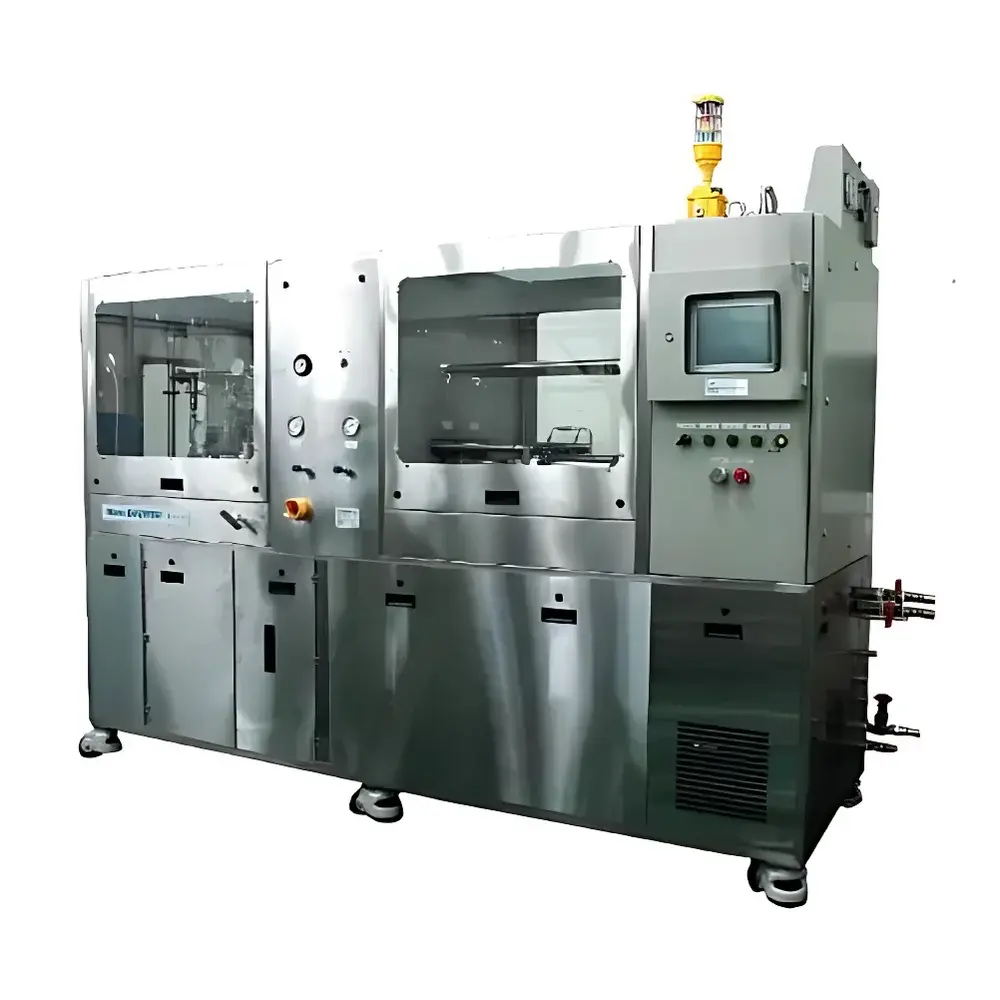
Ilshin Autoclave Nano-Disperser NH8000 High-Pressure Microfluidic Homogenizer
| Brand | Ilshin Autoclave |
|---|---|
| Origin | South Korea |
| Model | NH8000 |
| Instrument Type | High-Pressure Microfluidic Homogenizer |
| Operating Pressure | Up to 2,000 bar (rated 1,500 bar) |
| Max. Flow Rate | 8,000 mL/min |
| Interaction Chamber Orifice Sizes | 100 µm, 200 µm, 400 µm (Z/Y-type) |
| Dimensions (W×D×H) | 1000 mm × 3500 mm × 2100 mm |
| Weight | Approx. 3,000 kg |
| Pump System | Hydraulic unit (220/380 V, 3-phase, 50 hp) |
| Inlet Reservoir | Integrated solution tank with anti-solidification design |
| Cooling | Dedicated cooling line on high-pressure manifold |
| Additional Features | Real-time monitor & alarm system, automated back-flushing system |
Overview
The Ilshin Autoclave Nano-Disperser NH8000 is a high-pressure microfluidic homogenizer engineered for reproducible, scalable nanoscale dispersion and cell disruption across demanding R&D and cGMP-compliant manufacturing environments. Unlike conventional rotor-stator or ultrasonic systems, the NH8000 operates on the principle of controlled microfluidic cavitation and turbulent shear: pressurized fluid (up to 2,000 bar) is forced through precisely engineered interaction chambers with fixed orifice diameters (100–400 µm), inducing instantaneous pressure drop, supersonic velocity gradients, inter-particle collision, and hydrodynamic cavitation. This tri-modal mechanical stress—impact, shear, and cavitation—enables uniform particle size reduction to sub-100 nm with narrow polydispersity indices (PDI < 0.1), minimal thermal load, and negligible metal contamination. The system’s hydraulic drive architecture ensures stable pressure delivery independent of viscosity fluctuations, making it suitable for non-Newtonian suspensions, liposomal formulations, and high-solids slurries common in advanced material synthesis.
Key Features
- Triple-action microfluidic homogenization: simultaneous impact, turbulent shear, and transient cavitation within Z- or Y-type interaction chambers
- Modular interaction chamber system supporting interchangeable orifices (100 µm, 200 µm, 400 µm) for process optimization and scalability from lab to pilot scale
- Hydraulic power unit rated at 50 hp (220/380 V, 3-phase) delivering stable pressure up to 2,000 bar with ±0.5% pressure regulation accuracy
- Integrated cooling circuit on high-pressure manifolds to maintain sample temperature rise below 5 °C per pass under continuous operation
- Anti-solidification solution tank with level sensing and agitated feed to prevent sedimentation or gelation of viscous precursors
- Real-time HMI touchscreen interface with configurable alarm thresholds for pressure deviation, temperature excursion, flow interruption, and chamber blockage detection
- Automated back-flushing protocol triggered by differential pressure monitoring across the interaction chamber, reducing downtime and cross-contamination risk
Sample Compatibility & Compliance
The NH8000 accommodates aqueous, organic, and biphasic systems—including liposomes, polymeric nanoparticles, ceramic slurries, protein suspensions, and emulsions—with viscosities up to 10,000 cP. Its all-316L stainless-steel wetted path complies with FDA 21 CFR Part 11 requirements for electronic records when paired with validated software configurations. The system supports GLP/GMP documentation workflows via audit-trail-enabled data logging and meets ISO 22000 and USP criteria for particle size distribution validation in injectable and inhalable dosage forms. It is routinely employed in facilities audited under ISO 13485 (medical devices), ICH Q5A (biotech products), and ASTM D7853 (nanomaterial dispersion stability testing).
Software & Data Management
The embedded control firmware logs time-stamped operational parameters—including inlet pressure, outlet pressure, flow rate, chamber temperature, and cycle count—at 10 Hz resolution. Export formats include CSV and XML for integration with LIMS or MES platforms. Optional IQ/OQ/PQ validation packages are available, including traceable calibration certificates for pressure transducers (NIST-traceable), flow meters (ISO 17025 accredited), and temperature sensors. All data archives support 21 CFR Part 11-compliant user authentication, electronic signatures, and immutable audit trails. Remote diagnostics and firmware updates are accessible via secure TLS 1.2–encrypted Ethernet connection.
Applications
- Pharmaceuticals: Production of sterile nanoemulsions, liposomal doxorubicin analogs, mRNA-LNP formulations, and parenteral nanosuspensions compliant with USP and EP 2.9.31
- Biotechnology: High-yield mammalian cell lysis for intracellular protein recovery; vaccine antigen homogenization without denaturation
- Electronics: Dispersion of conductive metal oxides (e.g., ITO, AZO) and carbon nanotubes for transparent electrode inks used in MLCC dielectric layers
- Food & Nutraceuticals: Stabilization of omega-3 oil-in-water emulsions, plant sterol nanodispersions, and vitamin E nanoencapsulation with enhanced bioavailability
- Advanced Materials: Exfoliation of 2D materials (graphene, MoS₂), homogeneous mixing of ceramic precursors for sintering-grade slurries, and polymer nanocomposite masterbatch preparation
- Cosmetics: Submicron pigment dispersion for long-term colloidal stability in water-based foundations and sunscreen formulations
FAQ
What is the maximum allowable solids content for processing in the NH8000?
The system supports solids loading up to 40 wt% for ceramic and polymer dispersions, provided particles are pre-milled to <5 µm and slurry rheology remains pumpable (yield stress < 200 Pa).
Can the NH8000 be integrated into an aseptic processing line?
Yes—when equipped with SIP-capable interaction chambers, steam-jacketed inlet reservoir, and fully drainable fluid path, the NH8000 meets ASME BPE 2022 surface finish (Ra ≤ 0.4 µm) and can undergo validated steam-in-place cycles at 121 °C for 30 min.
How is process repeatability ensured across different orifice sizes?
Each interaction chamber is individually calibrated using NIST-traceable flow and pressure standards; chamber-specific correction factors are applied automatically by the control system to maintain consistent energy input (kJ/L) regardless of orifice geometry.
Does the system support GMP batch record generation?
Yes—the optional Data Integrity Module generates PDF-formatted batch reports containing operator ID, timestamped parameter curves, alarm history, and electronic signature fields compliant with Annex 11 and ALCOA+ principles.
What maintenance intervals are recommended for hydraulic system components?
Hydraulic oil and filter replacement is required every 2,000 operating hours; high-pressure seals are inspected during quarterly preventive maintenance and replaced after 500 hours of cumulative operation above 1,800 bar.



