
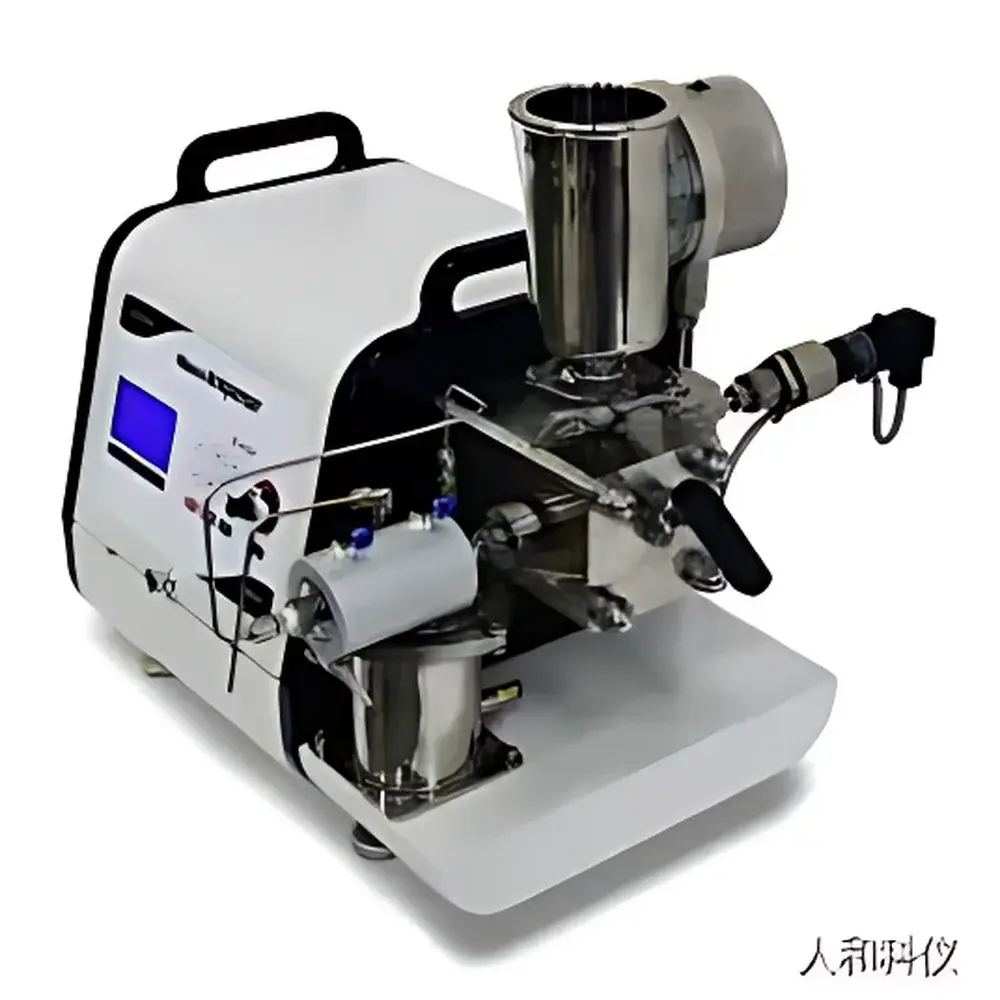
ILSHIN Nano Disperser NLM100 High-Pressure Homogenizer
| Brand | ILSHIN Autoclave |
|---|---|
| Origin | South Korea |
| Model | NLM100 |
| Instrument Type | High-Pressure Homogenizer |
| Dimensions (W×D×H) | 583 × 576 × 435 mm |
| Processing Flow Rate | 100 mL/min |
| Operating Pressure | 1,500 bar |
| Inlet Reservoir Capacity | 300 mL |
| Motor | 1 HP, 220 VAC, 1-Phase, 60 Hz |
| Weight | ~45 kg |
Overview
The ILSHIN Nano Disperser NLM100 is a high-pressure homogenizer engineered for laboratory-scale nano-dispersion and particle size reduction of suspensions, emulsions, and colloidal systems. It operates on the principle of controlled high-shear cavitation and turbulent energy dissipation generated by forcing liquid samples through a precisely engineered micro-orifice under ultra-high pressure—up to 1,500 bar. This mechanical energy input enables consistent deagglomeration, cell disruption, liposome formation, and nanoparticle stabilization without thermal degradation or chemical additives. Designed for research-intensive environments—including pharmaceutical formulation labs, nanomaterial synthesis groups, and academic colloid science facilities—the NLM100 delivers reproducible sub-100 nm particle distributions in aqueous and organic media. Its compact footprint and integrated PLC-based control system support seamless integration into GMP-aligned workflows and GLP-compliant experimental protocols.
Key Features
- Ultra-high operating pressure up to 1,500 bar for reliable nano-scale dispersion and homogenization
- PLC-controlled interface with adjustable motor speed regulation, enabling precise real-time control of pressure and flow rate
- Compact benchtop design (583 × 576 × 435 mm) optimized for space-constrained laboratories
- Integrated 300 mL feed reservoir with level monitoring and anti-dry-run protection
- Robust stainless-steel fluid path construction compliant with ISO 8573-1 for compressed air–free operation and corrosion resistance
- 1 HP AC motor (220 VAC, 1-phase, 60 Hz) delivering stable torque across variable load conditions
- Emergency stop circuit, pressure relief valve, and interlocked safety door meeting IEC 61000-6-2/6-4 electromagnetic compatibility standards
Sample Compatibility & Compliance
The NLM100 accommodates a broad range of sample types including aqueous polymer dispersions, lipid-based nanocarriers (e.g., liposomes, solid lipid nanoparticles), ceramic nanopowder suspensions, and biological lysates. It supports viscosity ranges up to 5,000 mPa·s at inlet conditions and tolerates pH 2–12 media when operated within recommended temperature limits (<40 °C ambient inlet). The system conforms to ISO 22000 and ASTM D7928 for particle size distribution analysis validation. While not certified as Class I medical device equipment, its architecture aligns with FDA 21 CFR Part 11 requirements for electronic record integrity when paired with validated third-party data acquisition software. All wetted components comply with USP material classification for pharmaceutical contact surfaces.
Software & Data Management
The NLM100 features an embedded programmable logic controller (PLC) with a 4.3-inch TFT-LCD HMI interface. Operators can store up to 20 user-defined process recipes—including target pressure, dwell time per pass, total cycle count, and ramp profiles—with timestamped execution logs. Raw operational data (pressure, motor RPM, runtime, fault codes) are exportable via USB 2.0 to CSV format for traceability. For advanced analytics, the system supports Modbus RTU communication protocol, enabling bidirectional integration with LabArchives ELN, DeltaV DCS, or custom Python-based monitoring dashboards. Audit trail functionality includes operator ID tagging, parameter change history, and immutable log archiving—essential for regulatory submissions under ICH M7 and EU Annex 11.
Applications
- Preclinical development of injectable nanomedicines requiring narrow PDI (<0.15) and mean particle size <80 nm
- R&D-scale production of nanoemulsions for topical delivery systems and nutraceutical formulations
- Cell lysis and organelle isolation in proteomics workflows where enzymatic integrity must be preserved
- Dispersion of graphene oxide, quantum dots, and metal-organic frameworks (MOFs) in solvent matrices
- Quality-by-Design (QbD) studies supporting DOE-driven optimization of homogenization parameters
- Accelerated stability testing of colloidal suspensions under repeated high-pressure cycling
FAQ
What is the maximum recommended number of homogenization passes for heat-sensitive biologics?
For proteins and monoclonal antibodies, we recommend ≤3 passes at ≤1,200 bar with pre-chilled inlet reservoirs (4 °C) to minimize aggregation risk.
Can the NLM100 process abrasive slurries containing silica or alumina nanoparticles?
Yes—provided slurry solids content remains ≤15 wt% and particles are pre-milled to <5 µm; extended use requires optional tungsten-carbide orifice inserts.
Is remote monitoring supported out-of-the-box?
No native Ethernet/WiFi module is included, but RS-485 Modbus connectivity allows integration with existing SCADA or IIoT platforms via external gateways.
Does the system meet CE marking requirements for placement in the European Economic Area?
Yes—the NLM100 carries CE marking under Machinery Directive 2006/42/EC and EMC Directive 2014/30/EU, with full technical documentation available upon request.
What maintenance intervals are recommended for optimal long-term performance?
Daily visual inspection of seals and pressure gauges; quarterly calibration of pressure transducers per ISO 6789; annual replacement of ceramic check valves and O-rings in the high-pressure manifold.



