
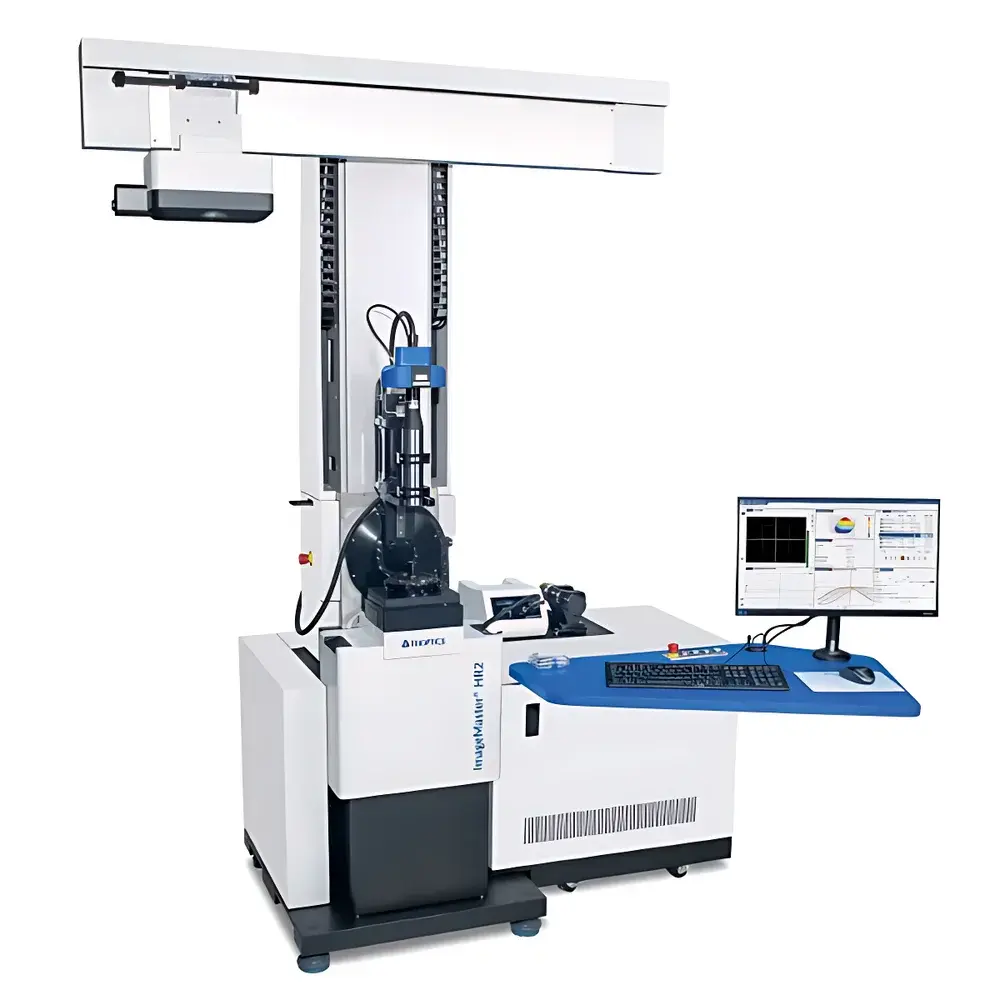
ImageMaster® HR Compact High-Precision Optical Transfer Function Analyzer by TRIOPTICS
| Brand | TRIOPTICS |
|---|---|
| Origin | Germany |
| Model | ImageMaster® HR |
| Configuration | Vertical Benchtop System |
| Measurement Principle | Monochromatic Laser-Based Imaging & Fourier Analysis of Point/Line Spread Functions |
| Compliance | Traceable to ISO 10110-5, ISO 9013, DIN EN ISO/IEC 17025 |
| Software Platform | OptiCentric® Suite v8.x with FDA 21 CFR Part 11–Ready Audit Trail & Electronic Signature Support |
| Automation Level | Fully Motorized (6-Axis Precision Stages), Integrated LED/Laser Target Generator |
| Sample Handling | Manual Loading for Lenses ≤ φ50 mm |
| Reporting | Exportable PDF/CSV Reports with MTF Curves, PSF/LSF Maps, EFL/FFL/Distortion Grids, and PTF Phase Residuals |
Overview
The ImageMaster® HR is a vertically configured, high-precision optical transfer function (OTF) measurement system engineered by TRIOPTICS GmbH — a Hamburg-based leader in automated optical metrology since 1991. Designed specifically for R&D labs and low-to-mid volume production environments, the system implements a rigorous imaging-based methodology grounded in monochromatic laser illumination, high-resolution CMOS sensor acquisition, and rigorous Fourier-domain analysis of point spread functions (PSF) and line spread functions (LSF). Unlike scanning or interferometric alternatives, the ImageMaster® HR directly captures spatial frequency response across the full field of view — delivering axisymmetric and off-axis modulation transfer function (MTF) data at user-defined spatial frequencies (up to 200 lp/mm), with sub-pixel centroid resolution and calibrated radiometric traceability. Its compact benchtop footprint (W × D × H: 850 × 720 × 1,450 mm) integrates all core subsystems — including motorized XYZθφz stages, collimated target generation, telecentric imaging path, and thermally stabilized environmental enclosure — into a single, maintenance-optimized platform compliant with ISO 10110-5 for image quality characterization.
Key Features
- Vertical optical layout minimizes gravitational lens deformation during measurement — critical for aspheric and thin-profile mobile phone lenses.
- Automated, script-driven measurement sequences support unattended batch testing of up to 200 units per shift with programmable pass/fail thresholds per parameter.
- Integrated monochromatic LED and tunable laser target generator enables wavelength-specific MTF evaluation at 488 nm, 532 nm, 633 nm, and 780 nm — aligned with common photopic and NIR imaging bands.
- High-dynamic-range CMOS detector (12-bit, 4096 × 3072 px) with pixel-level flat-field correction ensures <0.3% relative intensity uncertainty in PSF amplitude reconstruction.
- Real-time MTF mapping across full field (0°–±30°) with simultaneous extraction of EFL, distortion, field curvature, astigmatism, axial chromatic aberration, and lateral color — all referenced to NIST-traceable calibration artifacts.
- Modular software architecture allows seamless integration with factory MES systems via OPC UA and RESTful API interfaces.
Sample Compatibility & Compliance
The ImageMaster® HR accommodates lenses and lens modules with diameters up to 50 mm and focal lengths from 1 mm to 500 mm. It supports both bare optical elements and fully assembled camera modules (including IR-cut filters and cover glass stacks), provided mechanical mounting permits stable coaxial alignment. The system meets ISO/IEC 17025 requirements for accredited calibration laboratories and includes documented uncertainty budgets per ISO/IEC Guide 98-3 (GUM). All MTF results are traceable to PTB (Physikalisch-Technische Bundesanstalt) reference standards. For regulated industries, audit trails, electronic signatures, and role-based access control comply with FDA 21 CFR Part 11 and EU Annex 11 requirements. Measurement protocols align with ISO 9013 for industrial lens acceptance and USP for medical endoscope optics validation.
Software & Data Management
The system runs on TRIOPTICS’ OptiCentric® Suite v8.x — a Windows-based, modular application framework built on .NET Core. Core modules include MTF Analyzer, PSF Reconstruction Engine, Distortion Mapping Tool, and Report Composer. All measurement scripts are editable in Python (via embedded IronPython interpreter), enabling custom workflows such as multi-wavelength MTF fusion or Zernike decomposition of wavefront residuals. Raw image data, intermediate FFT outputs, and final parameter tables are stored in HDF5 format with embedded metadata (timestamp, operator ID, environmental logs). Full revision history, change tracking, and export to PDF/A-2, CSV, and XML are supported. Secure remote monitoring and diagnostics are enabled via TLS-encrypted web interface.
Applications
- Design verification of smartphone camera lenses (e.g., 6P/7P wide-angle, periscope telephoto, and ultrawide modules).
- Production-line sorting of automotive ADAS lenses (e.g., 1.8 MP–8 MP imaging lenses for surround-view and forward-facing radar-fused cameras).
- Characterization of thermal imaging optics (uncooled VOx microbolometer lenses) across 8–14 µm spectral band using optional LWIR target adapter.
- Validation of AR/VR pancake and birdbath optics for modulation fidelity at oblique incidence angles.
- Research-grade OTF benchmarking for diffractive and metasurface optics under controlled polarization states.
FAQ
What is the smallest measurable focal length supported by the ImageMaster® HR?
The system supports focal lengths down to 1 mm using its integrated close-focus collimation mode — validated per ISO 10110-5 Annex B for ultra-short focal length micro-optics.
Can the system measure lenses with integrated image sensors (e.g., wafer-level camera modules)?
Yes — when mounted in a dedicated holder that preserves optical axis alignment and provides electrical grounding; sensor noise floor is subtracted via dark-frame referencing prior to PSF calculation.
Is temperature stabilization included in the base configuration?
Yes — the optical bench features active air temperature control (±0.2 °C over 24 h) and low-thermal-expansion granite base to minimize drift-induced MTF variance.
Does the software support GLP-compliant report generation?
Yes — all reports include timestamped operator ID, instrument serial number, calibration certificate IDs, environmental logs, and digital signature fields meeting GLP Annex 11 and ISO/IEC 17025 documentation requirements.
How is chromatic aberration quantified?
By acquiring MTF curves at ≥3 discrete wavelengths and computing axial/lateral color shifts via EFL and chief ray angle deviations — reported as ∆EFL(λ) and ∆CRA(λ) with statistical confidence intervals.




