
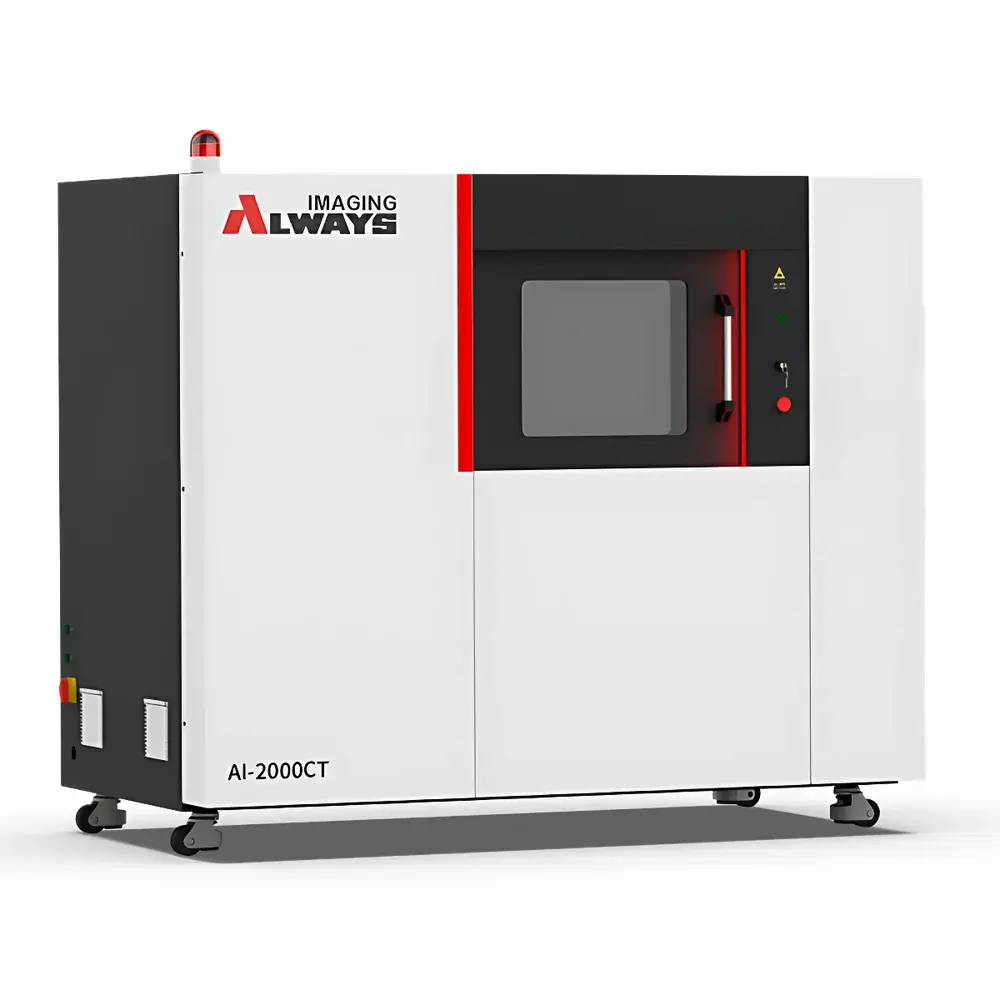
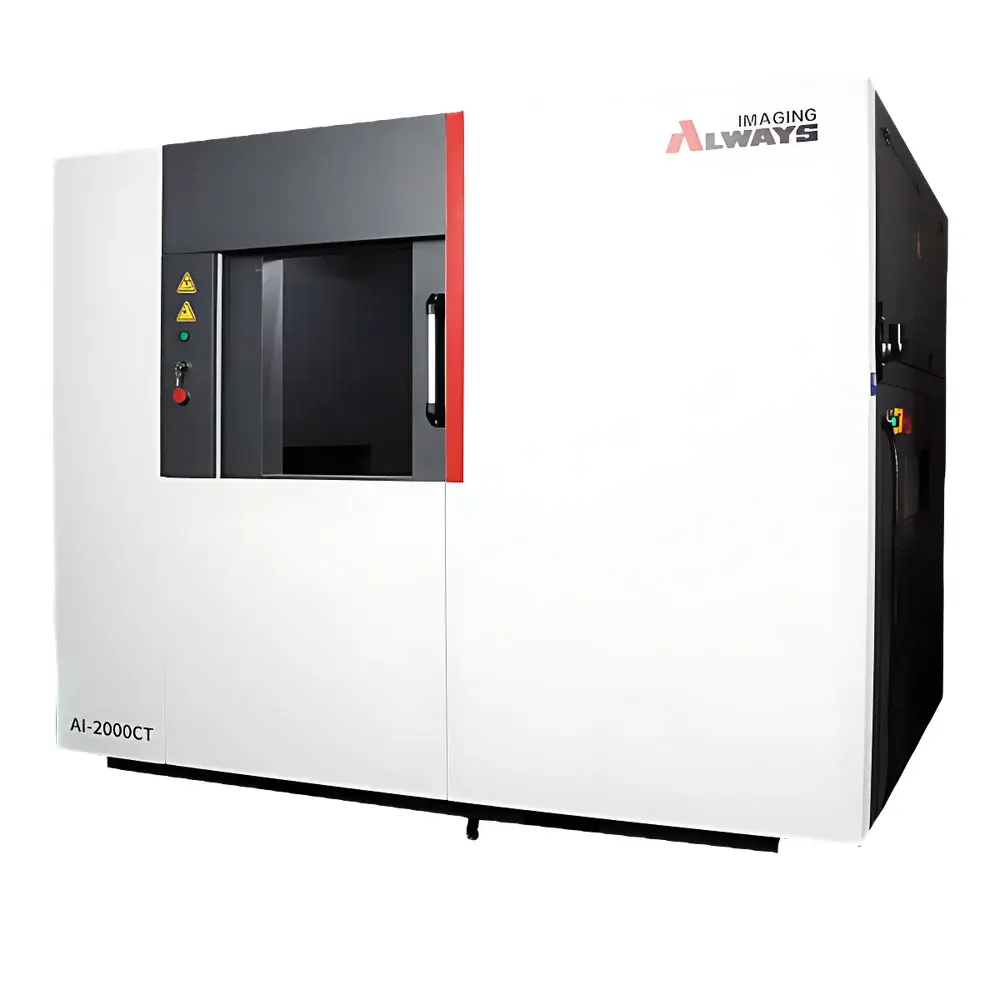
Always Imaging AI-2000CT Industrial Micro-CT System for Castings
| Brand | Always Imaging |
|---|---|
| Origin | Shanghai, China |
| Manufacturer Type | Direct Manufacturer |
| Origin Category | Domestic (China) |
| Model | AI-2000CT |
| Detector Type | Flat-Panel Detector |
| X-ray Energy | 195 kV |
| Maximum Sample Diameter | 500 mm |
| Maximum Sample Height | 500 mm |
| Maximum Sample Weight | 20 kg |
| System Dimensions (W×D×H) | 1900 × 1000 × 1600 mm |
| Contrast Resolution | <1% |
| Spatial Resolution (Defect Detection Limit) | 0.1 mm |
| Radiation Leakage | <1 µSv/h |
| Net Weight Range | 1500–5000 kg |
Overview
The Always Imaging AI-2000CT is a purpose-built industrial micro-computed tomography (micro-CT) system engineered for high-throughput, non-destructive evaluation of small-to-medium-sized metal castings. Operating on the principle of cone-beam X-ray computed tomography, the AI-2000CT acquires hundreds of 2D projection radiographs across a full 360° rotation, then reconstructs them into isotropic 3D volumetric datasets using filtered back-projection or iterative reconstruction algorithms. Its fixed 195 kV microfocus X-ray source—paired with a high-dynamic-range flat-panel detector—enables robust penetration of aluminum, magnesium, and low-alloy steel castings while preserving sub-0.1 mm defect detectability. Designed specifically for foundry QA/QC workflows, the system delivers metrologically traceable internal geometry characterization without sectioning, making it suitable for first-article inspection, production lot sampling, and failure root-cause analysis in automotive, aerospace, and energy sectors.
Key Features
- Optimized mechanical architecture for casting inspection: integrated rotary stage with ±0.01° angular repeatability and 20 kg load capacity supports stable, vibration-damped scanning of dense metallic components up to Ø500 mm × H500 mm.
- Compact footprint (1900 × 1000 × 1600 mm) enables deployment in standard metrology labs or production-floor clean zones—no dedicated shielded vault required due to built-in lead-lined enclosure and verified radiation leakage <1 µSv/h at 50 cm.
- One-click reconstruction workflow: proprietary acquisition software automates beam hardening correction, ring artifact suppression, and noise-adaptive filtering—reducing operator dependency and accelerating time-to-result.
- Modular hardware design: supports optional integration of robotic sample handling (ISO 9283 compliant grippers), ADR (Automated Defect Recognition) modules trained on ASTM E2865-compliant defect libraries, and dual-energy acquisition for material discrimination.
- Thermally stabilized X-ray source and detector assembly ensures long-term dimensional stability; drift compensation algorithms maintain voxel consistency across multi-hour scans.
Sample Compatibility & Compliance
The AI-2000CT accommodates a broad range of casting geometries—including sand-cast, investment-cast, and die-cast components—with minimal fixturing requirements. Its open gantry design allows vertical or horizontal orientation of samples up to 20 kg. All system firmware and safety interlocks comply with IEC 61000-6-2 (EMC immunity) and IEC 62464-1 (X-ray equipment safety). Radiation shielding meets national regulatory limits per GBZ 138–2022 and is certified by third-party dosimetry audits. For regulated environments, optional audit-trail-enabled operation mode supports GLP/GMP documentation requirements, including user authentication, parameter change logging, and DICOM-SR structured reporting export.
Software & Data Management
The base system includes Always Imaging’s AiScan Control Suite (v4.x), providing DICOM 3.0-compliant acquisition, reconstruction, and visualization. Optional VGStudio MAX 3.5 integration enables advanced metrology-grade analysis: GD&T-compliant coordinate measurement (ISO 1101), wall-thickness mapping (ASME Y14.5), CAD-to-CT deviation analysis (±2 µm uncertainty budget), porosity quantification per ASTM E1558, and reverse engineering via NURBS surface fitting. All software modules support automated report generation in PDF/HTML formats with embedded metadata (scan parameters, calibration certificates, timestamped operator logs). Data storage follows ISO 13485-aligned archive protocols, with optional encryption and role-based access control for multi-user facilities.
Applications
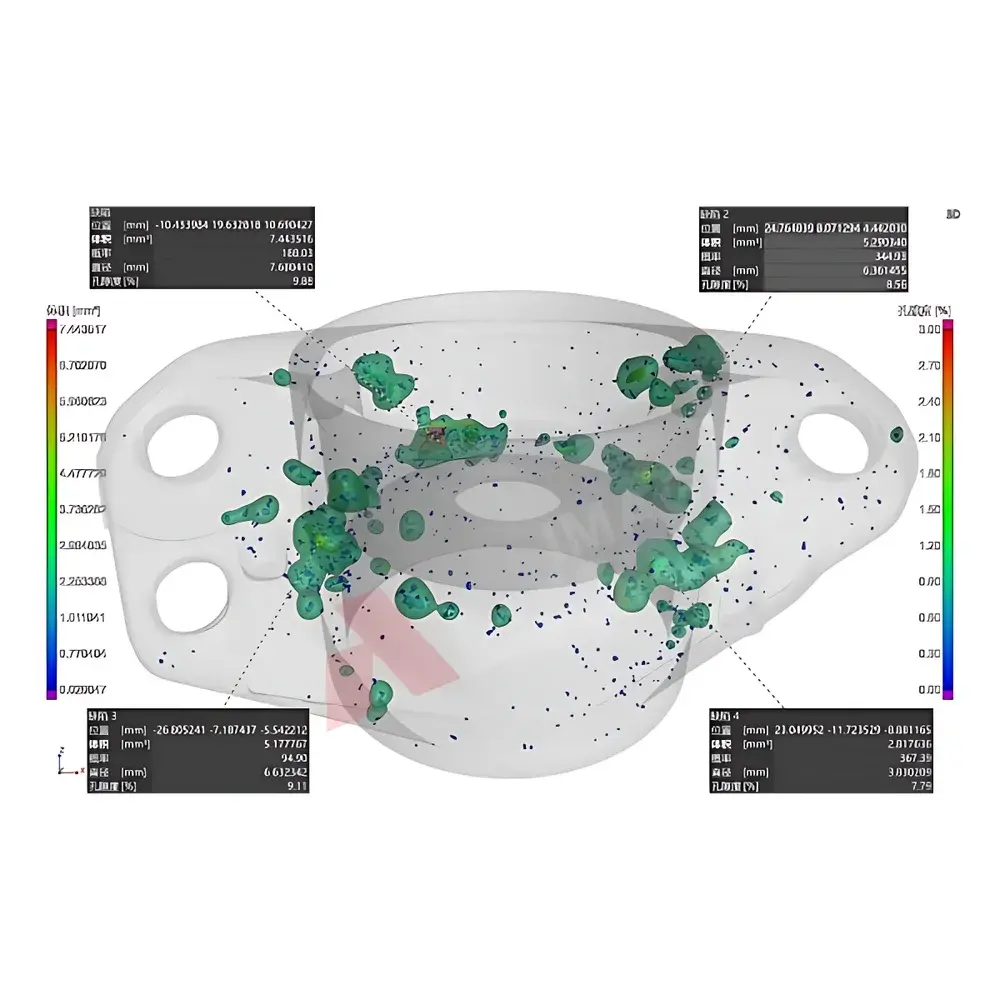
- Porosity and inclusion detection in aluminum engine blocks and transmission housings—quantifying volume fraction, sphericity, and spatial distribution per ASTM E1558 and ISO 10474.
- Core shift verification and mold cavity fidelity assessment in investment cast turbine blades.
- Internal channel integrity validation in ductile iron manifolds and hydraulic valve bodies.
- Dimensional validation of near-net-shape castings against nominal CAD models—including undercuts, fillets, and thin-walled sections inaccessible to CMM probing.
- Failure analysis of fatigue cracks, hot tears, and shrinkage cavities—correlating 3D defect morphology with fracture mechanics modeling inputs.
FAQ
What is the minimum detectable defect size under standard operating conditions?
Under typical scan settings (195 kV, 120 µA, 0.5° angular increment, 1200 projections), the AI-2000CT achieves a practical defect resolution limit of 0.1 mm for voids in aluminum alloys with contrast-to-noise ratio >5.
Does the system support quantitative density calibration?
Yes—via reference phantoms traceable to NIST SRM 2083, enabling linear attenuation coefficient calibration for relative density mapping and material composition estimation.
Can the AI-2000CT be integrated into an automated production line?
With optional robotic interface (RS-232/Profinet/EtherCAT), PLC-triggered scan sequencing, and pass/fail ADR output signals, the system supports inline or near-line deployment per Industry 4.0 architecture guidelines.
Is VGStudio MAX licensing perpetual or subscription-based?
VGStudio MAX licenses are available as perpetual with annual maintenance (includes updates, technical support, and certification renewals), fully compliant with FDA 21 CFR Part 11 when configured with electronic signature and audit trail modules.
What maintenance intervals are recommended for the X-ray source and detector?
Source anode replacement is recommended every 15,000 hours of operation; detector calibration and flat-field correction are performed automatically before each scan series and manually validated quarterly per ISO/IEC 17025 internal procedure.
Related Products



