
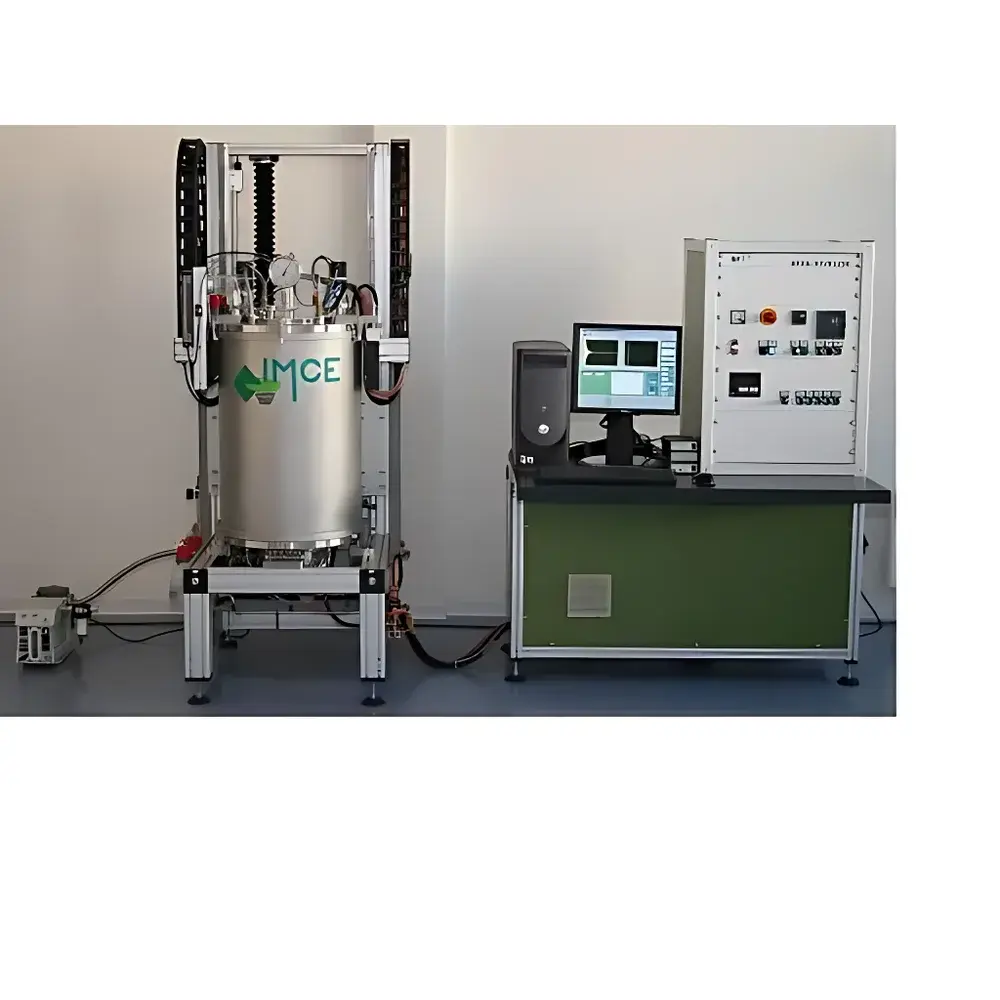
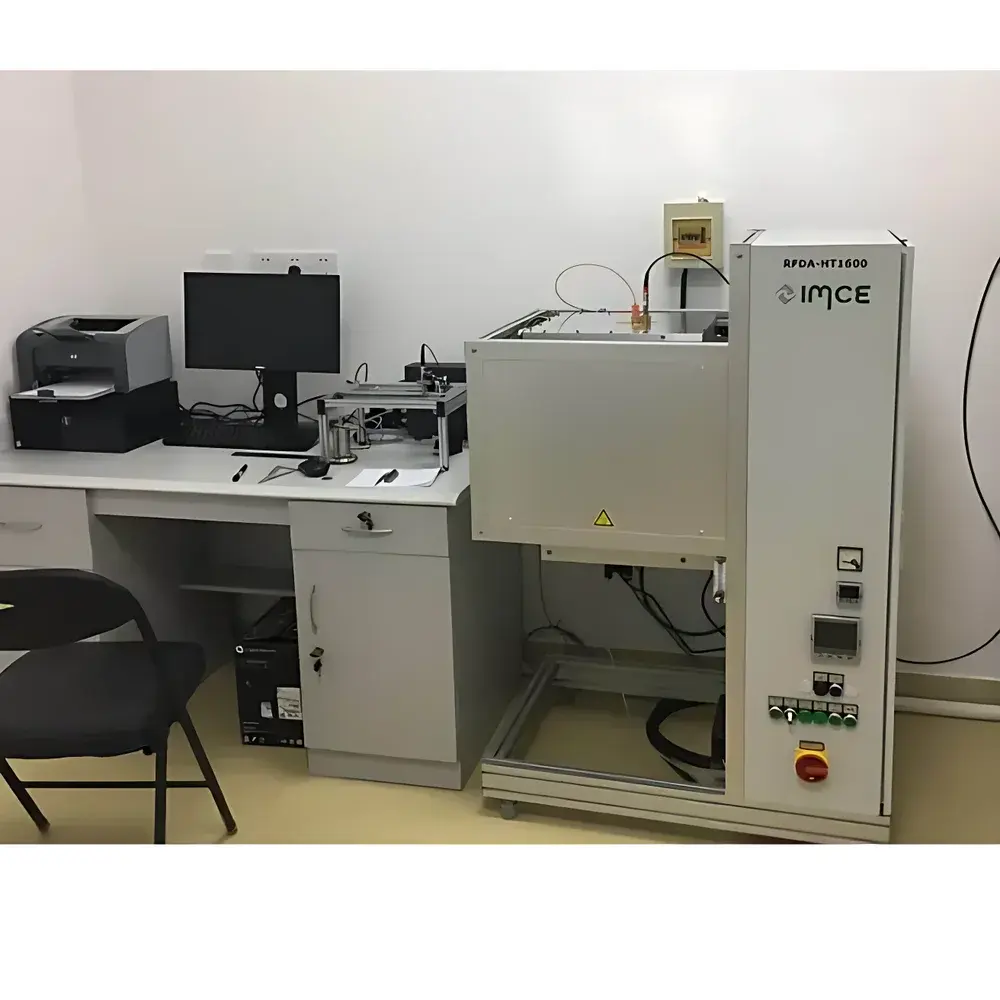
IMCE HTVP1600/1700C High-Temperature Dynamic Elastic Modulus and Damping Analyzer
| Brand | IMCE |
|---|---|
| Model | HTVP1600/1700C (HT1050/1600/1700) |
| Operating Temperature Range | Ambient to 1600 °C / 1700 °C |
| Temperature Stability | ±1 °C |
| Heating Rate | 0.1–20.0 °C/min |
| Resonance Frequency Range | 10 Hz–150 kHz (±0.5 Hz) |
| Damping/Internal Friction Measurement Range | 1×10⁻⁵–0.1 |
| Elastic Modulus Accuracy | <0.1% at RT, <5% at elevated temperature |
| Elastic Modulus Range | 10 MPa–880 GPa |
| Shear Modulus & Poisson’s Ratio | Calculated from resonance spectra |
| Atmosphere Control | Inert, oxidizing, reducing, vacuum-compatible |
| Detection Method | Non-contact laser Doppler vibrometry |
| Compliance | ASTM E1876, ASTM C1259 |
Overview
The IMCE HTVP1600/1700C High-Temperature Dynamic Elastic Modulus and Damping Analyzer is a precision instrument engineered for non-destructive, in-situ characterization of mechanical properties under controlled thermal and atmospheric conditions. Based on the resonant frequency method—rooted in the fundamental relationship between natural vibration modes, sample geometry, density, and elastic constants—the system determines dynamic Young’s modulus, shear modulus, Poisson’s ratio, and internal friction (damping) through high-resolution spectral analysis of free or forced flexural and torsional vibrations. Unlike static or quasi-static testing methods, this dynamic approach enables real-time monitoring of microstructural evolution during thermal cycling, phase transitions, sintering, or creep processes—without inducing plastic deformation or surface damage. The analyzer integrates seamlessly with IMCE’s modular high-temperature furnaces (HT1050, HT1600, HT1700, HTVP1600, HTVP1700C), supporting operation up to 1700 °C in air, argon, nitrogen, hydrogen, vacuum, or custom gas mixtures. Its laser Doppler vibrometry detection ensures sub-nanometer displacement resolution and immunity to electromagnetic interference, critical for reproducible measurements on brittle ceramics, refractory metals, CMCs, and advanced composites.
Key Features
- Non-destructive dynamic measurement based on free and forced resonance spectroscopy, compliant with ASTM E1876 (Standard Test Method for Dynamic Young’s Modulus, Shear Modulus, and Poisson’s Ratio by Sonic Resonance) and ASTM C1259 (Standard Test Method for Dynamic Young’s Modulus of Advanced Ceramics by Impulse Excitation of Vibration)
- High-temperature capability up to 1700 °C with ±1 °C thermal stability and programmable heating rates from 0.1 to 20.0 °C/min
- Integrated atmosphere control system supporting inert, oxidizing, reducing, and vacuum environments (down to 10⁻³ mbar)
- Laser Doppler vibrometer for contactless, high-fidelity displacement sensing—eliminating mass-loading artifacts and enabling measurements on fragile or irregularly shaped specimens
- Multi-mode excitation (impulse, swept sine, broadband noise) for linear and nonlinear viscoelastic analysis
- Modular furnace design compatible with interchangeable hot zones, crucible configurations, and thermocouple types (B, S, R, C, K)
Sample Compatibility & Compliance
The HTVP1600/1700C accommodates standard bar, disc, and cylindrical geometries (typical dimensions: 3–20 mm width/thickness, 30–120 mm length), including as-sintered, annealed, or coated specimens without machining requirements. It supports quality control and R&D applications across aerospace-grade superalloys, SiC/Si₃N₄ ceramics, nuclear fuel matrix materials, thermal barrier coatings, and metal-matrix composites. All measurement protocols adhere to internationally recognized standards for dynamic mechanical characterization, including ISO 12680-2 (refractories), ASTM E1876 (metals and ceramics), and ASTM C1259 (advanced ceramics). Data acquisition and reporting are structured to support GLP/GMP traceability, with full audit trail functionality available via RFDA MF Software for regulatory submissions and laboratory accreditation (e.g., ISO/IEC 17025).
Software & Data Management
The RFDA MF Software suite provides end-to-end control—from furnace ramp profiling and excitation parameter definition to real-time resonance peak tracking, modal identification, and multi-parameter curve fitting. It implements robust algorithms for automatic mode assignment (flexural, torsional, longitudinal), temperature-synchronized property mapping, and statistical outlier rejection. Raw time-domain signals and FFT spectra are stored in HDF5 format for long-term archival and third-party post-processing. The software supports 21 CFR Part 11-compliant user access control, electronic signatures, and immutable audit logs—ensuring data integrity for FDA-regulated materials development and QC workflows. Export options include CSV, MATLAB (.mat), and XML for integration with LIMS and enterprise analytics platforms.
Applications
- Monitoring elastic softening and damping onset during high-temperature phase transformations (e.g., martensitic transitions, perovskite ordering, glass transitions)
- Quantifying sintering kinetics and densification behavior in ceramic green bodies and powder metallurgy compacts
- Evaluating thermal fatigue resistance of TBC systems via cyclic modulus/damping hysteresis
- Correlating microcrack density and interfacial debonding in fiber-reinforced composites with internal friction peaks
- Validating constitutive models for high-temperature structural simulation (e.g., FEM input for turbine blade materials)
- Supporting ASTM-compliant certification of refractory linings and nuclear cladding alloys
FAQ
What standards does the HTVP1600/1700C comply with for dynamic modulus measurement?
ASTM E1876, ASTM C1259, ISO 12680-2, and DIN 51045-2—covering both metallic and non-metallic engineering materials.
Can the system measure damping under vacuum or reactive atmospheres?
Yes. The HTVP series features dual-chamber vacuum-rated furnaces with gas inlet/outlet ports and pressure regulation, enabling precise control from high vacuum (10⁻³ mbar) to 5 bar overpressure in H₂, CO, NH₃, or corrosive gas mixtures.
Is specimen machining required prior to testing?
No. The resonant method accepts as-fabricated samples—including irregular shapes, porous bodies, and coated substrates—as long as dimensional tolerances allow reliable mode identification.
How is temperature calibration verified during operation?
Each furnace is equipped with dual calibrated Type B thermocouples (one embedded, one surface-mounted), cross-referenced against NIST-traceable fixed-point cells (e.g., Pd, Ni, Co-C) during factory validation and optional annual recalibration.
Does the system support automated multi-step thermal-mechanical protocols?
Yes. RFDA MF Software enables fully programmable sequences combining temperature holds, ramp rates, dwell times, and synchronized resonance scans—ideal for time-dependent property mapping and kinetic studies.



