
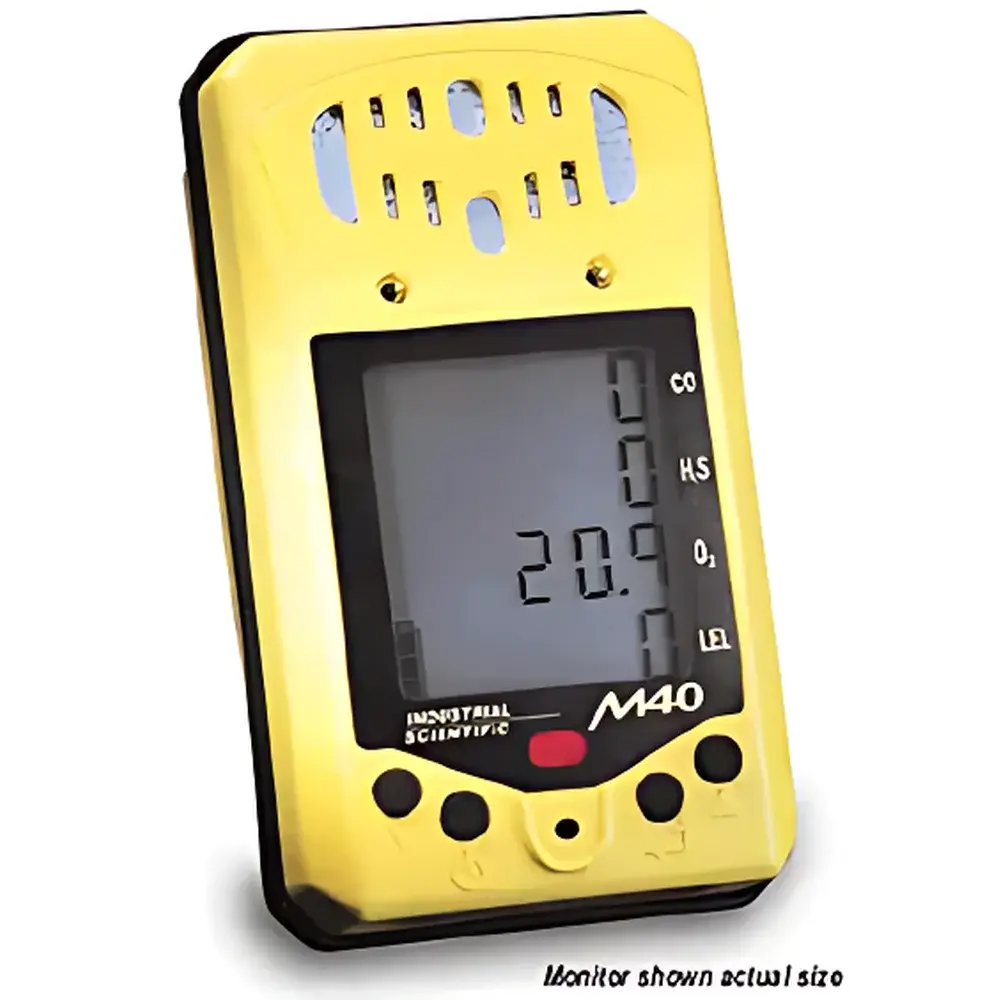
Industrial Scientific M40 Multi-Gas Detector (LEL, O₂, CO, H₂S)
| Origin | USA |
|---|---|
| Distribution Model | Authorized Distributor |
| Import Status | Imported |
| Model | M40 |
| Pricing | Upon Request |
| Enclosure Rating | IP65 |
| Dimensions | 109 × 62 × 35 mm |
| Weight | 244 g (326 g with SP40 pump) |
| Sensor Technology | Catalytic Bead (LEL), Electrochemical (O₂, CO, H₂S) |
| LEL Range | 0–100% LEL (1% LEL resolution) |
| CH₄ Range | 0–5% VOL (0.1% VOL resolution) |
| O₂ Range | 0–30% VOL (0.1% VOL resolution) |
| CO Range | 0–999 ppm (1 ppm resolution) |
| H₂S Range | 0–500 ppm (1 ppm resolution) |
| Battery Life | 18 h (12 h with SP40 pump) |
| Alarm | 90 dB audible, bright visual LED, vibration |
| Data Logging Capacity | 75 hours |
| Operating Temperature | −20 to +50 °C |
| Humidity Range | 15–95% RH (non-condensing) |
| Certifications | UL/CSA Class I, Groups A,B,C,D |
Overview
The Industrial Scientific M40 Multi-Gas Detector is a compact, intrinsically safe portable instrument engineered for continuous real-time monitoring of four critical atmospheric hazards in confined space entry, industrial hygiene, and emergency response applications. It simultaneously measures flammable gas (via catalytic bead sensor), oxygen concentration (electrochemical), carbon monoxide (CO), and hydrogen sulfide (H₂S)—all essential parameters defined in OSHA 1910.146 and NFPA 350 standards for permit-required confined space evaluation. Its robust design incorporates electromagnetic interference (EMI) and radio frequency interference (RFI) shielding, ensuring measurement stability in electrically noisy environments such as refineries, wastewater treatment plants, and utility tunnels. The device operates on a rechargeable lithium-ion battery and meets stringent international safety certifications—including UL/CSA Class I, MSHA, China MA, and IECEx Zone 0—enabling deployment across global regulatory jurisdictions without compromise to operational integrity.
Key Features
- Intrinsically safe construction compliant with IEC 60079-0/-11 and certified for hazardous locations (Class I, Div 1; Zone 0)
- IP65-rated impact-resistant composite housing resistant to dust, water jets, and mechanical shock
- Intuitive four-button interface enabling zero calibration, span adjustment, data review, and alarm silencing without menu navigation
- 5-second power-off delay prevents accidental shutdown during critical operation
- Vibration alert integrated with dual-stage audible (90 dB) and visual (high-brightness LCD backlight + red flashing LEDs) alarms
- Peak value retention and STEL/TWA exposure tracking aligned with ACGIH TLV® guidelines
- On-device data logging capacity of up to 75 hours at 10-second sampling intervals, exportable via RS232 interface
- Optional SP40 integrated sampling pump supporting remote detection up to 15 meters with flow rate regulation (0.5 L/min standard)
Sample Compatibility & Compliance
The M40 is validated for direct ambient air sampling and compatible with standardized calibration gases traceable to NIST-certified reference materials. Sensor cross-sensitivity profiles are characterized per ISO 16000-23 and ASTM D5402 protocols to ensure minimal interference from common background contaminants (e.g., ethanol, NO₂, SO₂). Regulatory compliance extends beyond hardware certification: firmware supports audit-ready event logging—including calibration history, bump test records, alarm triggers, and battery status—with time-stamped entries required under OSHA recordkeeping rules and EU Directive 2014/34/EU. All configurations meet GLP-aligned documentation requirements when used with the M·Cal Instrument Management Station, which performs automated functional checks, sensor verification, and thermal drift compensation prior to field deployment.
Software & Data Management
Data acquisition and instrument management are supported through the M·Cal desktop station—a field-portable, battery-powered diagnostic platform that executes full-system diagnostics, automatic charging, and gas challenge validation. When connected, M·Cal generates ANSI-standard calibration certificates with operator ID, date/time stamp, and pass/fail status per ISO/IEC 17025 clause 5.9. Raw log files export in CSV format compatible with industrial EHS platforms (e.g., Intelex, Sphera, ETQ Reliance) and support import into statistical process control (SPC) tools for trend analysis. Firmware updates maintain backward compatibility with legacy M40 units and incorporate security patches aligned with NIST SP 800-193 guidelines for embedded system integrity.
Applications
- Pre-entry verification and continuous atmospheric monitoring during confined space operations (tanks, sewers, vaults)
- Occupational exposure assessment for maintenance crews in petrochemical, mining, and pulp & paper facilities
- Emergency response triage by fire departments and HAZMAT teams conducting initial hazard identification
- Verification of ventilation effectiveness following hot work or chemical release incidents
- Periodic safety audits and compliance reporting under OSHA 1910.120, EPA 40 CFR Part 63, and ISO 45001 frameworks
FAQ
What gas combinations are available for the M40?
The M40 is configurable for single- to quad-gas detection: standard variants include LEL-only; LEL + O₂; LEL + O₂ + H₂S; and the full four-gas configuration (LEL, O₂, CO, H₂S). Custom sensor arrays require factory configuration.
Does the M40 support datalogging without the SP40 pump?
Yes—data logging is fully functional in diffusion-mode operation. Pump integration adds remote sampling capability but does not affect onboard memory or sampling interval settings.
Is the M40 compliant with FDA 21 CFR Part 11 for electronic records?
While the M40 itself does not implement electronic signature or audit trail features, its exported CSV logs—when managed through validated M·Cal workflows and controlled EHS software—can be incorporated into Part 11–compliant quality systems with appropriate procedural controls.
How often must the M40 undergo bump testing and calibration?
OSHA recommends daily bump testing before each shift. Full calibration is required before first use, after exposure to sensor poisons, and at intervals specified by manufacturer guidance (typically every 180 days), documented per ISO/IEC 17025.
Can the M40 operate in extreme cold environments?
Yes—the device maintains specified performance across −20 °C to +50 °C. Lithium-ion battery output is derated below 0 °C; extended cold-use scenarios should include thermal insulation of the unit and pre-warming prior to activation.







