
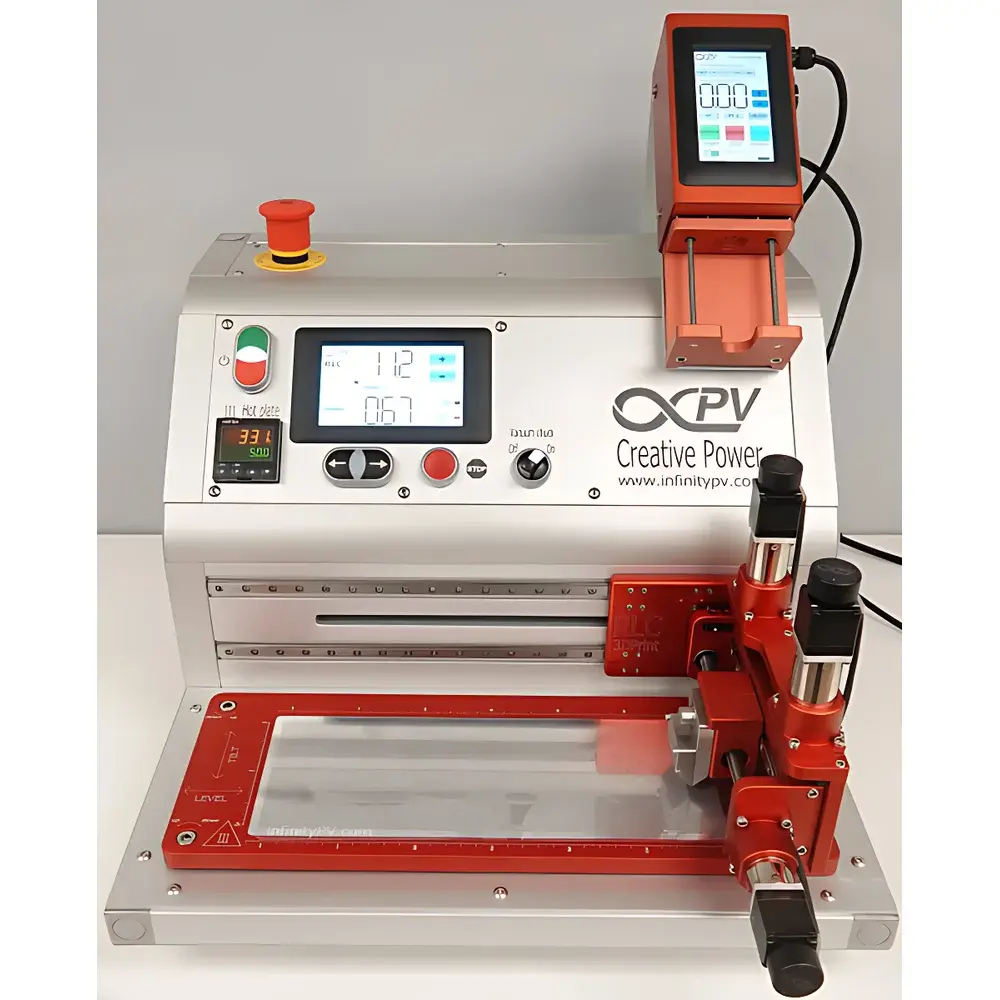
InfinityPV RLC Slot-Die Coater
| Brand | InfinityPV |
|---|---|
| Origin | Denmark |
| Model | RLC |
| Type | Research-Grade Slot-Die Coating System |
| Application Domain | Printed Electronics, Thin-Film Photovoltaics, Flexible Optoelectronics, Electrochemical Devices |
Overview
The InfinityPV RLC Slot-Die Coater is a precision-engineered, benchtop-scale slot-die coating platform designed for reproducible, scalable deposition of functional thin films in academic and industrial R&D environments. Based on the hydrodynamic principle of confined meniscus control, the RLC system enables uniform, metered delivery of viscous and low-viscosity solutions—ranging from polymer electrolytes and perovskite precursors to conductive nanocomposites and bio-ink formulations—onto flexible or rigid substrates at controlled web speeds (0.1–500 mm/s) and gap settings (10–500 µm). Developed by InfinityPV—a Danish deep-tech spin-off founded by Prof. Frederik C. Krebs—the RLC integrates fundamental advances in coating physics, fluid dynamics modeling, and substrate handling to bridge the gap between lab-scale discovery and roll-to-roll (R2R) manufacturing readiness. Its architecture supports both static (drop-cast mode) and dynamic (continuous web) operation, making it suitable for iterative process optimization, material formulation screening, and prototype device fabrication under ambient or inert-gas conditions.
Key Features
- Modular slot-die head with interchangeable dies (standard 25 mm, optional 50/100 mm widths) and precision-machined stainless-steel or PEEK flow channels for chemical compatibility with solvents including chlorobenzene, DMF, NMP, and aqueous systems.
- Motorized Z-axis height adjustment (0.1 µm resolution) with real-time gap monitoring via integrated capacitive sensors for sub-micron repeatability across coating width.
- Programmable dual-axis motion control: independent regulation of substrate translation speed and die-to-substrate gap during coating, enabling gradient film thickness profiling and multi-layer sequential deposition without breakage.
- Integrated solvent recovery port and optional glovebox integration (ISO Class 5 compatible) for oxygen/moisture-sensitive processes such as perovskite solar cell fabrication or lithium-metal anode interfacial layer deposition.
- Robust mechanical frame with granite baseplate and vibration-damped optical table mounting points, ensuring long-term dimensional stability and minimizing coating non-uniformity induced by environmental perturbations.
Sample Compatibility & Compliance
The RLC accommodates substrates up to 300 mm wide and 5 mm thick—including PET, PEN, PI, glass, silicon wafers, metal foils, and textile-based flexible electronics—and supports both rigid and stretchable formats. It complies with ISO 9001-certified manufacturing protocols and meets essential requirements of IEC 61000-6-3 (EMC emissions) and IEC 61000-6-2 (immunity). For regulated research environments, the system supports audit-ready operation when paired with third-party validated data acquisition software compliant with FDA 21 CFR Part 11 (electronic records/signatures) and GLP/GMP traceability standards. All wetted components are certified to USP Class VI biocompatibility where applicable, supporting biomedical thin-film applications such as biosensor electrode patterning and wearable diagnostic interfaces.
Software & Data Management
Control is executed via InfinityPV’s proprietary CoatingStudio™ software (v4.2+), a Windows-based application offering real-time parameter logging (flow rate, speed, gap, temperature), synchronized video capture (optional high-speed camera interface), and automated recipe management with version-controlled configuration files. Raw sensor data is exported in HDF5 format for post-processing in MATLAB, Python (NumPy/Pandas), or OriginLab. The software includes built-in statistical process control (SPC) modules for coating uniformity analysis (CV%, edge exclusion metrics) and supports integration with laboratory information management systems (LIMS) via RESTful API. Audit trails record all user actions, parameter changes, and system events with timestamped digital signatures—fully aligned with ALCOA+ data integrity principles.
Applications
- Organic and perovskite photovoltaics: scalable deposition of hole/electron transport layers, active blends (e.g., PM6:Y6), and interfacial modifiers.
- Flexible OLED/QLED displays: uniform coating of emissive polymers and charge injection layers on large-area plastic substrates.
- Printed electrochemical devices: fabrication of solid-state electrolyte membranes for microbatteries, fuel cells, and supercapacitors.
- Bio-integrated electronics: patterning of conductive hydrogels, enzyme-loaded films, and stretchable electrodes for epidermal sensors.
- Functional barrier and anti-reflective coatings: multilayer deposition of SiO₂, Al₂O₃, or hybrid sol-gel films on optical or packaging substrates.
- Microfluidic channel fabrication: selective coating of photoresist or PDMS precursor films with lateral resolution down to ±2 µm edge definition.
FAQ
What substrate materials are compatible with the RLC system?
Standard substrates include PET, PEN, PI, glass, silicon, stainless steel foil, and aluminum foil; custom adaptations for textiles, paper, and elastomeric substrates are supported via optional tension-control modules.
Can the RLC be integrated into a nitrogen-filled glovebox?
Yes—the system is fully compatible with standard ISO 5 gloveboxes; feedthroughs for power, USB, pneumatic lines, and solvent exhaust are available as factory-configured options.
Is remote diagnostics and firmware update supported?
CoatingStudio™ includes secure SSH-enabled remote access for technical support; firmware updates are delivered quarterly via encrypted download portal with SHA-256 verification.
Does InfinityPV provide application-specific coating protocol development?
Yes—customers receive one day of on-site or virtual application support with InfinityPV’s application engineers, including formulation viscosity mapping, meniscus stability assessment, and defect root-cause analysis.
What is the lead time for spare parts and consumables?
Critical spares (dies, O-rings, pump tubing) are stocked in Copenhagen and Shanghai distribution hubs; standard delivery is 5–7 business days within EEA/APAC regions.
Related Products





