
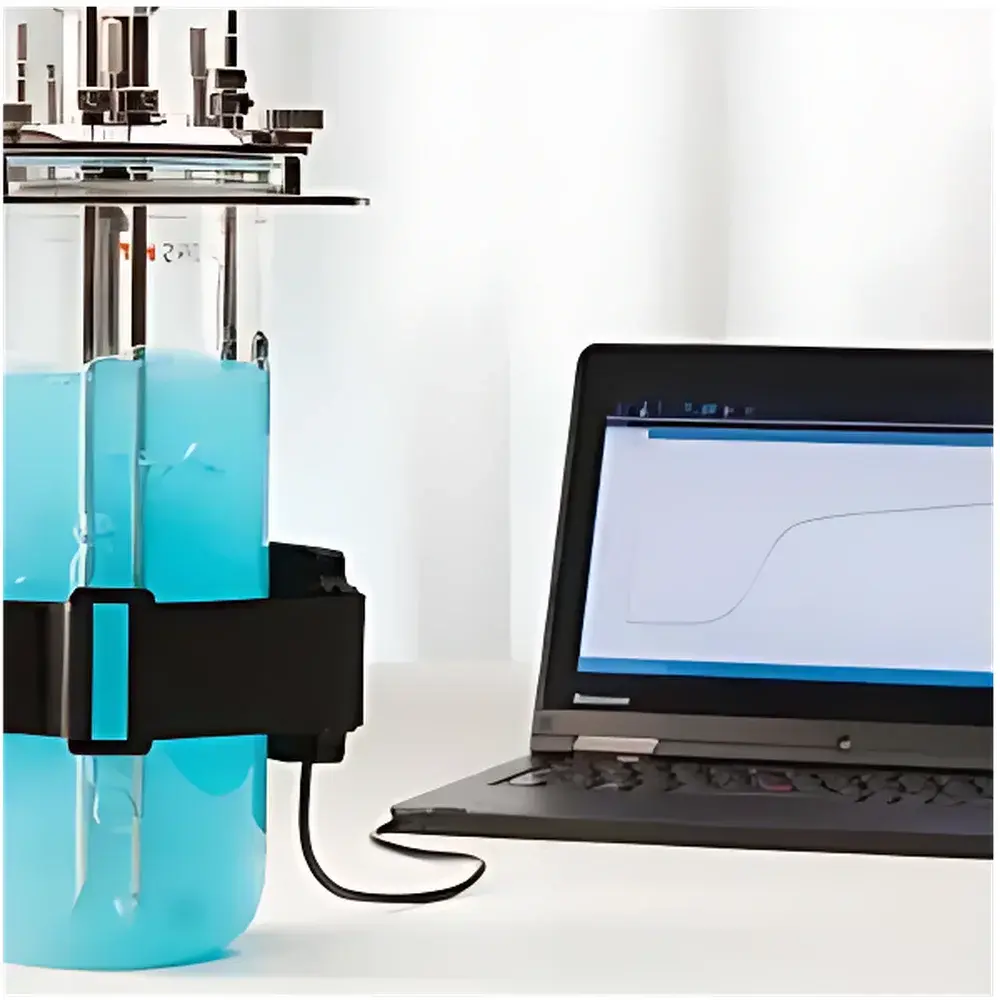
INFORS BioUniv CGQR Real-Time Cell Growth Monitoring System
| Brand | INFORS |
|---|---|
| Origin | Switzerland |
| Model | BioUniv CGQR |
| Measurement Principle | Optical Backscattering (521 nm & 940 nm dual-wavelength) |
| Installation | Non-invasive, external mounting on reactor wall or viewport |
| OD Range | Standard mode (521 nm): 0.5–50 |
| High-density mode (940 nm) | 15–300 |
| Compatibility | Single-wall and double-jacketed glass/metal bioreactors, including INFORS Multifors, Minifors, Techfors, and third-party vessels |
| Sterilization Requirement | None |
| Cleaning Requirement | None |
| Port Usage | Zero bioreactor port occupancy |
| Mounting Flexibility | Installable/removable during operation |
| Regulatory Alignment | Designed for GLP/GMP-compliant environments |
Overview
The INFORS BioUniv CGQR Real-Time Cell Growth Monitoring System is an optically based, non-invasive bioprocess analytical technology engineered for continuous in situ quantification of viable biomass concentration in stirred-tank, rocker, and roller bottle bioreactors. Operating on the principle of optical backscattering at two discrete wavelengths—521 nm (optimized for low-to-moderate cell densities) and 940 nm (optimized for high-density cultures)—the system delivers real-time, calibration-free turbidity-derived optical density (OD) signals directly correlated to microbial or mammalian cell concentration. Unlike traditional sampling-based methods or invasive probes requiring sterilizable ports, the BioUniv CGQR sensor mounts externally on the reactor vessel wall or integrated viewport, eliminating contamination risk, process interruption, and consumable dependency. Its physics-based measurement architecture ensures high reproducibility across batch-to-batch runs and enables kinetic modeling of growth phases—lag, exponential, stationary, and decline—with temporal resolution down to one-second intervals.
Key Features
- True non-invasive design: Sensor clamps externally to glass or stainless-steel reactor walls without penetrating the sterile boundary or occupying any process port.
- Dual-wavelength optical detection: Simultaneous or selectable operation at 521 nm (standard range: OD600-equivalent 0.5–50) and 940 nm (high-density range: OD600-equivalent 15–300), enabling seamless transition across fermentation or perfusion culture phases.
- No cleaning or autoclaving required: Eliminates validation burden associated with reusable probes and avoids thermal or chemical degradation of optical components.
- In-process installability: Can be mounted or repositioned during active cultivation—critical for troubleshooting, scale-down model verification, or adaptive control strategies.
- Reactor-agnostic mounting interface: Compatible with single-wall and double-jacketed vessels from INFORS (Multifors, Minifors, Techfors, Labfors) as well as third-party systems including Sartorius Biostat®, Eppendorf BioFlo®, and custom-built glass reactors.
- Temperature-stable optical path: Integrated thermal compensation algorithms mitigate signal drift caused by jacket coolant fluctuations or exothermic metabolic activity.
Sample Compatibility & Compliance
The BioUniv CGQR is validated for use with bacterial (e.g., E. coli, Bacillus), yeast (e.g., S. cerevisiae, P. pastoris), insect, and mammalian (CHO, HEK293) suspension cultures in standard complex or chemically defined media. It is not intended for filamentous fungi or highly viscous, particulate-laden broths where light scattering heterogeneity exceeds Mie theory assumptions. The system conforms to ISO 13485 design controls for medical device-associated bioprocess instrumentation and supports integration into quality management systems aligned with ICH Q5D, USP <71>, and EU GMP Annex 11. When deployed with INFORS’ IRIS software or third-party SCADA/DCS platforms configured for electronic records, it satisfies audit trail, user access control, and data integrity requirements under FDA 21 CFR Part 11 and EU Annex 11.
Software & Data Management
Raw backscatter intensity values are digitized at 10 Hz and transmitted via RS-485 or Ethernet/IP to host systems. INFORS IRIS v5.x provides native driver support, enabling real-time OD trending, derivative-based growth rate calculation (µ = d(lnOD)/dt), and automated event tagging (e.g., inoculation, feed initiation, harvest trigger). Export formats include CSV, HDF5, and ASAM-ODS for downstream analysis in MATLAB, Python (Pandas/SciPy), or JMP. All measurements are time-stamped with NTP-synchronized precision, and change history—including sensor gain adjustments or wavelength selection—is logged with operator ID and timestamp for full traceability.
Applications
- High-resolution growth kinetics profiling in strain screening and media optimization studies.
- Real-time feedback control of nutrient feeding in fed-batch CHO processes.
- Process characterization and comparability assessments across scales (e.g., 500 mL to 20 L).
- Monitoring of anaerobic fermentations where dissolved oxygen probes are ineffective.
- Supporting Quality by Design (QbD) frameworks through multivariate correlation of OD dynamics with metabolite profiles (e.g., lactate, glucose) and viabilities.
- Education and training platforms for bioprocess engineering curricula requiring robust, low-maintenance instrumentation.
FAQ
Does the BioUniv CGQR require calibration against offline OD600 measurements?
No—calibration is not required for relative growth tracking. However, empirical correlation to spectrophotometric OD600 may be established for specific organism–media combinations to enable absolute biomass estimation.
Can it be used with opaque or stainless-steel bioreactors?
Only with integrated optical viewports (e.g., sapphire or borosilicate windows); direct mounting on opaque metal surfaces is not supported due to lack of optical transmission.
Is the sensor affected by bubbles or foam in the culture?
Transient foaming causes short-term signal noise but does not induce permanent drift; advanced firmware includes bubble rejection algorithms that suppress spurious peaks during vigorous aeration.
What is the minimum vessel wall thickness supported?
Standard configuration supports glass walls up to 12 mm thick and stainless-steel viewports up to 8 mm; custom optical couplers are available for thicker or curved geometries.
How is long-term signal stability ensured over multi-week cultivations?
The system employs reference photodiode monitoring and automatic gain adjustment to compensate for LED aging and ambient temperature variation, maintaining ±2% signal consistency over 60-day continuous operation.



