
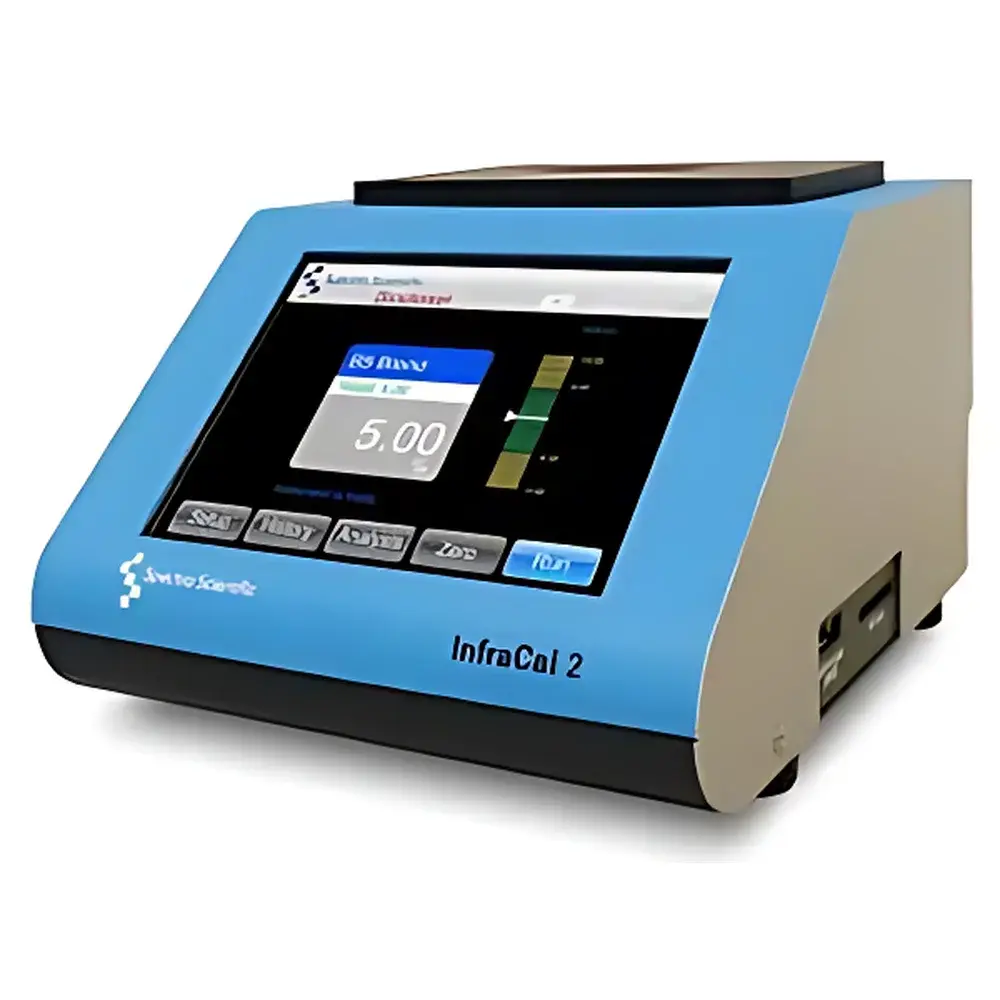
InfraCal 2 ATR-B Biofuel Analyzer by Spectro Scientific
| Brand | Spectro Scientific |
|---|---|
| Origin | USA |
| Manufacturer | Spectro Scientific |
| Type | Portable Mid-IR ATR Analyzer |
| Model | InfraCal 2 ATR-B |
| Detection Range | 0–100% biodiesel in diesel |
| Analysis Time | <30 s |
| Repeatability | ±0.2% (0–30%), ±1.0% (30–100%) |
| Compliant With | ASTM D7371, EN 14078 |
| Power | Rechargeable Li-ion battery (6+ hrs operation), 18 V DC input |
| Weight | 2.6 kg (net), 3.2 kg (with battery) |
| Dimensions | 17 × 19.8 × 13.2 cm |
| Operating Temperature | 5–40 °C |
| Wavelength | 5.7 µm (1745 cm⁻¹) |
| Interface | USB, RS-232 |
| Data Storage | Internal, password-protected, with operator/location/timestamp metadata |
| Display | Touchscreen LCD |
| Language Support | English, Spanish, French, Arabic |
Overview
The InfraCal 2 ATR-B Biofuel Analyzer is a field-deployable, mid-infrared (MIR) attenuated total reflectance (ATR) spectrometer engineered for rapid, quantitative determination of biodiesel (FAME) concentration in diesel fuel matrices. It operates on the fundamental principle of molecular vibrational absorption—specifically targeting the ester carbonyl (C=O) stretch band at 1745 cm⁻¹ (5.7 µm)—a spectral signature highly selective for fatty acid methyl esters and minimally interfered by hydrocarbon components in petroleum diesel. Unlike dispersive or FTIR benchtop systems, the InfraCal 2 ATR-B integrates a solid-state MIR source, diamond ATR crystal, and thermoelectrically stabilized detector into a single compact optical path, eliminating moving parts and enabling robust performance under variable ambient conditions. Its measurement methodology has been rigorously validated against reference laboratory methods and is explicitly endorsed in ASTM D7371 (“Standard Test Method for Determination of Biodiesel (Fatty Acid Methyl Esters) Content of Diesel Fuel Oil by Mid Infrared Spectroscopy”) and EN 14078 (“Liquid petroleum products — Determination of fatty acid methyl ester (FAME) content in middle distillates — Infrared spectroscopy method”). Designed for regulatory compliance, quality assurance, and supply chain verification, the instrument delivers traceable, auditable results without requiring solvent extraction, derivatization, or chromatographic separation.
Key Features
- Portable ATR-based MIR platform: No sample preparation; direct analysis of neat diesel/biodiesel blends via contact measurement on the diamond crystal surface.
- High repeatability: ±0.2% absolute (0–30% FAME), ±1.0% absolute (30–100% FAME), verified per ASTM D7371 precision criteria.
- Integrated rechargeable lithium-ion battery: Supports >6 hours of continuous operation—ideal for mobile labs, terminal inspections, fuel loading docks, and roadside verification.
- Touchscreen interface with multilingual support (English, Spanish, French, Arabic): Intuitive workflow navigation, real-time calibration status, and on-device pass/fail flagging.
- Password-protected system access: Secures calibration curves, user settings, and stored datasets to meet GLP/GMP documentation integrity requirements.
- Onboard data logging: Records each analysis with operator ID, GPS-optional location tag (via external module), date/time stamp, and result confidence indicator.
- Minimal consumables: Diamond ATR crystal requires only ethanol or isopropanol wipe cleaning between samples; no disposable cells, filters, or reagents.
- Zero-installation deployment: Weighing 2.6 kg (net), fully operational within seconds of power-on—no alignment, warm-up, or routine optical recalibration needed.
Sample Compatibility & Compliance
The InfraCal 2 ATR-B is validated exclusively for homogeneous liquid blends of petroleum-derived diesel (ASTM D975, EN 590) and fatty acid methyl ester (FAME)-type biodiesel (ASTM D6751, EN 14214). It is not intended for use with hydrotreated vegetable oil (HVO), renewable diesel, or pyrolysis oils, which lack the diagnostic C=O bond. Sample viscosity must remain below 5 mm²/s at 40 °C to ensure uniform film formation on the ATR crystal. The analyzer complies with ISO/IEC 17025 technical competence requirements when operated per manufacturer-specified procedures and maintained with certified calibration standards (e.g., 403-1024 Certified Biodiesel Standard Set). Its measurement uncertainty budget has been assessed per EURACHEM/CITAC Guide CG4 and supports audit readiness for FDA 21 CFR Part 11–aligned environments where electronic records and signatures are enforced.
Software & Data Management
Data acquisition and reporting are managed through embedded firmware—not external PC software—ensuring deterministic response and immunity to OS-level vulnerabilities. All measurements are stored internally in a structured binary format with SHA-256 checksums for tamper detection. Export is supported via USB mass storage mode (no drivers required) or RS-232 serial dump, generating CSV files compatible with LIMS integration. Each exported record includes full metrological metadata: instrument serial number, firmware version, calibration curve ID (e.g., 405-2041-24), analyst code, environmental temperature reading, and raw absorbance at 1745 cm⁻¹. Audit trails are retained for all calibration modifications and user account changes, satisfying ALCOA+ principles (Attributable, Legible, Contemporaneous, Original, Accurate, Complete, Consistent, Enduring, Available).
Applications
- Fuel terminal QC: Real-time verification of B5–B20 blend accuracy prior to dispatch.
- Regulatory enforcement: On-site testing by EPA, state fuel agencies, or EU market surveillance authorities per Directive 2009/28/EC.
- Biodiesel production monitoring: In-line batch release testing at transesterification facilities.
- Forensic fuel analysis: Detection of adulteration or mislabeling in commercial diesel supplies.
- Research & development: Rapid screening of novel feedstock-derived FAME profiles during catalyst optimization studies.
- Marine fuel compliance: Verification of ISO 8217 Annex D-compliant biodiesel content in residual and distillate marine fuels.
FAQ
Does the InfraCal 2 ATR-B require annual recalibration by the manufacturer?
No. The instrument employs a factory-established, NIST-traceable calibration curve (e.g., part #405-2041-24) that remains stable over time. Users may verify performance quarterly using the supplied Certified Standard Set (403-1024); recalibration is only necessary if physical damage occurs or after extended exposure to extreme thermal cycling.
Can it measure biodiesel in heating oil or kerosene?
Not without method validation. While chemically similar, ASTM D396 heating oil and ASTM D1655 jet fuel contain additives and aromatic profiles that may shift baseline absorbance. Application-specific validation per ASTM D7371 Annex A1 is required before deployment.
Is the internal battery replaceable in the field?
Yes—the Li-ion pack (part #403-1024) is user-swappable using standard Torx tools and requires no firmware reinitialization.
What happens if the ATR crystal becomes scratched?
Diamond crystals are rated for >100,000 measurements under proper cleaning protocol. Minor scratches do not affect quantitation if confined to non-active surface areas; severe damage necessitates replacement (part #403-0012) and recalibration.
Does it support automated report generation with company branding?
Raw data export enables third-party report templating (e.g., via Python/Pandas or LabWare LIMS). The device itself does not perform branded PDF generation—but all metadata fields are exposed for downstream formatting.




