
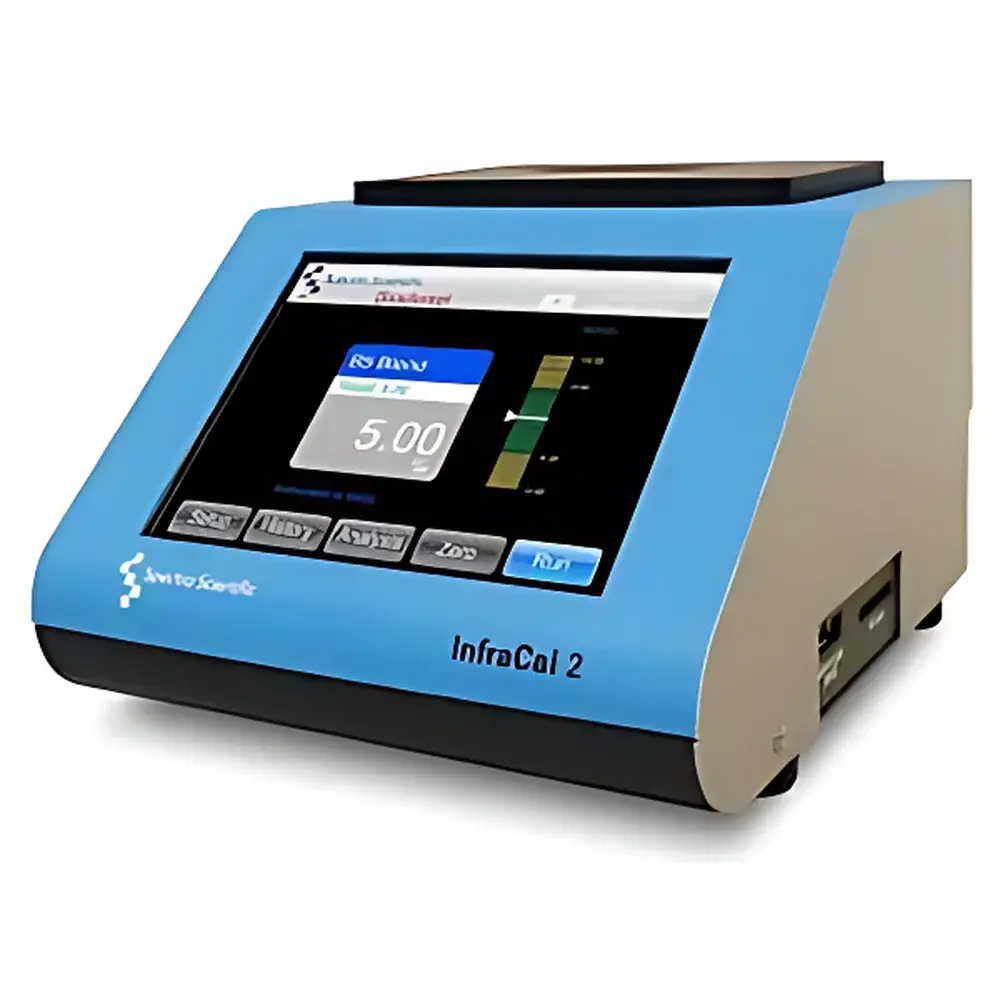
InfraCal 2 ATR-B Biofuel Analyzer by Spectro Scientific
| Brand | Spectro Scientific |
|---|---|
| Origin | USA |
| Model | InfraCal 2 ATR-B |
| Measurement Principle | Attenuated Total Reflectance (ATR) Mid-Infrared Spectroscopy |
| Compliant Standards | ASTM D7371, EN 14078 |
| Detection Range | 0–100% biodiesel in diesel |
| Repeatability | ±0.2% (0–30%), ±1.0% (30–100%) |
| Analysis Time | <30 seconds |
| Power Supply | Rechargeable Li-ion battery (18 V DC, 3.3 A), >6 h operation |
| Weight | 2.6 kg (net), 3.2 kg (with battery) |
| Dimensions | 17 × 19.8 × 13.2 cm |
| Operating Temperature | 5–40 °C |
| Interface | Touchscreen display, USB, RS-232 |
| Data Storage | Internal memory with user, location, date/time stamping |
| Language Support | English, Spanish, French, Arabic |
| Calibration Options | Pre-loaded ATR-B curve (405-2041-24), optional multi-point calibration kits (e.g., 403-1024) |
Overview
The InfraCal 2 ATR-B Biofuel Analyzer is a field-deployable, mid-infrared (MIR) spectrometer engineered for rapid, quantitative determination of biodiesel concentration (B0–B100) in petroleum diesel fuel. It operates on the principle of Attenuated Total Reflectance (ATR) spectroscopy at a characteristic absorption band centered at 1745 cm⁻¹ (5.7 µm), corresponding to the ester carbonyl (C=O) stretch vibration unique to fatty acid methyl esters (FAME). This spectral signature enables selective, interference-resistant quantification without sample dilution or solvent extraction. Unlike dispersive FTIR systems requiring cryogenic detectors and complex alignment, the InfraCal 2 ATR-B employs a robust, thermoelectrically stabilized solid-state detector and fixed-path ATR crystal—eliminating moving parts and optical realignment. Its measurement traceability is anchored to ASTM D7371 (Standard Test Method for Determination of Biodiesel (Fatty Acid Methyl Esters) Content of Diesel Fuel Oil by Mid Infrared Spectroscopy) and EN 14078 (Liquid petroleum products — Determination of fatty acid methyl ester (FAME) content in middle distillates — Infrared spectroscopy method), ensuring regulatory acceptability across North America, Europe, and ISO-compliant markets.
Key Features
- Portable ATR-MIR platform: Compact form factor (17 × 19.8 × 13.2 cm), net weight 2.6 kg; fully operational without external power for >6 hours via integrated rechargeable Li-ion battery.
- Field-optimized optics: Diamond-coated ZnSe ATR crystal with high chemical resistance and consistent contact pressure—enabling reproducible spectra from viscous, low-volatility diesel/biodiesel blends.
- Intuitive human interface: 5-inch capacitive touchscreen with multilingual support (English, Spanish, French, Arabic); password-protected access to calibration parameters and stored results.
- Regulatory-grade data integrity: Internal non-volatile memory logs each analysis with operator ID, GPS-tagged location (if enabled via external module), timestamp (date/time), and instrument serial number—supporting GLP/GMP audit trails.
- Minimal consumables architecture: No solvents, filters, or disposable cells required; only periodic cleaning of the ATR crystal surface with isopropanol is recommended per ASTM D7371 Section 8.3.
- Plug-and-play deployment: Factory-calibrated using NIST-traceable reference fuels (kit 403-1024); no site-specific installation, optical alignment, or warm-up time needed—ready for analysis within 60 seconds of power-on.
Sample Compatibility & Compliance
The InfraCal 2 ATR-B is validated exclusively for homogeneous liquid-phase samples meeting ASTM D975 and EN 590 specifications for diesel fuel. It accepts undiluted diesel/biodiesel blends containing up to 100% FAME (B100), including rapeseed methyl ester (RME), soybean methyl ester (SME), and used cooking oil methyl ester (UCOME). Samples must be free of suspended particulates (>5 µm), water droplets (>200 ppm), or heavy oxidation products that may coat the ATR crystal surface and attenuate signal fidelity. The analyzer complies with electromagnetic compatibility requirements per IEC 61326-1 and carries CE marking for use in industrial environments. Its measurement uncertainty profile satisfies the repeatability criteria defined in ASTM D7371 (±0.2% absolute for B0–B30; ±1.0% for B30–B100) and EN 14078 (repeatability r ≤ 0.5% for B5–B20; r ≤ 1.0% for B20–B100), making it suitable for custody transfer verification, blending control, and regulatory compliance screening.
Software & Data Management
Data acquisition and reporting are managed through embedded firmware v3.2+, supporting direct export of CSV-formatted result files via USB mass storage mode or RS-232 serial output. Each record includes raw absorbance values at 1745 cm⁻¹, calculated biodiesel %, operator code, measurement ID, and environmental metadata (ambient temperature, battery voltage). Files are timestamped using an onboard real-time clock synchronized during USB connection. Optional SpectroLink desktop software (v2.1+) enables batch processing, calibration curve validation (linearity R² ≥ 0.999), and generation of 21 CFR Part 11–compliant audit reports—including electronic signatures, change history, and locked archive exports. All calibration curves (e.g., part #405-2041-24) are digitally signed and encrypted to prevent unauthorized modification.
Applications
- Fuel terminal quality assurance: Real-time verification of B5/B20 blend accuracy prior to dispatch.
- Refinery blending optimization: Feedback control of transesterification reactor output and post-treatment FAME concentration.
- Regulatory inspection: On-site testing by EPA, CARB, or national petroleum agencies for compliance with RFS2, RED II, or local biofuel mandates.
- Marine fuel certification: Screening of residual and distillate marine fuels per IMO 2020 sulfur cap and upcoming biofuel blending guidelines.
- Research & development: Rapid screening of novel feedstock-derived FAMEs (e.g., algae, camelina) against baseline diesel matrices.
FAQ
Does the InfraCal 2 ATR-B require annual recalibration?
No. The factory-installed calibration curve (part #405-2041-24) remains stable for ≥12 months under normal operating conditions. Verification against reference standards (e.g., kit 403-1024) is recommended quarterly per ASTM D7371 Section 9.2.
Can it measure biodiesel in gasoline or jet fuel?
No. The analyzer is specifically validated for diesel-range hydrocarbons (T90 ≤ 360 °C). Gasoline’s volatility and jet fuel’s aromatic composition produce spectral interferences that invalidate the 1745 cm⁻¹ quantification model.
Is the ATR crystal replaceable in the field?
Yes. The ZnSe ATR element (part #403-0021) is user-replaceable using standard Torx T6 tools; replacement requires <5 minutes and no optical recalibration.
How is data security maintained during USB export?
All exported CSV files are write-only; the device does not permit firmware or calibration file uploads via USB—preventing accidental overwrites or malware injection.
What environmental conditions affect measurement accuracy?
Ambient temperatures outside 5–40 °C may induce thermal drift in detector response. The instrument includes automatic temperature compensation, but prolonged exposure to condensing humidity (>80% RH) requires protective housing (accessory #403-1086).




