
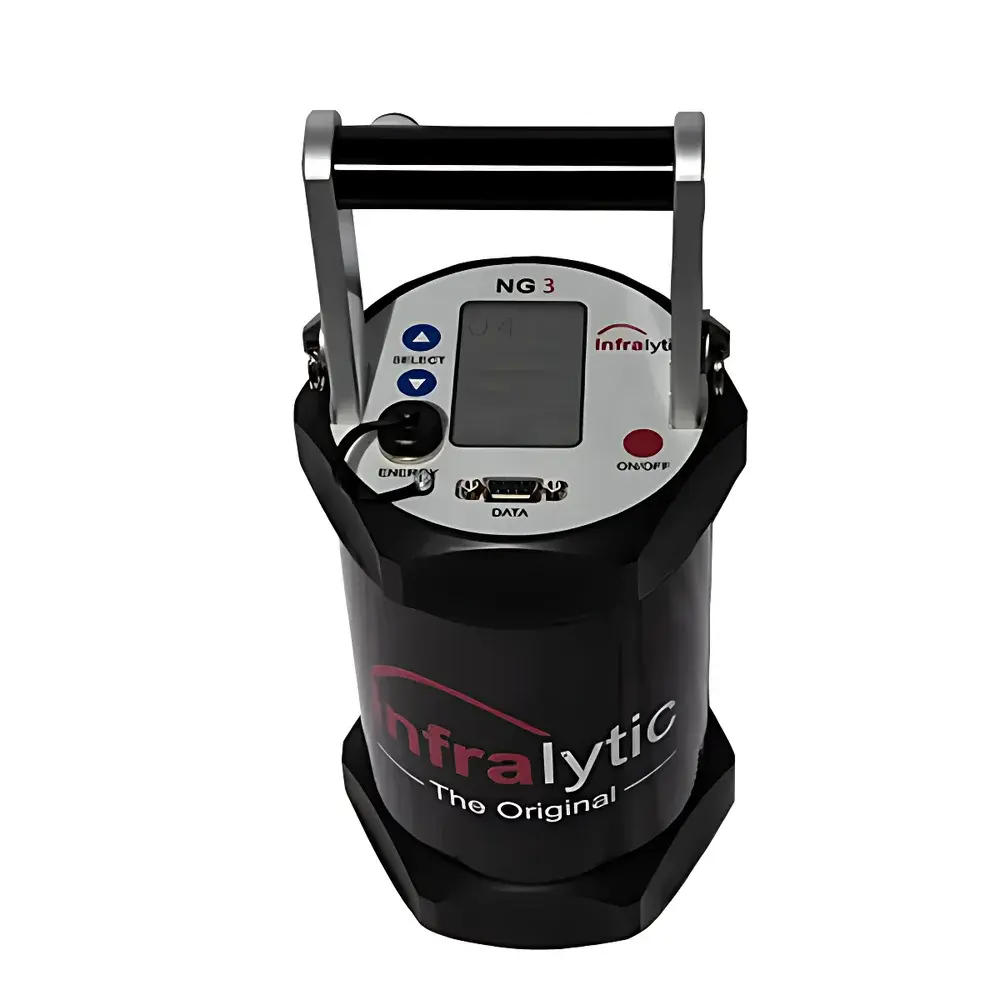
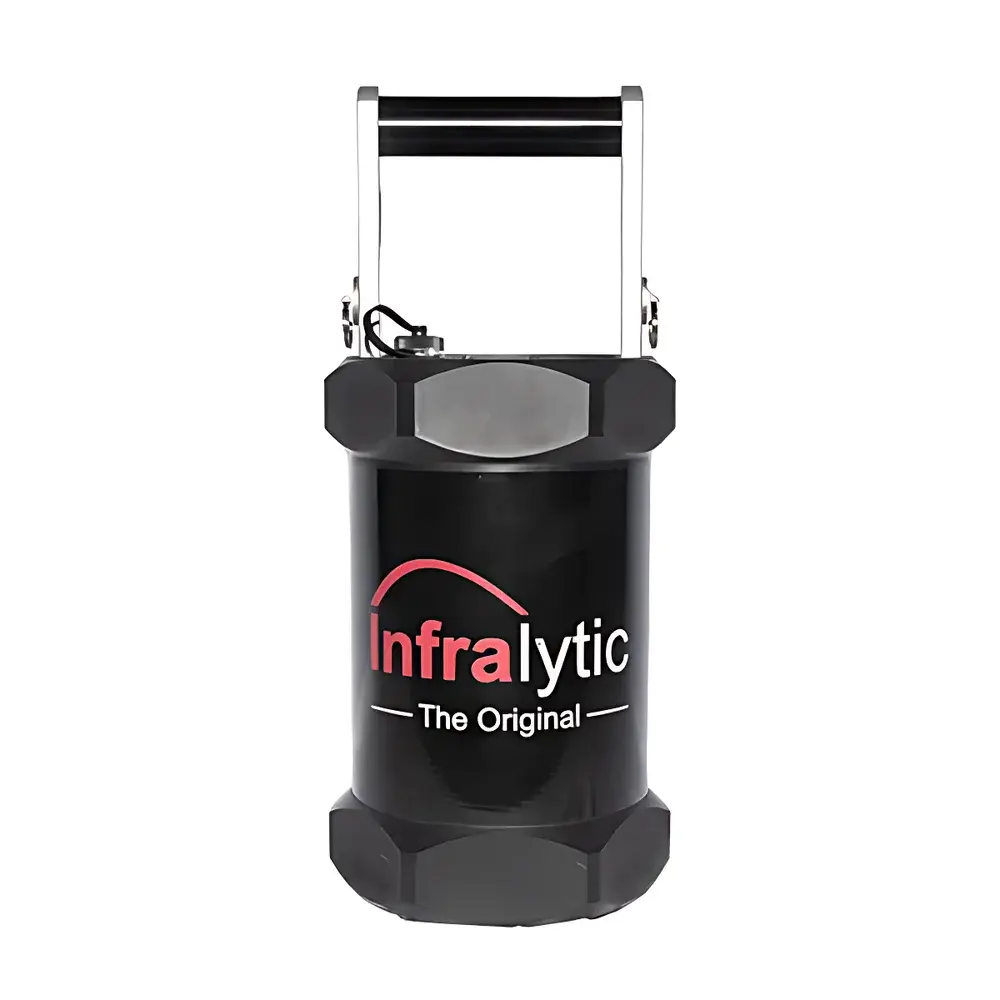
Infralytic NG03 Non-Contact Infrared Oil Film Thickness Gauge
| Brand | Infralytic |
|---|---|
| Origin | Germany |
| Model | NG03 |
| Measurement Principle | Near-Infrared (NIR) Absorption Spectroscopy |
| Measurement Range | 0.05–6 g/m² |
| Accuracy | ±0.015 g/m² (0.02–0.3 g/m²), ±0.2 g/m² (0.3–2 g/m²), ±10% of reading (>2 g/m²) |
| Repeatability | <0.0010 g/m² |
| Resolution | 0.001 g/m² |
| Standoff Distance | 8 mm (+5/−2 mm) |
| Operating Temperature | 0–45 °C |
| IP Rating | IP65 |
| Substrate Compatibility | Cold-rolled steel, hot-dip galvanized (HDG), electrogalvanized (EG), phosphated EG, annealed galvannealed (GA), Al, ZnMg, aluzinc |
| Lubricant Compatibility | Mineral oils, thixotropic mineral oils, hot-melt adhesives, waxes, other organics (with custom calibration) |
Overview
The Infralytic NG03 is a non-contact, portable infrared oil film thickness gauge engineered for high-precision, real-time quantification of ultra-thin organic coatings on metallic substrates in industrial metalworking environments. Unlike conventional eddy-current or beta-backscatter instruments, the NG03 employs calibrated near-infrared (NIR) absorption spectroscopy—measuring characteristic vibrational overtones and combination bands of C–H, O–H, and C=O bonds in lubricants—to determine mass-based coating thickness (g/m²) without physical contact or surface disruption. This optical method delivers intrinsic immunity to substrate topography, conductivity variations, and magnetic permeability—critical advantages when measuring on hot-dip galvanized, phosphated, or ZnMg-coated steel strips where electromagnetic methods suffer interference. The NG03 is purpose-built for inline and offline process verification in cold rolling mills, continuous galvanizing lines (CGL), and coil coating facilities, supporting quality assurance protocols aligned with ISO 2178, ASTM D7091, and EN 13523-15.
Key Features
- True non-contact measurement at fixed 8 mm standoff distance—no mechanical wear, zero risk of surface contamination or scratch damage
- Automated material recognition and rolling direction detection via integrated spectral signature analysis, eliminating manual substrate selection errors
- On-device self-validation routine: internal reference standard verifies optical path integrity and detector linearity before each measurement sequence
- Smartphone-integrated operation: live preview, photo-anchored documentation, timestamped metadata export via Bluetooth LE (iOS/Android)
- Battery endurance exceeding 12 hours under continuous use—enabling full-shift deployment without recharging
- Ruggedized aluminum housing rated IP65—dust-tight and protected against low-pressure water jets, suitable for humid, oily, or dusty production floors
Sample Compatibility & Compliance
The NG03 is validated for quantitative measurement across a defined matrix of industrially relevant substrate–lubricant combinations. Certified calibrations are provided for cold-rolled uncoated steel, hot-dip galvanized (HDG), electrogalvanized (EG), phosphated EG (including automatic phosphate layer detection), galvannealed (GA), pure aluminum, and ZnMg-alloyed surfaces. Lubricant coverage includes mineral oils, thixotropic variants, hot-melt adhesives, waxes, and other organic formulations—subject to application-specific calibration using traceable NIST-traceable reference standards. All factory calibrations comply with ISO/IEC 17025 requirements for metrological traceability. The instrument supports GLP-compliant data integrity through embedded audit trail logging (user ID, timestamp, location tag, calibration status) and encrypted CSV export compatible with LIMS integration.
Software & Data Management
The NG03 operates with embedded firmware v3.2+, featuring dual-mode data handling: local on-device storage (2,000+ measurements) and wireless synchronization to the Infralytic Cloud Analytics Platform. Raw spectra (128-point NIR absorbance vectors), processed g/m² values, substrate ID, environmental temperature, and operator annotations are stored with SHA-256 hash integrity verification. Export formats include CSV (with ISO 8601 timestamps), PDF reports (PDF/A-2b compliant), and XML for ERP/MES integration. Audit trail records capture all configuration changes, calibration events, and user logins—fully satisfying FDA 21 CFR Part 11 electronic record requirements when deployed in regulated manufacturing environments. Custom calibration models may be uploaded via secure HTTPS interface with digital certificate validation.
Applications
- Real-time lubrication control during cold rolling: verifying oil film uniformity prior to final pass to prevent surface scoring and roll marking
- Process validation in continuous galvanizing lines: monitoring post-galvannealing oil application consistency across strip width and speed
- Quality gate inspection for automotive stamped parts: confirming compliance with OEM-specified lubricant mass tolerances (e.g., Ford WSS-M1A225-A, GM GMW14872)
- Coating optimization R&D: correlating g/m² values with friction coefficient (μ), drawability, and post-forming cleanability
- Supplier qualification audits: objective, operator-independent verification of delivered coil lubrication specifications
FAQ
Does the NG03 require periodic recalibration by the user?
No—built-in self-validation ensures measurement stability between factory calibrations. Annual traceable recalibration by an Infralytic-certified lab is recommended per ISO/IEC 17025.
Can it measure on moving strip at production line speeds?
Yes—optimized for velocities up to 800 m/min; measurement cycle time is <150 ms per point with motion-compensated averaging.
Is phosphating detection truly automated?
Yes—the NG03 identifies phosphate crystal signatures (P–O stretch bands at ~1050 cm⁻¹) within the NIR spectrum and flags presence/absence without operator input.
What spectral resolution does the instrument employ?
Fixed 16 nm bandwidth at 1700–2200 nm; optimized for hydrocarbon absorption maxima while minimizing water vapor interference.
How is measurement uncertainty reported in compliance documentation?
Uncertainty budgets follow GUM (JCGM 100:2018) methodology, incorporating type A (repeatability) and type B (calibration, environmental, model) components—available in Certificate of Calibration.



