
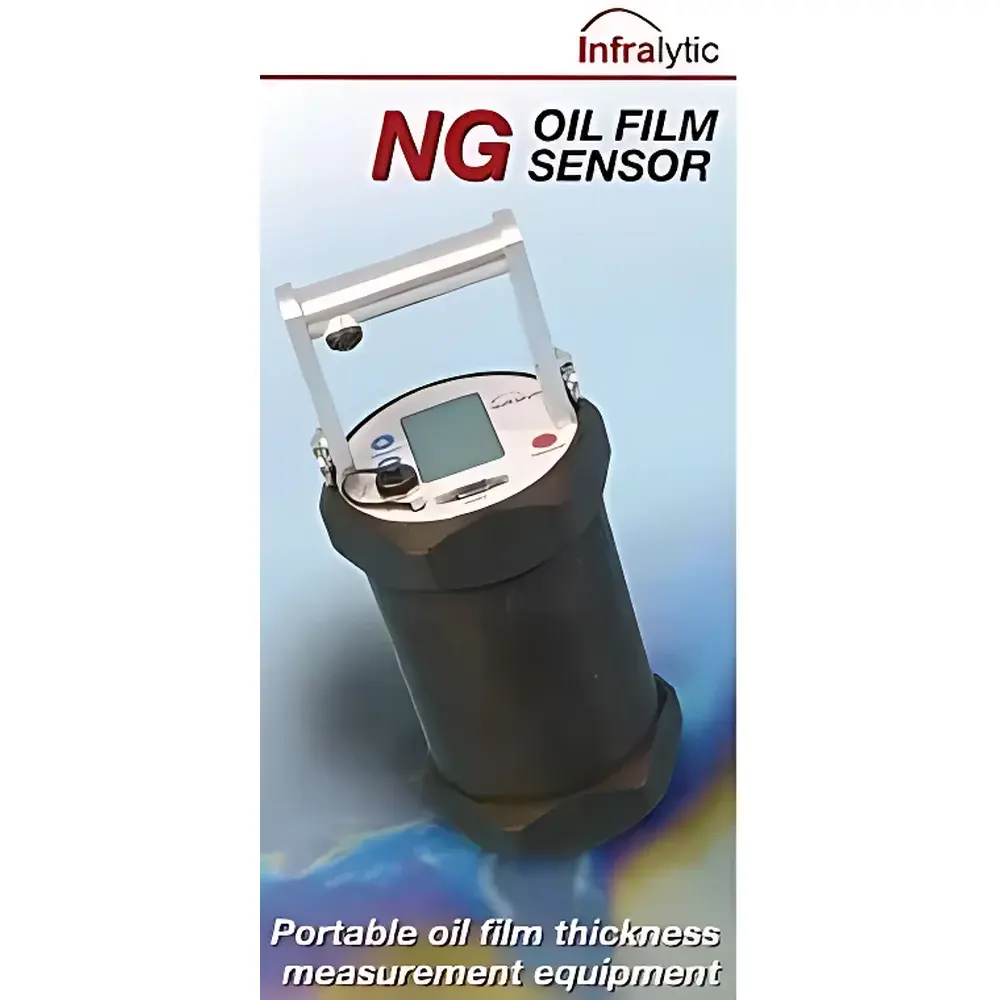
Infralytic NG1 Portable Infrared Oil Film Thickness Gauge
| Brand | Infralytic |
|---|---|
| Origin | Germany |
| Model | NG1 |
| Measurement Principle | Dual-Wavelength Near-Infrared Absorption Spectroscopy |
| Typical Measurement Range | 0.1–20 g/m² (oil equivalent on metal substrates) |
| Accuracy | ±0.05 g/m² (calibrated against reference standards) |
| Repeatability | <±0.02 g/m² |
| Response Time | <1 second per measurement |
| Power Supply | Rechargeable NiMH battery (included) |
| Interface | USB 2.0 with proprietary PC software |
| Compliance | CE, RoHS, ISO/IEC 17025 traceable calibration support |
| Operating Temperature | 10–40 °C |
| Weight | 0.85 kg (with battery) |
Overview
The Infralytic NG1 Portable Infrared Oil Film Thickness Gauge is a precision-engineered, field-deployable instrument designed for non-contact, quantitative determination of thin organic coatings—primarily lubricating oils, passivation layers, fingerprint-resistant films, and insulating varnishes—on conductive metallic substrates. It operates on the principle of dual-wavelength near-infrared (NIR) absorption spectroscopy, exploiting characteristic absorption bands of hydrocarbon-based compounds (e.g., mineral oils, ester-based lubricants, acrylic resins) in the 1.6–1.8 µm spectral region. By measuring the differential attenuation of two closely spaced NIR wavelengths—one strongly absorbed by the coating and one minimally absorbed—the NG1 calculates mass per unit area (g/m²) with high specificity and minimal substrate interference. Unlike beta-backscatter or X-ray fluorescence methods, it requires no radioactive sources or ionizing radiation, making it intrinsically safe for continuous use in production environments, quality control labs, and incoming inspection stations.
Key Features
- Single-button, one-second measurement cycle with audible and visual confirmation
- Factory-calibrated using certified reference standards traceable to PTB (Physikalisch-Technische Bundesanstalt), Germany
- Integrated temperature-compensated detector array to maintain accuracy across ambient fluctuations (10–40 °C)
- Ergonomic handheld housing with IP54-rated enclosure for dust and splash resistance
- Real-time display of measured value, standard deviation of last 5 readings, and battery status
- Onboard memory stores up to 2,000 measurement records with timestamp and operator ID fields
- Modular optical head design allows rapid replacement of sapphire windows without recalibration
Sample Compatibility & Compliance
The NG1 is validated for use on flat or gently curved metallic surfaces including cold-rolled steel, galvanized steel (GI/GA), aluminum alloys (e.g., AA3003, AA5182), silicon electrical steel, and tinplate. It supports measurement of oil films (mineral, synthetic, biodegradable), chromate and trivalent passivation layers, acrylic- and polyester-based anti-fingerprint coatings, epoxy-phenolic insulating varnishes, and UV-curable resin topcoats. All factory calibrations are performed in accordance with ISO 2178 (non-magnetic coatings on magnetic substrates) and ASTM D7091 (standard practice for nondestructive measurement of dry film thickness of nonmagnetic coatings applied to ferrous metals). The instrument supports GLP-compliant data integrity via optional audit trail logging and meets the electronic record requirements outlined in FDA 21 CFR Part 11 when used with validated software configurations.
Software & Data Management
The included Infralytic Control Suite (v4.2+) runs on Windows 10/11 and enables full configuration, statistical analysis, and report generation. It provides SPC charting (X-bar/R, Cpk/Ppk), batch-level summary exports (CSV, PDF, XML), and configurable alarm thresholds for out-of-specification events. Raw spectral data (absorbance vs. wavelength) is stored for retrospective analysis and method revalidation. The software supports integration with enterprise MES/QMS platforms via OPC UA or RESTful API endpoints. All measurement files include embedded metadata: instrument serial number, calibration certificate ID, operator login, environmental sensor readings (ambient temp/humidity), and GPS coordinates (when connected via Bluetooth-enabled tablet).
Applications
- Roll mill QC: Monitoring oil application uniformity on cold-rolled steel coils prior to annealing
- Automotive stamping lines: Verifying draw lubricant coverage on exposed flanges and hemmed edges
- Can manufacturing: Quantifying resin solids deposition on aluminum beverage can bodies
- Electrical steel processing: Controlling insulation coating weight on grain-oriented (GO) and non-oriented (NO) silicon steel
- Galvanizing lines: Measuring chromate-free passivation layer mass on hot-dip galvanized (HDG) sheet
- Coil coating plants: Validating primer coat consistency before curing oven entry
- Recycling facilities: Screening residual oil content on scrap metal prior to shredding and melting
FAQ
Does the NG1 require daily recalibration?
No—factory calibration remains stable for ≥6 months under normal operating conditions. A quick verification check using the supplied reference foil is recommended before each shift.
Can it measure on painted or pre-coated substrates?
Yes, provided the underlying paint layer is fully cured and spectrally transparent in the 1.6–1.8 µm range; validation with representative samples is required prior to deployment.
Is surface roughness a limiting factor?
Measurements remain accurate up to Ra = 1.6 µm; for rougher surfaces (e.g., shot-blasted steel), contact-mode averaging over ≥5 mm diameter is advised.
What maintenance does the optical path require?
The sapphire window should be cleaned weekly with lint-free wipes and spectroscopic-grade isopropanol; no alignment or internal servicing is user-accessible.
How is measurement uncertainty determined?
Total uncertainty (k=2) is calculated per GUM (JCGM 100:2008) and includes contributions from calibration standard uncertainty, repeatability, temperature drift, and operator positioning error—typically ≤±0.08 g/m² for oils on steel.



