
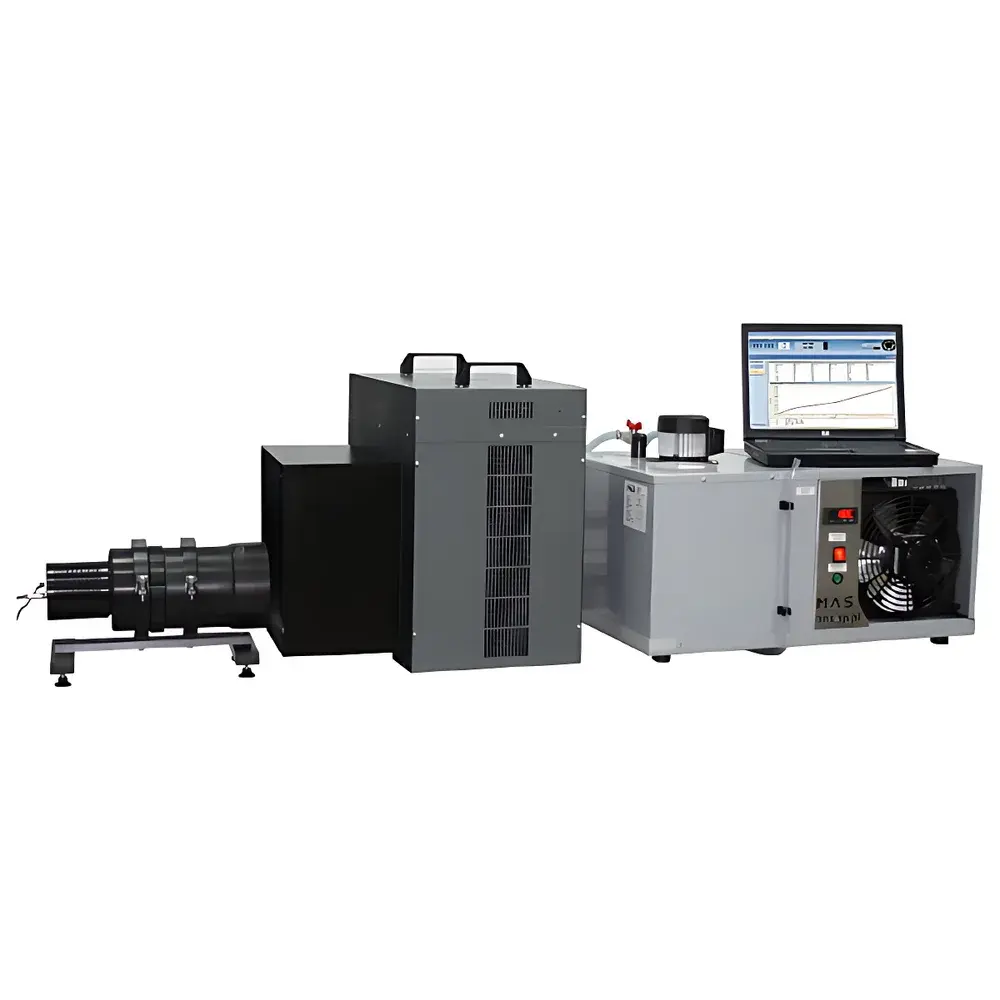
Inframet BLIQ Liquid Nitrogen-Cooled Blackbody
| Brand | Inframet |
|---|---|
| Origin | Poland |
| Model | BLIQ |
| Temperature Range | –40 °C to +170 °C (standard), optional –30 °C to +100 °C or –30 °C to +170 °C |
| Temperature Resolution | 1 mK |
| Emissivity | 0.97 ± 0.01 |
| Temperature Uniformity | < 0.002(T–25) + 0.02 °C (over 90% of emitter area) |
| Temperature Stability | ±2 mK @ ΔT = 10 °C (BLIQ-4D), ±3 mK @ ΔT = 10 °C (BLIQ-12D) |
| Heating/Cooling Rate | 0.4 °C/s at 25 °C (heating), 0.2 °C/s at 25 °C (cooling) |
| Stabilization Time | < 50 s (BLIQ-4D), < 120 s (BLIQ-12D) |
| Interface | RS-232 or USB 2.0 (optional) |
| Power Supply | 110–230 VAC, 50/60 Hz |
| Max. Power Consumption | 1400 W |
| Operating Ambient | 5–40 °C |
| Storage Ambient | –10–60 °C |
| Relative Humidity | ≤95% RH (non-condensing) |
| Weight | blackbody unit only — specified per configuration (BLIQ-4D / BLIQ-12D) |
Overview
The Inframet BLIQ Liquid Nitrogen-Cooled Blackbody is a high-precision, actively temperature-controlled infrared radiation source engineered for metrological-grade calibration and characterization of thermal imaging systems. Unlike conventional thermoelectric or resistive blackbodies, the BLIQ integrates a cryogenic cooling stage using liquid nitrogen (LN2) in conjunction with three independent PID-controlled temperature regulators—enabling stable operation down to –40 °C while maintaining exceptional thermal uniformity and long-term stability. Its core principle relies on Planckian radiance generation from a precisely characterized cavity emitter with certified emissivity of 0.97 ± 0.01, traceable to national standards. The system operates within a sealed, dry-nitrogen-purged enclosure to eliminate frost formation, moisture condensation, and thermal drift caused by ambient humidity—critical for low-temperature IR source integrity during extended calibration cycles.
Key Features
- Extended low-temperature capability: –40 °C minimum operating point, uniquely achieved via integrated LN2 heat sink combined with active thermoelectric regulation—ideal for calibrating uncooled microbolometer arrays and cryogenically stabilized IR detectors.
- Triple-stage temperature control architecture: Independent regulation of cavity baseplate, aperture ring, and rear shield ensures minimal thermal gradients across the emitting surface.
- Dry-nitrogen purge system: Hermetically sealed housing continuously flushed with ultra-dry N2 (dew point < –40 °C), preventing ice deposition and maintaining optical path integrity over multi-hour stabilization periods.
- High spatial uniformity: Temperature variation < 0.002(T–25) + 0.02 °C across ≥90% of emitter area (defined per ISO 18434-1 Annex B), verified via calibrated IR camera mapping and contact thermometry.
- Metrological traceability: Emissivity value certified per ASTM E1543 and ISO/IEC 17025-accredited procedures; uncertainty budget includes contributions from spectral emissivity deviation, cavity geometry, and temperature measurement error.
- Rapid thermal response: Achieves ±0.01 °C stability in < 50 seconds (BLIQ-4D) or < 120 seconds (BLIQ-12D) following setpoint change—enabling high-throughput radiometric verification in production QA environments.
Sample Compatibility & Compliance
The BLIQ supports calibration of diverse infrared sensing platforms including cooled MCT and InSb focal plane arrays (FPAs), uncooled VOx and a-Si microbolometers, scanning line-scan imagers, and single-element pyrometers. Its aperture sizes (40 × 40 mm and 120 × 120 mm variants) accommodate standard collimator inputs and full-field irradiance testing configurations. The device complies with ISO/IEC 17025 requirements for reference standards used in accredited laboratories and meets essential criteria outlined in ASTM E1256 (Standard Test Methods for Radiation Thermometers), IEC 62906-5-2 (Laser display devices), and EU Directive 2014/30/EU (EMC). Optional documentation packages include full uncertainty budgets, calibration certificates traceable to PTB (Physikalisch-Technische Bundesanstalt) or CENAM, and GLP-compliant audit trails for regulated industries.
Software & Data Management
Inframet provides the proprietary BlackBody Control Suite, a Windows-based application supporting real-time monitoring, multi-point ramp/soak profiling, and automated sequence execution. All temperature setpoints, actual readings, and status flags are timestamped and logged with millisecond resolution. Export formats include CSV, HDF5, and XML—compatible with MATLAB, Python (NumPy/Pandas), and LabVIEW environments. For regulated environments, optional 21 CFR Part 11 compliance modules enable electronic signatures, role-based access control, and immutable audit logs—including user actions, parameter modifications, and calibration event history. Firmware updates and diagnostic routines are delivered via secure HTTPS channel with SHA-256 signature verification.
Applications
- Primary and secondary calibration of thermal cameras in national metrology institutes (NMIs) and accredited calibration labs.
- Verification of NETD (Noise Equivalent Temperature Difference), MRTD (Minimum Resolvable Temperature Difference), and spatial resolution performance per MIL-STD-3009 and STANAG 4347.
- Characterization of spectral responsivity of IR detectors operating in MWIR (3–5 µm) and LWIR (8–14 µm) bands.
- Validation of non-uniformity correction (NUC) algorithms during FPA burn-in and post-repair testing.
- Reference source for radiometric intercomparison campaigns between international laboratories under BIPM CCPR key comparisons.
- Environmental stress testing of IR optics and windows under controlled thermal cycling conditions (–40 °C to +170 °C).
FAQ
What cryogen is required for BLIQ operation?
Liquid nitrogen (LN2) is the sole cryogenic fluid required; no liquid helium or mechanical cryocoolers are needed. A standard 170-L dewar provides >8 hours of continuous operation at –40 °C.
Can BLIQ be used in a cleanroom environment?
Yes—the nitrogen purge system eliminates particulate outgassing, and the stainless-steel housing meets ISO Class 5 compatibility when installed with appropriate vibration isolation.
Is emissivity uniformity validated across the entire temperature range?
Yes—emissivity mapping and cavity uniformity tests are performed at five representative temperatures (–40 °C, 0 °C, 25 °C, 100 °C, 170 °C) per ISO 18434-1 Clause 6.3.
How is temperature uncertainty quantified for BLIQ?
Total expanded uncertainty (k=2) is ≤±5 mK across –40 °C to +100 °C and ≤±8 mK up to +170 °C, incorporating sensor calibration, spatial non-uniformity, and environmental influence factors.
Does BLIQ support automated integration into robotic calibration cells?
Yes—RS-232 and USB 2.0 interfaces provide SCPI-compliant command sets compatible with industrial PLCs and motion controller ecosystems (e.g., Beckhoff, National Instruments).






