
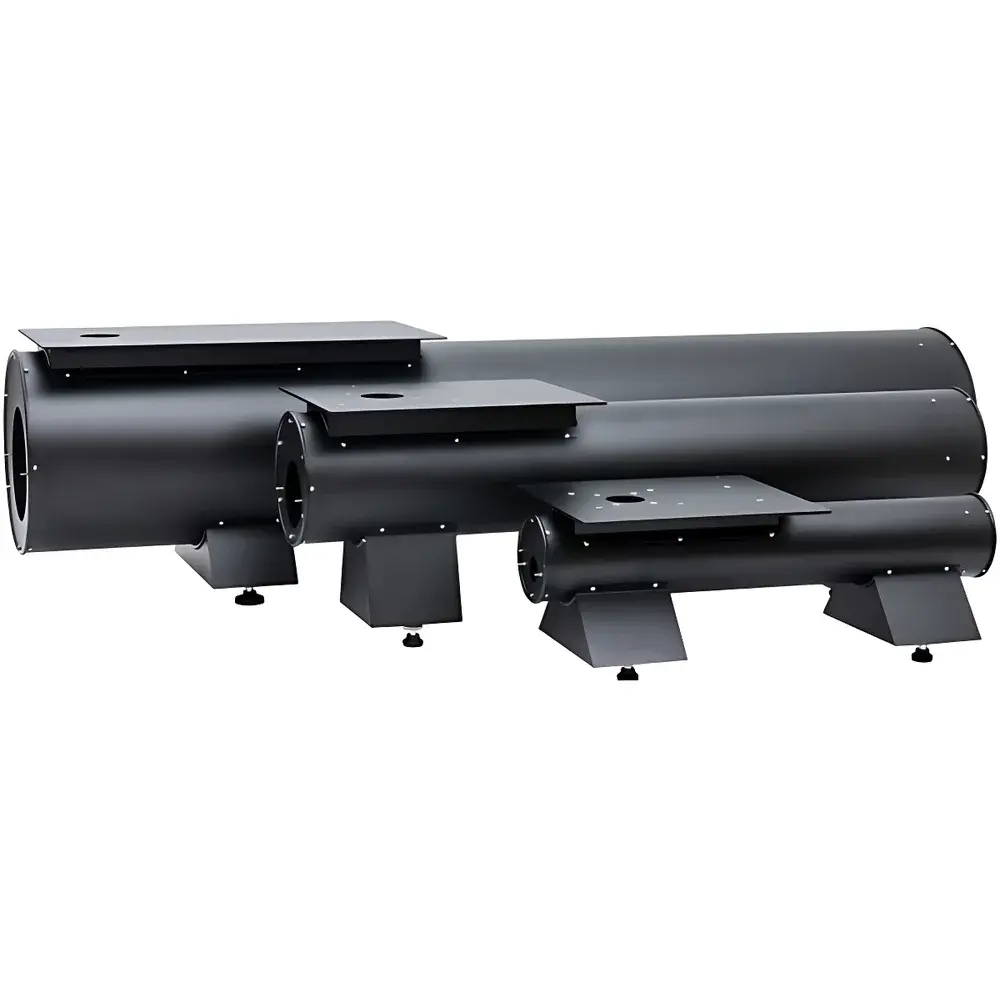
Inframet CDT Off-Axis Reflective Collimator
| Brand | Inframet |
|---|---|
| Origin | Poland |
| Manufacturer Type | Authorized Distributor |
| Origin Category | Imported |
| Model | CDT |
| Price Range | USD 42,000 – 70,000 |
Overview
The Inframet CDT Off-Axis Reflective Collimator is a precision optical calibration instrument engineered for high-fidelity collimated beam generation in infrared and multispectral testing environments. Unlike conventional on-axis reflective or refractive collimators, the CDT employs a vertically oriented off-axis parabolic mirror configuration—positioning the focal plane above the optical axis in a perpendicular orientation. This architecture eliminates central obscuration, minimizes diffraction artifacts, and enables unobstructed beam paths critical for thermal imaging system characterization. The vertical geometry further enhances thermal uniformity during blackbody-based radiometric calibration: by aligning the collimator’s optical axis orthogonal to gravity, natural convection gradients across extended-area blackbody sources are significantly reduced compared to horizontally mounted equivalents—directly improving temperature homogeneity (±0.15 °C over 100 mm aperture) and spatial emissivity consistency per ASTM E1543 and ISO 18434-1.
Key Features
- Vertically aligned off-axis parabolic design with focal plane positioned orthogonally above the primary mirror—reducing footprint requirements by up to 40% versus horizontal configurations and enabling compact integration into constrained optical benches.
- Four standardized surface figure accuracy grades: SR (PV ≤ λ/2 @ 630 nm), HR (PV ≤ λ/6 @ 630 nm, typical λ/10), UR (PV ≤ λ/10 @ 630 nm), and SQ (PV ≤ λ/14 @ 630 nm), all verified via phase-shifting interferometry traceable to PTB standards.
- Primary mirror coating options: protected aluminum (R ≥ 90% from 400 nm to 2 µm) for visible–NIR applications; protected gold (R ≥ 98% from 2 µm to 14 µm) for MWIR/LWIR thermal imaging validation per MIL-STD-810H and IEC 62676-3.
- Modular mechanical interface compliant with ISO 10110-7 mounting standards; supports interchangeable secondary mirrors and field-stop assemblies without realignment.
- Thermally stabilized baseplate with low-expansion Invar alloy construction (CTE < 1.2 × 10⁻⁶ K⁻¹), minimizing focus drift under ambient fluctuations ±2 °C.
Sample Compatibility & Compliance
The CDT collimator is compatible with standard blackbody sources (e.g., CI Systems BB-1500, Mikron M390), integrating seamlessly into automated test stations for infrared camera MTF, NEdT, spatial resolution, and modulation transfer function verification. Its optical layout satisfies requirements for ISO 12233 Annex D (spatial frequency response), USP analytical instrument qualification (AIQ) for optical subsystems, and FDA 21 CFR Part 11-compliant calibration workflows when paired with validated software. All delivered units include NIST-traceable interferometric surface map reports and spectral reflectance certificates.
Software & Data Management
While the CDT is a passive optical component, Inframet provides optional calibration support packages including MATLAB-based beam profiling scripts, Zemax OpticStudio-compatible .ZAR files for system-level modeling, and CSV-formatted wavefront error datasets aligned to ANSI/ISO 10110-5. Integration with LabVIEW and Python (via PyVISA) is supported for automated alignment verification sequences. Audit trails for mirror certification data comply with GLP/GMP documentation standards—including revision-controlled metadata, operator ID, environmental conditions, and uncertainty budgets per GUM (JCGM 100:2018).
Applications
- Radiometric calibration of cooled and uncooled thermal imagers (VOx, InSb, QWIP, HgCdTe detectors)
- MTF measurement using slanted-edge or bar-target methodologies per ISO 12233 and IEEE 1858
- Non-uniformity correction (NUC) pattern generation and stability assessment
- Optical distortion mapping for wide-field IR lenses and panoramic systems
- Validation of hyperspectral imager linearity and spectral registration accuracy
- Development and verification of radiometric transfer standards in national metrology institutes
FAQ
What is the minimum usable wavelength range for the protected aluminum coating?
Protected aluminum delivers R ≥ 90% from 400 nm to 2 µm—optimal for SWIR and visible-band imaging systems.
Can the CDT be used with cryogenic blackbodies operating below −40 °C?
Yes—the Invar baseplate and low-outgassing mirror substrates meet ESA ECSS-Q-ST-70-02C for vacuum-compatible cryogenic operation down to −60 °C.
Is custom focal length available beyond standard 100 mm, 200 mm, and 500 mm options?
Yes—custom focal lengths from 50 mm to 1000 mm are offered with full interferometric verification and spectral coating optimization.
Does Inframet provide installation and alignment support?
Yes—on-site optical alignment services and remote beam-walkthrough support are included with UR and SQ grade deliveries.
How is surface figure accuracy verified post-shipment?
Each unit ships with a certified interferogram (633 nm HeNe laser), PV/RMS deviation report, and mount-induced deformation analysis conducted at 20 ± 0.5 °C in ISO Class 5 cleanroom conditions.





