
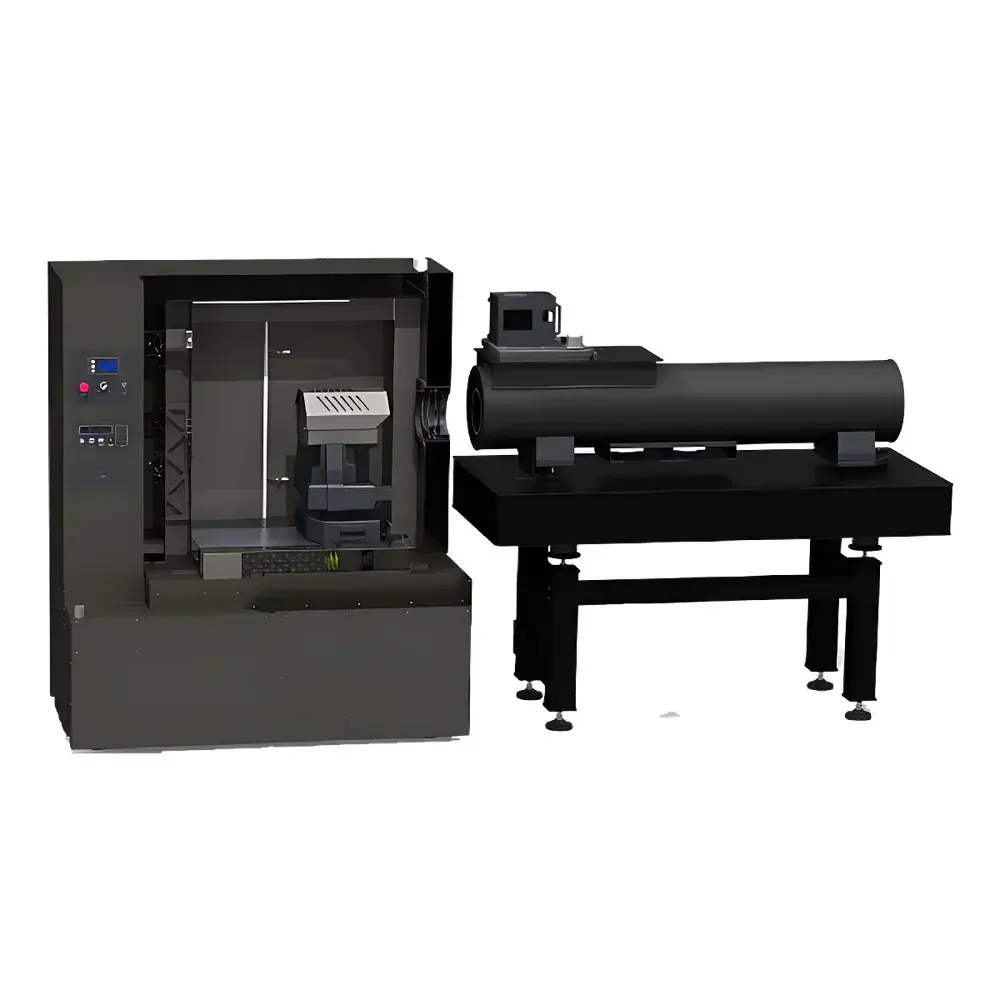
Inframet EXIR Environmental Thermal Imaging Test System
| Brand | Inframet |
|---|---|
| Origin | Poland |
| Model | EXIR |
| Temperature Range | −40 °C to +60 °C (ambient & background simulation) |
| Application | MRTD, MTF, NETD measurement under variable thermal conditions |
| Compliance | Designed for MIL-STD-810G environmental test alignment and ISO 18523-1:2021 optical performance validation |
Overview
The Inframet EXIR Environmental Thermal Imaging Test System is an engineered solution for evaluating the operational performance of uncooled and cooled thermal imaging cameras under dynamically controlled ambient and background temperature conditions. Unlike conventional laboratory-based test systems—which assume stable 20 °C ambient and background temperatures—the EXIR system replicates real-world thermal environments where ambient temperature, target background temperature, and apparent target temperature difference (ΔTapp) vary simultaneously across physiologically and geographically relevant ranges (−40 °C to +60 °C). It employs a dual-chamber architecture: one chamber houses the thermal imager under test (TUT), precisely regulating its enclosure temperature; the second chamber controls the thermal background against which standardized test targets are presented. This configuration enables true separation and independent control of the three critical thermal variables governing thermal imaging performance: (1) TUT ambient temperature, (2) background radiance temperature, and (3) target-to-background apparent temperature difference. The system supports quantitative measurement of key performance parameters—including Minimum Resolvable Temperature Difference (MRTD), Modulation Transfer Function (MTF), and Noise-Equivalent Temperature Difference (NETD)—in accordance with ISO 18523-1:2021, ASTM E1933-18, and MIL-STD-810G Method 501.5.
Key Features
- Dual-zone thermal control: Independent regulation of camera ambient temperature (−40 °C to +60 °C) and background temperature (−40 °C to +60 °C) with ±0.3 °C stability over 24 h
- Optically transparent, low-emissivity window assembly (ZnSe or Ge-coated CaF2) minimizing spectral attenuation and thermal distortion across 3–5 µm and 8–14 µm bands
- Integrated high-precision blackbody source (±0.1 K accuracy, uniformity <0.2 K over 100 mm aperture) for calibrated target presentation
- Motorized collimator with adjustable focal length (f/2 to f/8) supporting angular resolution testing from 0.1 to 5.0 mrad
- Modular design compatible with Inframet’s DT-series test platforms for automated MRTD/MTF/NETD acquisition and analysis
- Real-time thermal drift compensation via embedded thermistor array and closed-loop PID control of chamber wall gradients
Sample Compatibility & Compliance
The EXIR system accommodates thermal imagers up to 300 mm × 250 mm × 200 mm (W × H × D) and supports lens diameters up to Ø120 mm. It is validated for use with microbolometer (uncooled), QWIP, and Type-II superlattice focal plane arrays. All thermal control hardware complies with IEC 61000-6-3 (EMC emissions) and IEC 61000-6-2 (immunity). Data acquisition workflows meet FDA 21 CFR Part 11 requirements for electronic records and signatures when configured with audit-trail-enabled software. System calibration certificates traceable to NIST and PTB standards are provided with each delivery. Testing protocols align with NATO AEP-77 (Thermal Imager Performance Evaluation) and support GLP-compliant reporting for defense procurement qualification.
Software & Data Management
The EXIR platform operates under Inframet’s ThermTest v4.2 software suite, a Windows-based application developed in accordance with IEC 62304 Class B medical device software standards. It provides synchronized control of thermal chambers, blackbody sources, collimators, and imaging acquisition hardware. All test sequences—including multi-point MRTD sweeps across temperature combinations—are scriptable via Python API (PyThermTest). Raw thermal video streams (16-bit TIFF, uncompressed AVI) and metadata (chamber setpoints, thermistor readings, shutter timing, lens focus position) are stored in HDF5 format with embedded provenance tags. Built-in statistical engine computes confidence intervals for MRTD curves per ISO 18523-1 Annex C, and exports reports in PDF/A-2b and XML formats compliant with MIL-HDBK-340A archival requirements.
Applications
- Defense R&D: Validation of long-range surveillance systems under arctic, desert, and maritime thermal profiles
- Automotive ADAS certification: Performance verification of night vision systems across seasonal ambient gradients (e.g., −30 °C startup vs. +55 °C highway cruise)
- Firefighting equipment qualification: Assessment of thermal camera sensitivity degradation during prolonged exposure to radiant heat and ambient cold shock
- Medical thermography device registration: Demonstration of measurement repeatability under clinical room-temperature variability (±3 °C) and patient-skin emissivity shifts
- Spacecraft thermal imager pre-flight testing: Simulation of orbital thermal cycling (−100 °C shadow to +120 °C sunlit) using extrapolated EXIR-3 derivative configurations
FAQ
Does the EXIR system support real-time MRTD measurement while ambient temperature is ramping?
Yes—ThermTest v4.2 implements adaptive frame averaging and dynamic ROI selection to maintain measurement validity during controlled thermal transients (ramp rates up to 2 °C/min).
Can background temperature be held constant while varying only ambient temperature?
Yes—dual-chamber architecture allows fully decoupled control; either parameter may be fixed, swept, or cycled independently.
Is the system compatible with third-party thermal imagers requiring external trigger synchronization?
Yes—TTL and LVDS trigger I/O ports support hardware-synchronized acquisition with external frame grabbers or pulse generators.
What level of uncertainty is associated with NETD measurements under extreme temperature conditions?
Expanded uncertainty (k=2) remains ≤12% across the full −40 °C to +60 °C range, verified per ISO/IEC 17025:2017 by accredited calibration laboratories.
How is optical window thermal drift compensated during extended tests?
Real-time surface temperature mapping via embedded thermopile array feeds into collimator focus correction algorithms, maintaining diffraction-limited target projection across thermal cycles.




