
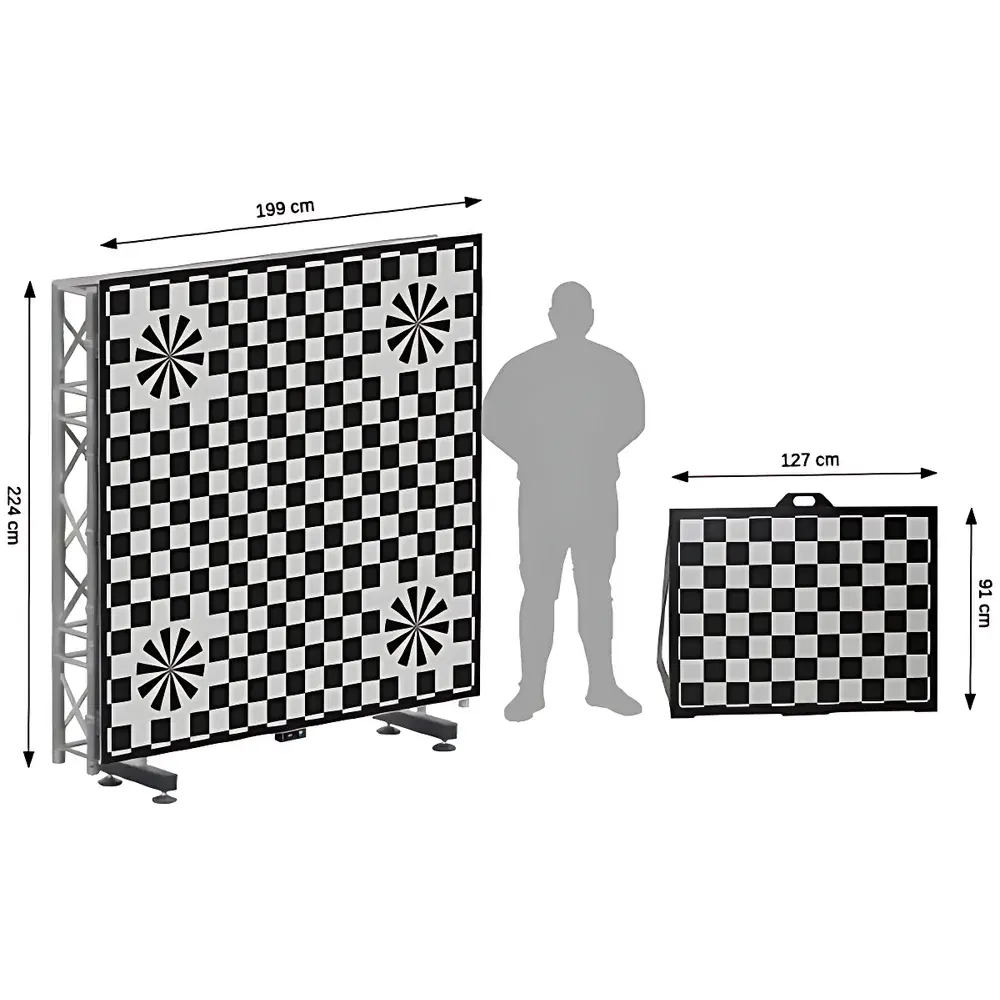
Inframet FUT Series Multispectral Calibration Target
| Brand | Inframet |
|---|---|
| Origin | Poland |
| Model | FUT |
| Type | Active Multispectral Reference Target |
| Dimensions (W×H×D) | 127×91×73 cm (FUT118) to 230×195×50 cm (FUT2216) |
| Weight | 30–145 kg |
| Power Supply | AC 110/230 V |
| Stabilization Time | 15–45 min |
| Surface Thermal Contrast | ~10 °C |
| Temperature Stability | <1 K |
| Spatial Temperature Uncertainty | 0.6–2.0 K |
| Visible/NIR Black Square Reflectance | <0.05 |
| Visible/NIR White Square Reflectance | >0.8 |
| LWIR/MWIR Black Square Emissivity | >0.9 |
| LWIR/MWIR White Square Emissivity | <0.1 |
| Pattern | Chessboard (100×100 mm squares, customizable) |
| Standard Sizes | FUT118 (1100×800 mm), FUT1511 (1500×1100 mm), FUT2020 (1900×1900 mm), FUT2216 (2200×1600 mm) |
Overview
The Inframet FUT Series Multispectral Calibration Target is an actively heated, high-contrast reference target engineered for rigorous geometric and radiometric validation of dual-channel fused imaging systems. Unlike passive targets requiring external illumination or blackbody sources, the FUT operates as a self-contained, temperature-stabilized radiation source that simultaneously emits in the long-wave infrared (LWIR) and mid-wave infrared (MWIR) bands while exhibiting spectrally selective reflectance in the visible (VIS) and near-infrared (NIR) ranges. Its core principle relies on spatially controlled surface emissivity modulation—achieved through precision thermal processing—yielding a high-fidelity chessboard pattern with alternating high-emissivity (black) and low-emissivity (white) squares across the thermal spectrum, and complementary high-reflectance (white) and low-reflectance (black) regions in VIS/NIR. This dual-spectrum signature ensures identical geometric registration for both thermal and visible imaging sensors, enabling pixel-level co-alignment analysis without cross-spectral registration ambiguity.
Key Features
- Active multispectral emission/reflection: Simultaneous LWIR/MWIR radiation and VIS/NIR reflectance from a single monolithic surface.
- High-contrast thermal pattern: Surface thermal contrast of approximately +10 °C between adjacent squares after stabilization, with emissivity contrast >0.8 between black (>0.9) and white (<0.1) squares in IR bands.
- Geometric fidelity: Precision-engineered 100 mm × 100 mm square lattice (customizable), supporting resolution assessment per ISO 12233 and MIL-STD-150A methodologies.
- Thermal stability architecture: Integrated PID-controlled heating system with <1 K temporal stability and ≤2.0 K spatial temperature uncertainty (FUT2216), verified via calibrated IR thermography.
- Modular scalability: Four standard configurations (FUT118, FUT1511, FUT2020, FUT2216) cover field-of-view requirements from compact lab setups to full-system outdoor test ranges; custom dimensions and pattern layouts available upon request.
- Electrical safety & compliance: CE-marked design with reinforced insulation, overtemperature protection, and IEC 61000-6-3 EMC conformity for laboratory and industrial environments.
Sample Compatibility & Compliance
The FUT target is compatible with all uncooled and cooled microbolometer-based thermal imagers (7.5–14 µm), InSb/MCT MWIR cameras (3–5 µm), and silicon- or InGaAs-based VIS/NIR imagers (0.4–1.7 µm). It supports calibration workflows aligned with ASTM E1213 (Standard Test Method for Determining Thermal Imager Resolution), ISO 18544 (Infrared thermography — Vocabulary and symbols), and MIL-HDBK-171A (Test methods for electro-optical imaging systems). Its uniform thermal output and geometric repeatability make it suitable for GLP-compliant verification protocols, including those requiring traceable temperature references and documented thermal drift logs. The target’s passive cooling design eliminates fan-induced vibration, ensuring mechanical stability during high-magnification alignment measurements.
Software & Data Management
While the FUT target itself is hardware-only, its output integrates natively into industry-standard image analysis platforms including MATLAB Image Processing Toolbox, Python-based OpenCV pipelines, and commercial EO/IR test suites such as FLIR Tools+, OASIS (Optical Analysis Software for Imaging Systems), and Radiant Vision Systems’ TrueTest™. Users may extract displacement vectors, rotation matrices, and magnification mismatch parameters using sub-pixel centroid detection algorithms applied to synchronized dual-band image pairs. All FUT models support automated thermal stabilization logging via optional external thermocouple arrays or integrated PT100 sensors (available as OEM add-on), enabling time-stamped audit trails compliant with FDA 21 CFR Part 11 when paired with validated acquisition software.
Applications
- Co-registration error quantification: Measurement of angular misalignment (pitch/yaw), rotational offset, and 2D spatial translation maps between thermal and visible channels.
- Fusion algorithm validation: Ground-truth dataset generation for evaluating pixel-level fusion fidelity, edge preservation, and false-color artifact suppression.
- MTF and resolution characterization: Use of sharp thermal/visible edges for modulation transfer function derivation per ISO 12233 Annex D.
- Geometric distortion mapping: Generation of sensor-specific correction grids via polynomial warping models fitted to known chessboard vertex coordinates.
- GMP/QA documentation: Traceable performance verification for defense contractors, automotive ADAS suppliers, and medical thermography device manufacturers subject to ISO 13485 or AS9100 audits.
FAQ
Is the FUT target suitable for both laboratory and field testing?
Yes—the FUT series is designed for indoor laboratory use under controlled ambient conditions (15–30 °C, <60% RH), but FUT1511 and larger variants can be deployed outdoors with appropriate weather shielding and thermal mass compensation.
Can the thermal contrast be adjusted dynamically during operation?
Standard FUT units provide fixed thermal contrast (~10 °C); however, programmable versions with adjustable setpoint control are available as custom configurations (lead time applies).
What power infrastructure is required?
All models operate on standard AC 110 V or 230 V ±10%, 50/60 Hz; no dedicated grounding or UPS is mandatory, though recommended for metrology-grade stability.
How is thermal uniformity verified prior to use?
Each unit undergoes factory calibration using NIST-traceable infrared scanning radiometry; a certificate of conformance—including thermal image maps and emissivity measurement reports—is supplied with delivery.
Does Inframet provide application support for integration with proprietary test software?
Yes—Inframet offers technical integration assistance, including API documentation, sample acquisition scripts (Python/MATLAB), and on-site setup support for qualified OEM and Tier-1 customers.



