
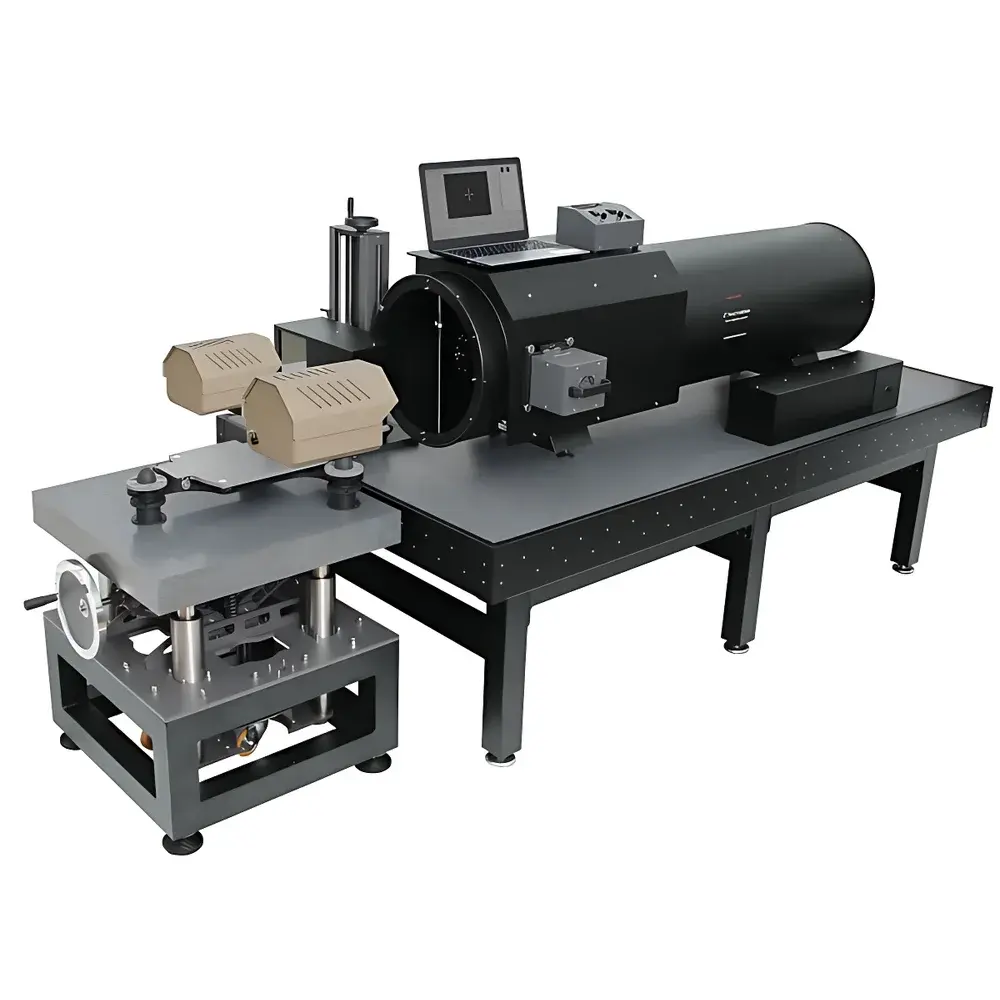
Inframet JIMS Series Large-Aperture Multi-Sensor Boresight Test System
| Brand | Inframet |
|---|---|
| Origin | Poland |
| Model | JIMS |
| Aperture Extension Capability | Up to 1000 mm (horizontal configuration) |
| Angular Accuracy | 0.2 mrad |
| Base Platform Compatibility | Horizontal optical benches for EO/IR systems |
| Core Configuration | CJT400 collimator + CEB beam-expanding module |
| Compliance | Designed for MIL-STD-3009, ISO 10110-5, and NATO AEP-70 alignment verification protocols |
| Software Platform | BOR v5.x with audit trail, calibration certificate generation, and GLP-compliant reporting |
Overview
The Inframet JIMS Series is a large-aperture, multi-sensor boresight test system engineered for precise optical axis alignment verification of electro-optical (EO) and infrared (IR) systems deployed on horizontal mechanical platforms—particularly those with apertures exceeding 1000 mm. Unlike conventional collimator-based alignment solutions, the JIMS architecture integrates a modular CEB (Collimator Expansion Box) unit with the proven CJT400 collimator platform, enabling controlled horizontal beam expansion while maintaining wavefront fidelity and minimizing internal misalignment contributions. Its operational principle relies on high-resolution imaging of standardized test targets (e.g., USAF 1951, IR-USAF, multi-pattern charts) projected through a stabilized collimated beam; angular deviation between sensor optical axes is quantified via sub-pixel centroid analysis of target features across multiple focal planes. The system is not a standalone metrology instrument but a purpose-built alignment verification station—optimized for integration into final assembly lines, ground support equipment suites, and satellite payload integration facilities where physical constraints preclude vertical collimation setups.
Key Features
- Modular CEB beam-expansion architecture supporting apertures from 600 mm (JIMS600) to 1000 mm (JIMS1000), with fixed mechanical interface compatibility across all variants
- Dual-band illumination capability: Visible–NIR (VIR-A source) and mid-wave/long-wave IR (CVIR-A controller with calibrated blackbody or laser diode sources)
- Multi-sensor synchronization: Simultaneous acquisition from imaging sensors (thermal cameras, TV imagers, star trackers) and active laser subsystems (single/multi-pulse rangefinders, designators)
- Configurable hardware modules: MON (monitoring), TEG (target edge gradient), TEP (target energy profile), OA (optical attenuation), AH1 (adapter hub), ABS (beam splitter), LIC (laser intensity control), ILU (integrated laser unit), and SR10 (spatial resolution reference camera)
- Automated collimator alignment option (Y3/Y4 configurations) featuring motorized tip/tilt stages and real-time feedback from BRL and SR10 reference cameras
- Passive thermal stabilization of critical optical paths to mitigate drift during extended alignment sessions (>4 hr)
Sample Compatibility & Compliance
The JIMS system accommodates EO/IR payloads mounted on rigid horizontal optical tables or structural frames—common in Earth observation satellites, airborne surveillance turrets, and ground-based missile warning systems. It supports alignment verification of co-boresighted sensor suites including cooled/uncooled thermal imagers (3–5 µm, 8–12 µm), visible/NIR cameras (0.4–1.0 µm), laser rangefinders (1.064 µm, 1.55 µm), and laser designators. All hardware and software components are designed to meet electromagnetic compatibility (EMC) requirements per EN 61326-1 and mechanical vibration tolerance per MIL-STD-810H. The BOR software complies with FDA 21 CFR Part 11 for electronic records and signatures, providing full audit trail, user access control, and calibration certificate traceability to NIST-traceable standards. Test procedures align with ISO 10110-5 (surface form tolerances), MIL-STD-3009 (EO/IR system performance testing), and NATO AEP-70 Annex E (boresight accuracy validation).
Software & Data Management
BOR (Boresight Optimization & Reporting) software v5.x serves as the central control and analysis environment. It orchestrates hardware sequencing—including collimator focus, target selection, illumination modulation, and image capture—and performs automated feature extraction using adaptive thresholding and moment-based centroid algorithms. Measurement data are stored in SQLite-backed structured databases with timestamped metadata (operator ID, environmental conditions, calibration epoch). Reports export in PDF/A-2b format compliant with ISO 19005-2, including uncertainty budgets derived from repeatability studies (n ≥ 20 at 23 ± 1 °C, 45–55% RH). For GxP environments, BOR supports role-based permissions, electronic signatures, and configurable retention policies aligned with GLP/GMP documentation requirements.
Applications
- Final integration alignment of multi-spectral Earth observation payloads (e.g., VIIRS, OLI-class instruments) on horizontal cleanroom benches
- Ground verification of airborne targeting pods prior to flight qualification
- Factory acceptance testing (FAT) of naval electro-optical fire control systems
- Periodic re-alignment of spaceborne sensor clusters following thermal vacuum cycling
- Validation of laser designation accuracy against imaging channels in dual-mode targeting systems
- Quantitative divergence measurement of pulsed laser rangefinders (Y4 configuration with SR10 camera and calibrated beam profiling)
FAQ
What distinguishes JIMS from the standard JT series?
The JIMS system incorporates the CEB module to enable horizontal beam expansion up to 1000 mm, whereas the JT series is optimized for vertical configurations with smaller apertures and higher intrinsic angular accuracy (≤0.1 mrad). JIMS trades marginal precision for practical deployability in constrained horizontal integration environments.
Can JIMS perform absolute collimator calibration?
No—the JIMS system is a relative alignment verification tool. Absolute collimator calibration requires an independent interferometric or autocollimator reference, which must be performed externally per ISO 10110-5 Annex D.
Is the CEB module compatible with non-Inframet collimators?
CEB is mechanically and optically designed exclusively for integration with the CJT400 collimator family. Interfacing with third-party collimators voids metrological traceability and is not supported.
Does BOR software support automated pass/fail decision logic?
Yes—users can define configurable tolerance thresholds per sensor channel and measurement type (e.g., boresight error < 0.15 mrad, laser divergence ±5% of spec), triggering color-coded status indicators and auto-generated non-conformance reports.
What environmental conditions are required for valid measurements?
Valid operation requires ambient temperature stability within ±1 °C over the measurement period, relative humidity between 45–55%, and vibration isolation meeting ISO 23828 Class 2 specifications. Air turbulence mitigation (e.g., laminar flow enclosures) is recommended for apertures >800 mm.




