
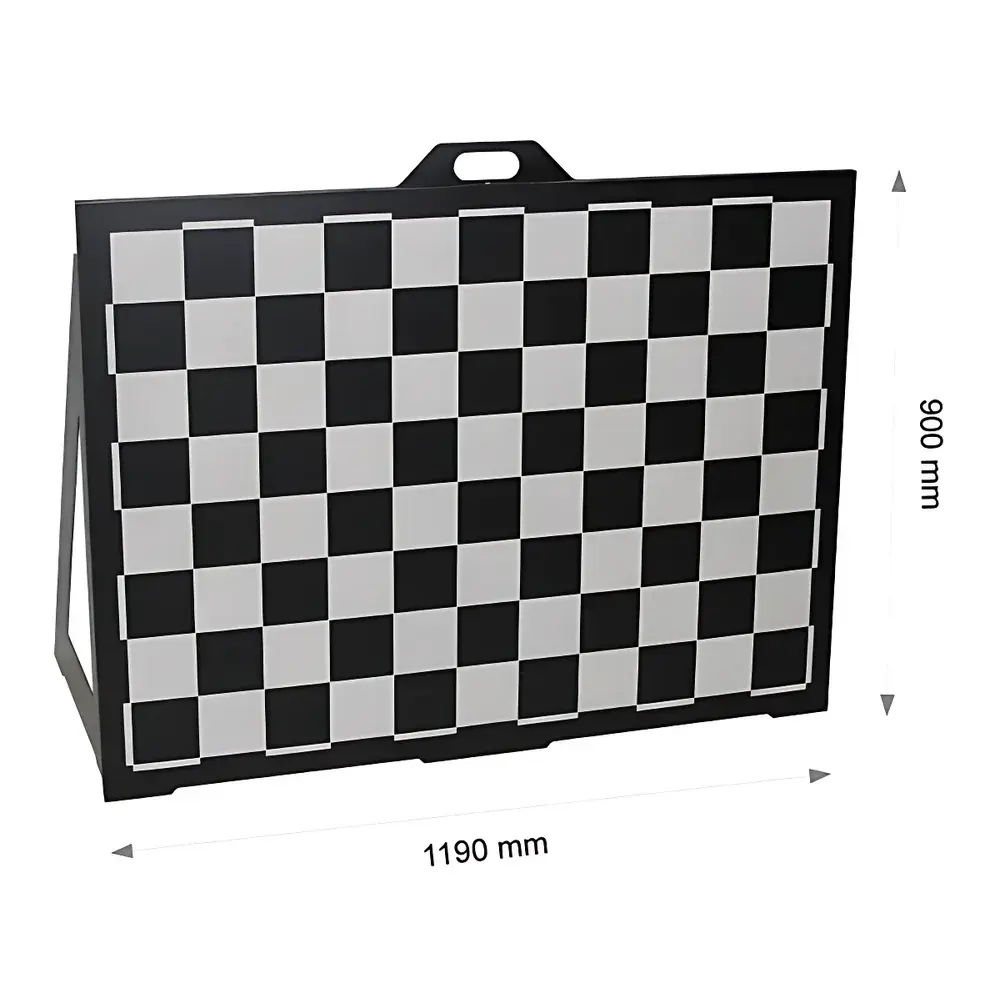
Inframet LAM Multispectral Target
| Key | Brand: Inframet |
|---|---|
| Origin | Poland |
| Model | LAM |
| Power Supply | AC 230/110 V |
| Pattern Dimensions | 11 × 8 squares (110 × 80 mm) |
| Single Square Size | 100 mm |
| Overall Dimensions | 1190 × 575 × 900 mm |
| Weight | 15 kg |
| Imaging Mode | Chessboard-type thermal-radiative target |
Overview
The Inframet LAM Multispectral Target is a precision-engineered calibration and verification tool designed for the quantitative assessment of dual-band image fusion systems—specifically those integrating thermal infrared (LWIR or MWIR) and visible/near-infrared (VIS/NIR) imaging channels. Unlike conventional static targets, the LAM operates as an active, temperature-stabilized radiometric reference with engineered emissivity contrast: its high-emissivity background (ε > 0.95) is patterned with low-emissivity (ε ≈ 0.1–0.2) chessboard squares formed via controlled surface treatment. This differential emissivity structure emits uniform, spectrally stable radiation across the thermal band while maintaining high optical reflectance in the VIS/NIR band—enabling simultaneous, co-registered acquisition from both sensor modalities under identical illumination and thermal conditions. Its large physical footprint (1190 × 575 × 900 mm) ensures full-field coverage of modern fused imaging systems—including panoramic gimbals, UAV-mounted payloads, and vehicle-integrated surveillance platforms—eliminating edge truncation and enabling pixel-level spatial registration analysis across the entire FOV.
Key Features
- Active, thermally stabilized chessboard pattern with calibrated emissivity contrast between background (high-ε) and squares (low-ε), ensuring consistent radiometric output across operational ambient temperatures (15–35 °C).
- Large-format design (11 × 8 grid, 110 × 80 mm active pattern area; 100 mm per square) optimized to fill the field of view of wide-angle and multi-sensor fusion optics without interpolation or tiling artifacts.
- Integrated thermal uniformity control: heating elements and PID-regulated feedback maintain ±0.3 °C spatial temperature homogeneity across the active surface, critical for minimizing thermal drift during extended test sequences.
- Modular power architecture supporting dual-voltage input (AC 230 V / 110 V, 50/60 Hz), compliant with IEC 61000-4 electromagnetic compatibility standards for laboratory and field-deployable use.
- Robust mechanical construction using aluminum alloy frame and ceramic-coated steel substrate, providing long-term dimensional stability and resistance to thermal cycling-induced warping.
Sample Compatibility & Compliance
The LAM Target is compatible with all standard thermal imaging systems operating in the 3–5 µm (MWIR) or 8–14 µm (LWIR) spectral bands, as well as visible-light cameras conforming to EMVA 1288 photoresponse linearity and dynamic range specifications. It supports analog (PAL/NTSC) and digital interfaces including USB 2.0/3.0, Camera Link (CL), GigE Vision, HDMI, and HD-SDI—ensuring seamless integration with commercial off-the-shelf (COTS) image acquisition hardware. The system meets ISO 12233:2017 Annex E requirements for geometric distortion and spatial registration testing, and its radiometric behavior is traceable to PTB (Physikalisch-Technische Bundesanstalt) reference standards via documented calibration certificates. For regulated environments, the FUS software module supports audit-trail logging and user-access controls aligned with GLP and ISO/IEC 17025 documentation requirements.
Software & Data Management
The ICAS (Image Capture and Analysis System) comprises a Windows 7–based industrial PC equipped with a synchronized dual-channel frame grabber supporting simultaneous timestamped capture from thermal and visible sensors. The proprietary FUS software performs real-time co-registration analysis using sub-pixel centroid detection on high-contrast edges of the chessboard pattern. It computes three primary fusion performance metrics: (1) boresight misalignment angle (arcmin resolution), quantifying angular deviation between thermal and visible optical axes; (2) rotational offset (degrees, ±0.05° repeatability), derived from affine transformation fitting; and (3) 2D spatial displacement vector map (pixel-level x/y offsets with directionality), generated via normalized cross-correlation across corresponding regions-of-interest. All results are exportable in CSV, XML, and PDF formats—with metadata embedded per IEEE 1621-2021 standard for imaging test reporting.
Applications
- Factory acceptance testing (FAT) and periodic verification of military-grade EO/IR fusion sights, targeting pods, and border surveillance systems.
- R&D validation of deep-learning-based fusion algorithms requiring ground-truth spatial correspondence datasets.
- ISO/IEC 17025-accredited calibration laboratories performing uncertainty-budgeted fusion performance certification per MIL-STD-810H and STANAG 4347 Annex B.
- Development and benchmarking of multi-spectral image alignment correction firmware in embedded vision processors (e.g., NVIDIA Jetson AGX Orin, Xilinx Zynq UltraScale+).
- Training and certification programs for EO/IR system integrators and defense test engineers, supported by standardized test protocols and report templates.
FAQ
What is the recommended minimum working distance for accurate boresight measurement?
For optimal signal-to-noise ratio and diffraction-limited edge detection, the minimum recommended standoff distance is 3 m for 640 × 480 thermal sensors and 5 m for 1280 × 1024 configurations.
Can the LAM Target be used with uncooled microbolometer cameras?
Yes—the target’s thermal contrast design and uniformity control ensure reliable performance with both cooled photon detectors and uncooled microbolometers, provided the camera’s NETD is ≤80 mK.
Is FUS software compliant with FDA 21 CFR Part 11 for electronic records?
While FUS does not include full Part 11 functionality out-of-the-box, it supports third-party e-signature and audit-trail add-ons certified for GxP environments upon configuration.
Does the system support automated test sequences for production-line throughput?
Yes—FUS provides a COM/ActiveX API enabling integration into LabVIEW, Python (PyWin32), or custom C# test automation frameworks for batch-mode operation.
How often does the LAM Target require recalibration?
Invariance testing per ISO/IEC 17025 recommends annual radiometric and geometric recalibration; emissivity characterization remains stable for ≥5 years under normal handling conditions.




