
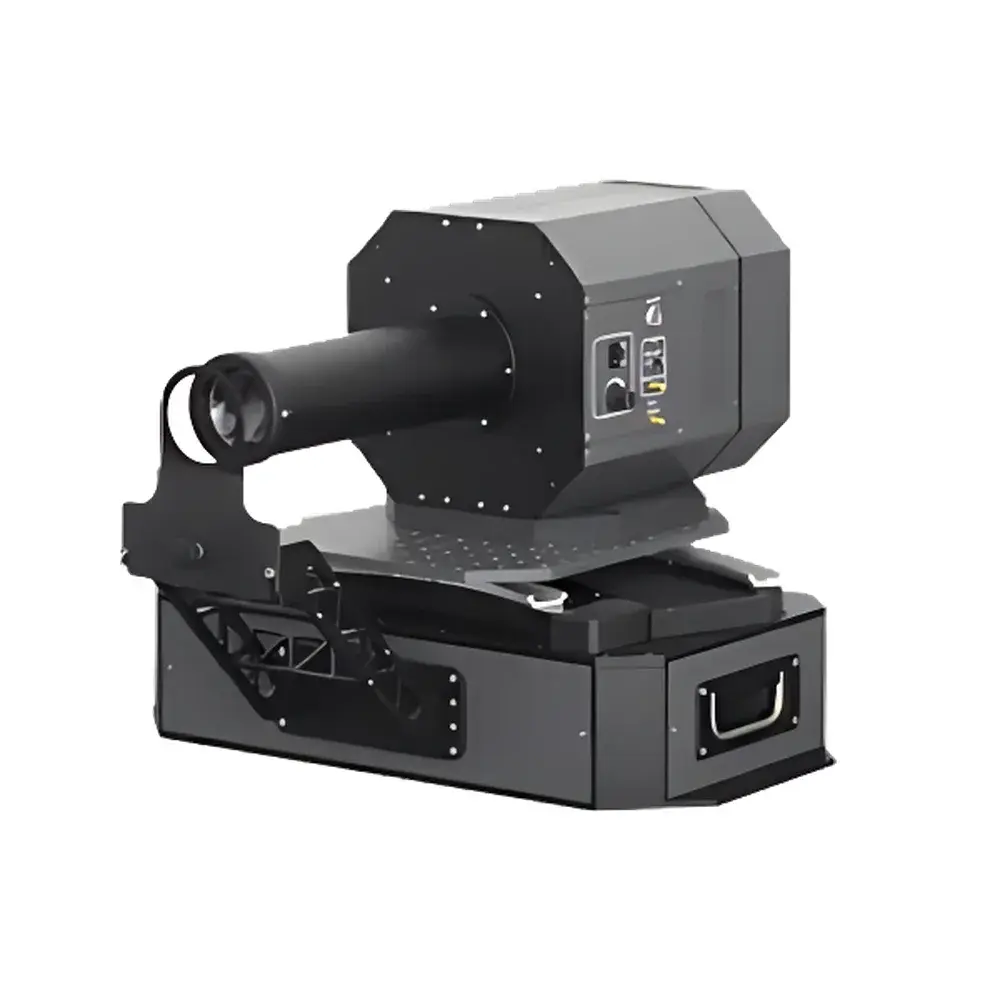
Inframet LAR64 Directed Pulsed Laser Receiver Test System
| Brand | Inframet |
|---|---|
| Origin | Poland |
| Model | LAR64 |
| Wavelength | 1064 nm ±5 nm |
| Spectral Bandwidth | ≤10 nm |
| Optical Aperture Compatibility | <54 mm |
| Collimator Type | Refractive |
| Collimator Aperture | 60 mm |
| Resolution | >60 lp/mrad |
| Output Uniformity | ≤10% (measured at 40 mm aperture) |
| Peak Irradiance Range | 100 nW/cm² to 40 mW/cm² |
| Dynamic Range | ≥400,000:1 |
| Pulse Width Range | 20–500 ns |
| Pulse Width Resolution | 1 ns |
| PRF Range (Internal Sync) | 1 Hz – 20 kHz |
| PRF Range (External Sync) | 0.1 Hz – 20 kHz |
| PRF Stability Error | ≤0.0001% (for integer-multiple frequencies), ≤0.00001% × f (Hz) (others) |
| Angular Target Size Range | 0.1–10 mrad |
| Angular Position Range (Azimuth/Elevation) | ±30° / ±6° |
| Angular Resolution | 0.05° |
| Angular Positioning Speed (Azimuth/Elevation) | 1.5°/s / 0.5°/s |
| Trigger Modes | Internal electrical (free-run), External electrical, External optical |
| Sync Output | TTL-compliant |
| Input Trigger Voltage | 2.4–4.1 V |
| Communication Interface | USB 2.0 |
| Power Supply | AC 230 V |
| Operating Temperature | +5°C to +35°C |
| Storage Temperature | −5°C to +55°C |
| Weight | <12 kg (excl. rotation stage) |
| Dimensions | ≤500 × 280 × 190 mm (excl. rotation stage) |
Overview
The Inframet LAR64 Directed Pulsed Laser Receiver Test System is a high-fidelity laboratory-grade simulation platform engineered for the functional verification and performance characterization of directed pulsed laser receivers operating in the 1064 nm spectral band — including laser seekers, LIDAR systems, laser rangefinders (LRF), laser trackers, and free-space optical communication terminals. Unlike passive measurement instruments, the LAR64 functions as an active, programmable laser point projector that emulates a dynamic distant target under controlled radiometric, temporal, and spatial conditions. Its core operational principle relies on collimated pulsed laser projection through a refractive collimator (CLT730), enabling precise control over irradiance at the device-under-test (DUT) optical plane, pulse timing parameters (pulse width, PRF, jitter), and angular target geometry (size, position, trajectory). The system does not perform signal analysis of DUT output; instead, it provides traceable, repeatable stimulus inputs against which users conduct independent functional assessments — such as sensitivity threshold mapping, dynamic response validation, and axis alignment verification — under fully reproducible lab conditions.
Key Features
- Ultra-wide pulse repetition frequency (PRF) range: 1 Hz to 20 kHz, with internal or external synchronization support and sub-microsecond period resolution (1 µs grid)
- High-dynamic-range irradiance control: 100 nW/cm² to 40 mW/cm² at collimator output, achieving ≥400,000:1 modulation ratio for realistic near- and far-field target simulation
- Precise temporal parameter tuning: pulse width continuously adjustable from 20 ns to 500 ns with 1 ns resolution — exceeding typical industry standards (often limited to ≥5 ns resolution)
- Programmable angular target projection: motorized azimuth (±30°) and elevation (±6°) positioning with 0.05° resolution and closed-loop repeatability
- Refractive collimator architecture (CLT730, 60 mm aperture): compact footprint (60 lp/mrad resolution, and ≤10% irradiance non-uniformity (40 mm measurement aperture)
- Multi-mode synchronization: internal free-run, external electrical (TTL), and external optical triggering with configurable delay (0.1–650 µs)
- Optional PIM (Pulse Interval Modulation) capability: configurable via Y1 (predefined code set ≤20) or Y2 (user-defined mathematical code generation) firmware options
- Integrated axis alignment support: dual-path visible/NIR co-registration using optional reference alignment camera calibrated to mechanical axis per customer-provided DUT drawings
Sample Compatibility & Compliance
The LAR64 accommodates laser receivers with optical apertures up to 54 mm and supports both imaging (e.g., quadrant photodiodes with VIS/IR cameras) and non-imaging configurations (e.g., seeker heads with mechanical reference planes). It complies with standard optical test environment requirements per ISO 11146 (laser beam parameters), ISO 13694 (laser irradiance measurements), and IEC 60825-1 (laser product safety). For regulated applications — including defense qualification and aerospace component validation — the system supports audit-ready operation when paired with user-developed test protocols aligned with MIL-STD-883, DO-160, or NATO AEP-97. While the LAR64 itself is not FDA- or EU-MDR-certified, its stimulus-generation architecture enables full traceability of irradiance, timing, and angular parameters — essential for GLP/GMP-aligned test documentation and 21 CFR Part 11-compliant data management workflows when integrated with validated third-party software.
Software & Data Management
Control and configuration are executed via the native L64 Control Program running on Windows-based laptops (USB 2.0 interface). The software provides hierarchical parameter access: manual single-parameter adjustment (e.g., PRF, pulse width, target angle), multi-parameter sequence scripting (e.g., ramped irradiance + synchronized angular sweep), and pre-programmed trajectory execution (up to 10 discrete angular positions per cycle). All parameter changes are logged with timestamps and user IDs. Export formats include CSV (irradiance vs. time), XML (full stimulus configuration), and binary logs compatible with MATLAB and Python-based post-processing pipelines. For environments requiring electronic records integrity, the software supports integration with external LIMS or ELN platforms via OPC UA or REST API adapters — enabling metadata tagging, version-controlled test method storage, and automated report generation compliant with ISO/IEC 17025 clause 7.7.
Applications
- Sensitivity threshold determination: measuring minimum detectable irradiance across varying PRF, pulse width, and angular target sizes
- Dynamic response characterization: evaluating receiver latency, pulse-pair resolution, and tracking fidelity under simulated maneuvering targets
- Axis alignment verification: quantifying angular misalignment between optical axis and mechanical reference axis (non-imaging DUTs) or between optical axis and alignment camera line-of-sight (imaging DUTs)
- Protocol conformance testing: validating receiver behavior under standardized PIM codes (e.g., STANAG 3733, MIL-STD-1377) or custom interval-modulated waveforms
- Environmental stress screening: assessing irradiance-dependent saturation effects, timing jitter accumulation, and thermal drift during extended PRF cycling
- Design verification: supporting iterative development of new receiver electronics by decoupling optical stimulus from signal processing chain
FAQ
What is the maximum optical aperture size supported by the LAR64?
The system is optimized for receivers with optical apertures <54 mm. Larger apertures are technically feasible but require irradiance recalibration — notify Inframet prior to delivery for custom calibration support.
Can the LAR64 simulate variable-distance scenarios?
Yes — via synchronized, time-correlated modulation of peak irradiance, angular target size, and angular position, enabling realistic emulation of closing-range or receding-target dynamics.
Is the CLT730 collimator included as standard equipment?
Yes — the CLT730 refractive collimator is integral to all LAR64 configurations and factory-aligned to the LS64 light source module.
Does the system support both PRF and PIM modes simultaneously?
No — PRF and PIM are mutually exclusive operational modes. Selection is made at firmware level; dual-mode hardware variants are not available.
What documentation is provided for metrological traceability?
Each unit ships with a factory calibration certificate referencing NIST-traceable irradiance standards (at 1064 nm), timing analyzers (Keysight 53230A), and angular encoders (Renishaw RESOLUTE). Full uncertainty budgets are available upon request.




