
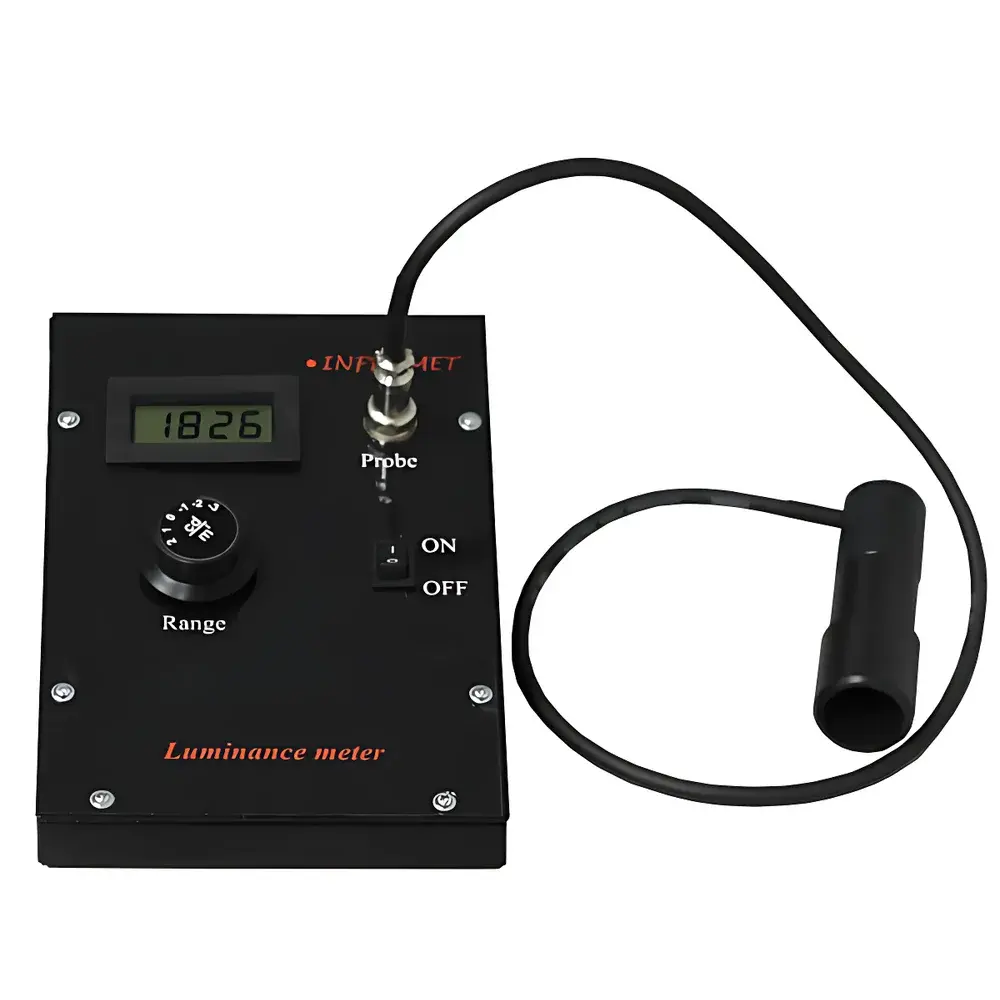
Inframet LM-1 Precision Luminance Meter
| Brand | Inframet |
|---|---|
| Origin | Poland |
| Model | LM-1 |
| Brightness Range | 30 mcd/m² to 500 kcd/m² |
| Photodetector | Silicon photodiode with CIE V(λ)-matched correction filter |
| Spectral Match Accuracy | Within 10% of CIE photopic luminosity function V(λ) |
| Aperture Diameter | 7 mm |
| Field of View | 10° |
| Dark Current Error | < 0.1% at readings < 4 |
| Resolution | 1 digit / 1999 counts full scale |
| Measurement Uncertainty | ±2% (with included calibrated probe) |
| Power Supply | 12 V DC / 300 mA (AC adapter: 100–240 V AC → 12 V DC / 3 A) |
| Operating Temperature | +5°C to +35°C (optional: −5°C to +45°C) |
| Dimensions (H×W×D) | 220 × 140 × 80 mm |
| Weight | 0.5 kg |
Overview
The Inframet LM-1 Precision Luminance Meter is a traceable, laboratory-grade photometric instrument engineered for high-fidelity measurement of luminance in demanding optical metrology environments. Based on the fundamental principle of photopic luminance detection—where incident radiation is converted by a spectrally corrected silicon photodiode and weighted according to the CIE 1931 standard observer’s V(λ) function—the LM-1 delivers photometrically accurate readings across an exceptionally wide dynamic range: from 30 mcd/m² (at minimal signal threshold) up to 500 kcd/m². Its core design prioritizes metrological integrity: the integrated LP1 probe features a precision-matched interference filter ensuring spectral responsivity within ±10% of the CIE V(λ) curve, minimizing photopic mismatch error—a critical requirement for compliance with ISO/CIE standards in night vision device (NVD) evaluation and calibration of reference light sources.
Key Features
- High-dynamic-range photometric sensing with calibrated linearity over six orders of magnitude (30 mcd/m² to 500 kcd/m²)
- LP1 probe with 7 mm effective aperture and 10° half-angle field-of-view, optimized for uniform irradiance sampling and spatial rejection of stray light
- Low dark current electronics (<0.1% contribution at low-end readings), enabling stable sub-1 cd/m² measurements without thermal drift compensation
- 1999-count digital display resolution with auto-ranging and manual range selection for controlled measurement uncertainty management
- Modular architecture supporting integration into automated test stations—including NV-series night vision testers—as an external luminance reference channel
- Rugged aluminum housing (0.5 kg mass, 220 × 140 × 80 mm footprint) designed for benchtop stability and portable deployment in calibration labs and production test floors
Sample Compatibility & Compliance
The LM-1 is explicitly validated for use with two primary application classes: (1) as a primary luminance reference in NV-series night vision testing stations, where it quantifies output luminance of image intensifier tubes under standardized phosphor excitation conditions; and (2) as a transfer standard for recalibrating DAL-series reference light sources used in photometric intercomparison and luminance source certification. Its spectral response meets CIE S 014-2/E:2016 requirements for photopic luminance meters, and its calibration traceability is maintained to PTB (Physikalisch-Technische Bundesanstalt) via Inframet’s accredited calibration laboratory. The instrument supports GLP-compliant operation through documented calibration certificates (including probe-specific correction factors), and its measurement uncertainty budget (±2% at 95% confidence, k=2) satisfies ISO/IEC 17025 requirements for accredited photometric laboratories.
Software & Data Management
While the LM-1 operates as a standalone analog/digital meter with front-panel readout, it provides RS-232 serial interface (DB9 connector) for bidirectional communication with host systems. Inframet-supplied PC software enables remote control, real-time data logging, statistical analysis (mean, SD, min/max), and export to CSV or Excel-compatible formats. All logged measurements include timestamp, probe ID, range setting, and ambient temperature reading (via internal sensor). Audit trail functionality records operator ID, calibration date, and firmware version per session—supporting 21 CFR Part 11 readiness when deployed in regulated quality assurance workflows. Firmware updates are delivered via secure HTTPS portal and require cryptographic signature verification.
Applications
- Calibration and verification of night vision goggle (NVG) and image intensifier tube (IIT) luminance output per MIL-STD-3009 and STANAG 4295
- Periodic recalibration of DAL-series reference luminance sources used in national metrology institutes and third-party calibration labs
- Photometric validation of cockpit displays, HUDs, and avionics lighting under low-light ambient conditions
- Luminance uniformity mapping of OLED/LCD panels during R&D and production screening
- Supporting ISO 9241-307 (visual display ergonomics) and IEC 62471 (photobiological safety) assessments requiring absolute luminance traceability
FAQ
Is the LM-1 suitable for measuring luminance of pulsed or modulated light sources?
Yes—its analog front-end bandwidth exceeds 1 kHz, enabling accurate RMS luminance capture of flickering or PWM-driven sources when used with appropriate averaging settings.
Does the LM-1 require annual recalibration to maintain stated uncertainty?
Per ISO/IEC 17025 and Inframet’s calibration protocol, annual recalibration against a NIST-traceable standard is recommended; the instrument stores calibration date and due date internally.
Can the LP1 probe be replaced or re-calibrated independently of the main unit?
Yes—the LP1 probe is a serialized, individually calibrated module; replacement probes are supplied with unique correction coefficients loaded automatically via USB during initialization.
What environmental conditions affect measurement stability?
Ambient temperature deviations beyond +5°C to +35°C induce measurable drift; optional extended-range version (−5°C to +45°C) includes active thermal stabilization and expanded uncertainty characterization.
Is the LM-1 compliant with FDA or EU regulatory requirements for medical device luminance testing?
It fulfills photometric traceability requirements in IEC 62304 and EN 60601-2-57 for display luminance verification in diagnostic imaging equipment, though final system-level compliance remains the responsibility of the medical device manufacturer.




